World Cup 2026, a historic yet controversial tournament across North America
World Cup across the United States, Mexico, and Canada ‘simply the greatest event that humanity has ever seen’ -- FIFA President Gianni Infantino
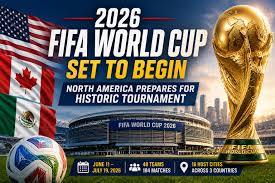
FIFA President Gianni Infantino has hailed the 2026 World Cup as the “greatest ever,” but the expanded tournament across the United States, Mexico, and Canada is already facing mounting global scrutiny.
From record-breaking revenues and unprecedented scale to rising ticket prices, political tensions, security concerns and climate questions, football’s biggest event is being defined as much by controversy off the pitch as excitement on it.
As host cities from Mexico City to Los Angeles prepare for kickoff, the world’s most lucrative World Cup is also emerging as one of its most closely watched and hotly debated.
FIFA President Gianni Infantino has described this summer’s expanded World Cup across the United States, Mexico, and Canada as “simply the greatest event that humanity has ever seen.”
As ever, the head of world football’s governing body has positioned the tournament as the most inclusive and unifying edition in history. Yet beyond the promotional language, the 2026 World Cup is already being viewed through a far more complicated lens.
For some, it will be the most politicised World Cup ever staged. For others, the most expensive, potentially the most environmentally challenging, and certainly the most commercially lucrative tournament in FIFA’s history.
Whatever the perspective, what is clear is that this expanded 48-team, 104-match spectacle is set to be one of the most contentious global sporting events ever organised.
Spanning three countries for the first time, the competition will see matches staged across 16 cities in North America, with around three-quarters of fixtures hosted in the United States.
The opening spotlight falls on Mexico City, where the iconic Estadio Azteca prepares to make history as the first stadium to host matches in three separate World Cups. It will stage the opening fixture between Mexico and South Africa in Group A.
Yet even in football’s most historic venues, excitement is accompanied by concern.
High ticket prices have sparked widespread criticism among fans, while security fears persist in parts of Mexico following recent cartel-related violence. Protests have already emerged in Mexico City, including demonstrations targeting World Cup installations and calls for improved public sector wages.
Elsewhere, geopolitical tensions are casting a long shadow over preparations.
The participation of Iran has become a focal point of international scrutiny, with shifting arrangements for team logistics and reports of strained diplomatic relations affecting travel and visa procedures. Allegations of political interference have been raised by Iranian officials, while discussions around flags and representation have added further sensitivity to their matches.
In the United States, fixtures involving Iran are expected to carry heightened political significance, particularly in cities with large diaspora communities.
Notably, this marks the first World Cup staged in a host nation involved in active geopolitical tensions with a participating country — a situation that underscores the complexity surrounding this edition.
The decision to award the 2026 World Cup to North America was originally seen as a safer and more commercially stable choice following corruption controversies linked to earlier tournaments in Russia and Qatar.
Infrastructure readiness and strong commercial markets were key factors. The outcome has delivered unprecedented financial returns for FIFA, with projected revenues reaching record levels driven by broadcasting and sponsorship deals.
However, the commercial success has come at a cost.
Ticket pricing has become one of the defining controversies of the build-up. While initial bid documents suggested final tickets would peak at around $1,550, resale and premium pricing have seen some seats listed at more than five times that amount.
Critics have described the pricing model as exclusionary, arguing that long-standing supporters risk being priced out of the tournament. The introduction of dynamic pricing — where ticket costs fluctuate based on demand — has further fuelled backlash.
Regulators in parts of the United States have already begun reviewing pricing practices amid accusations of inflated costs and lack of transparency.
On one hand, the 2026 World Cup promises unprecedented global reach, expanded participation, and record-breaking financial success for FIFA.
On the other, it faces mounting questions over accessibility, political neutrality, security, and environmental impact, according to BBC.
From Mexico City to New York, from on-field drama to off-field controversy, the tournament is shaping up to be as much about global tension as footballing celebration.
As the world turns its attention to the opening whistle, the 2026 World Cup stands not only as a sporting milestone — but as a reflection of a rapidly changing and increasingly complex world