Kuwaiti diwaniyas gain UNESCO heritage status, highlights tradition of dialogue
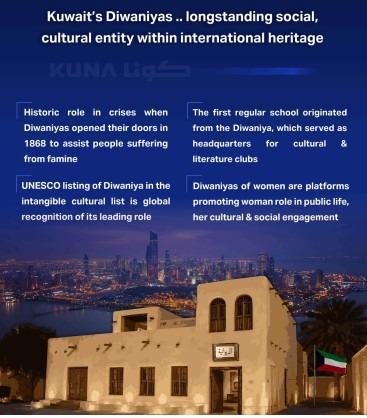
- The UNESCO inscription of Kuwait’s diwaniyas on its Intangible Cultural Heritage list underscores the institution’s enduring role as a forum for dialogue, civic engagement and cultural preservation, while spotlighting its contribution to the country’s social and political development.
Kuwait’s diwaniya tradition has gained international recognition following its inscription on UNESCO’s Representative List of the Intangible Cultural Heritage of Humanity, a milestone that cultural experts say reflects the institution’s enduring role in shaping the country’s social fabric and national identity.
Long regarded as a cornerstone of Kuwaiti society, the diwaniya serves as a gathering place where citizens meet to discuss community affairs, exchange ideas and debate social, cultural and political issues. Over time, it has evolved from a traditional meeting space into a platform that fosters dialogue, civic participation and the transmission of values across generations.
Officials say the UNESCO recognition acknowledges the diwaniya’s contribution to preserving social cohesion, promoting tolerance and strengthening community ties at a time when many societies are grappling with the challenges of rapid social and technological change.
Mohammad bin Redha, Acting Assistant Secretary-General for Antiquities and Museums at the National Council for Culture, Arts and Letters, described the inscription as a significant national achievement that reflects Kuwait’s commitment to safeguarding its living heritage.
“The recognition confirms the diwaniya’s importance as a cultural and social practice that promotes dialogue, tolerance and the exchange of knowledge and values between generations,” he said.
According to cultural historians, the influence of diwaniyas extends far beyond social gatherings. Many of Kuwait’s key educational, cultural and reform initiatives were first discussed within their walls, the Kuwait News Agency reports.
Among the most notable examples was the establishment of Al-Mubarakiya School in 1911, Kuwait’s first formal educational institution, which originated from discussions held in the diwaniya of educator Yusuf bin Isa Al-Qina’i. Similarly, the concept of the country’s first literary club emerged in the diwaniya of Sheikh Abdullah Al-Jaber Al-Sabah before its establishment in 1924.
Professor of Modern and Contemporary History Ayed Al-Juraid said several landmark national projects, including early reform initiatives and proposals related to civic participation, were first conceived in diwaniyas.
The institution has also played a critical role during times of hardship. Historical records show that diwaniyas provided community support during economic crises and periods of famine. In 1868, for example, many opened their food stores to assist families affected by severe shortages.
Beyond their social and charitable functions, diwaniyas have traditionally served as a bridge between citizens and the country’s leadership. The longstanding practice of rulers visiting diwaniyas created a direct channel for public dialogue, allowing community concerns and ideas to be discussed in an informal setting.
In recent decades, the institution has evolved to reflect broader societal changes, including the rise of women’s diwaniyas. These forums have expanded opportunities for cultural exchange, social engagement and public discussion among women.
Writer and academic Souad Al-Mejel said women’s diwaniyas emerged from the historical role Kuwaiti women played in supporting families and communities, particularly during the era of pearl diving and maritime trade. She noted that pioneering women’s gatherings later became platforms for discussing social issues, education and women’s rights.
Examples include the diwaniya of Lulwa Al-Qatami, which focused on advancing women’s causes, and that of Dr. Souad Al-Sabah, which developed into a prominent intellectual and cultural forum.
Experts believe UNESCO recognition will encourage further research, documentation and educational initiatives aimed at preserving the diwaniya tradition while introducing it to new generations.
As Kuwait modernises and embraces digital transformation, the UNESCO listing highlights the continued relevance of an institution that has helped shape the country’s cultural, educational and political landscape for generations, ensuring that the spirit of dialogue and community remains at the heart of Kuwaiti society.