US scientists have officially declared the onset of El Niño, the natural Pacific Ocean climate pattern known for driving global temperature increases and disrupting weather systems worldwide.
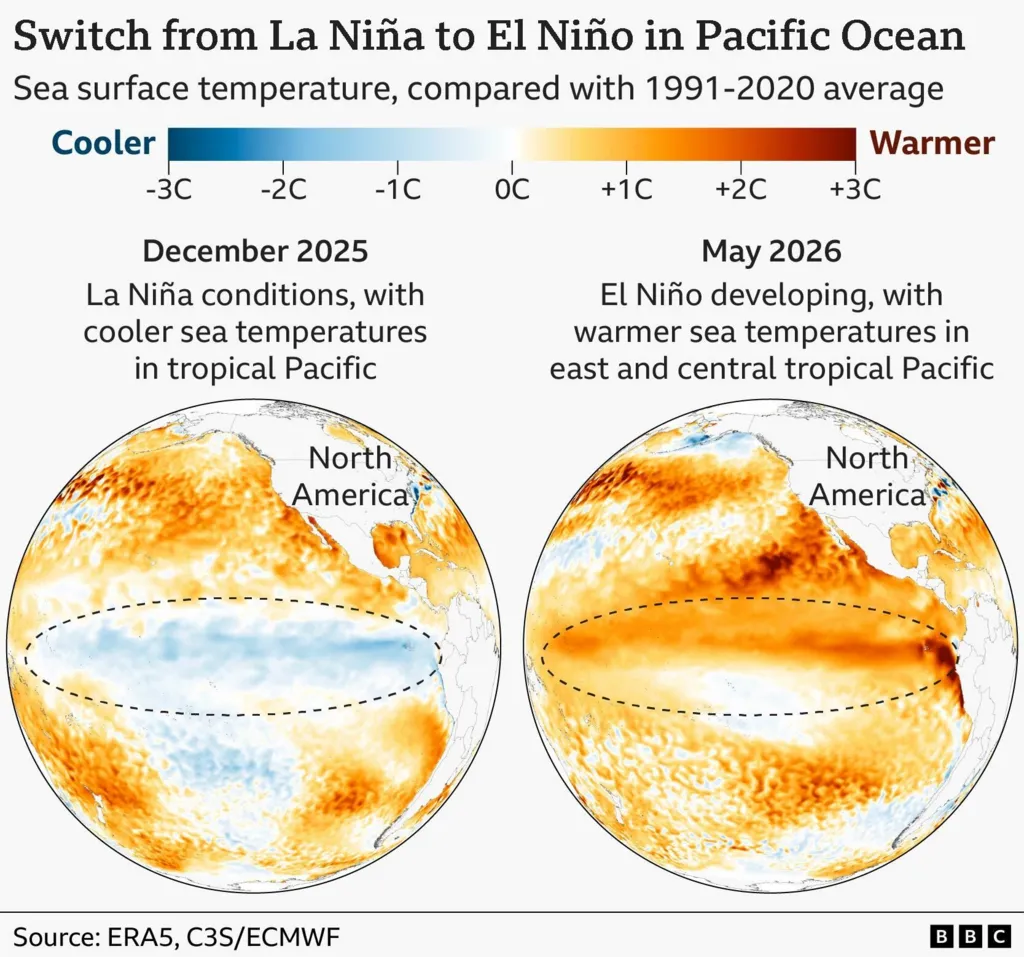
The US National Oceanic and Atmospheric Administration (NOAA) confirmed that El Niño conditions are now established across the tropical Pacific, following a sustained rise in sea surface temperatures in recent months.
Forecasters are warning that the current event could intensify into a “super” El Niño, potentially ranking among the strongest recorded since modern observations began in 1950.
The development comes on top of long-term human-induced global warming and is expected to further elevate global temperatures, with 2027 now emerging as a likely candidate for another record-hot year.
NOAA reported that sea surface temperatures in the central and eastern equatorial Pacific have exceeded the 0.5°C threshold used to define El Niño conditions, accompanied by shifting wind patterns indicating a coupled ocean-atmosphere response.
According to the agency’s outlook, there is a 63% probability of a very strong El Niño forming during the November–January period, which would place it among the most significant events in recent history, alongside the major episodes of 1982–83, 1997–98, and 2015–16.
Climate models from the US and Europe suggest that ocean temperatures in parts of the tropical Pacific could rise more than 3°C above average by late this year, although forecasters caution that impacts vary across regions.
Experts stress that while El Niño events naturally cycle every two to seven years, their effects are now unfolding in a significantly warmer global climate, amplifying their overall impact, BBC reports.
A very strong El Niño typically raises global average temperatures by around 0.2°C by releasing stored ocean heat into the atmosphere, further intensifying already record-breaking global heat levels.
Scientists warn that this combination of natural variability and long-term warming could drive widespread climate disruptions, including heavy rainfall in parts of South America and East Africa, drought and wildfire risks in Australia and Southeast Asia, and shifts in global food production patterns.
While some agencies, including Australia’s Bureau of Meteorology, have not yet formally declared El Niño under stricter thresholds, most global forecasting bodies agree that conditions are either present or rapidly developing.
The phenomenon is expected to persist for around a year, with potential global impacts extending well into 2027.