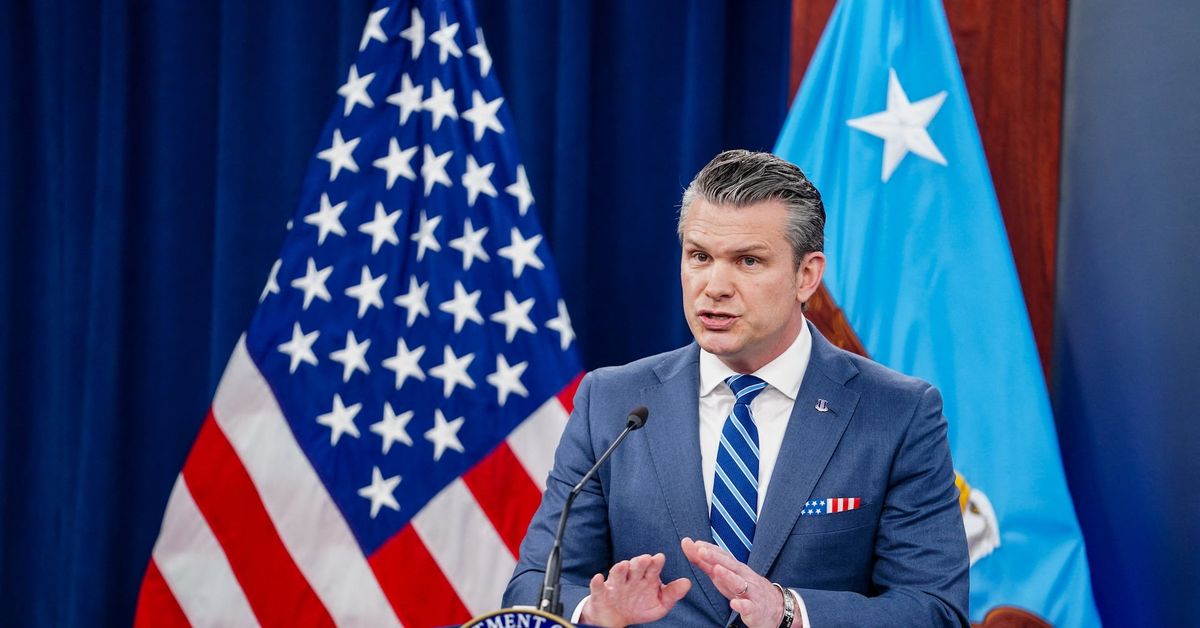
The U.S. naval blockade of Iran is just an example of “polite” behavior during the ongoing ceasefire and U.S. forces are ready to strike Iran’s power plants and energy industry if ordered, U.S. Defense Secretary Pete Hegseth said today (Thursday).
Standing alongside two of the U.S. military’s most senior officers, Hegseth said Iran needs to choose wisely as it prepares for negotiations with the United States.
General Dan Caine, chairman of the Joint Chiefs of Staff, said U.S. forces were “ready to resume major combat operations at literally a moment’s notice.” U.S. Navy ships would pursue any Iranian flagged vessel or any vessel attempting to provide material support to Iran, he told the briefing, according to The New York Times.
“We’d rather not have to do it, but we’re ready to go at the command of our president and at the push of a button,” Hegseth said.
Defense Secretary Pete Hegseth on Thursday renewed his threat to attack Iran’s electrical infrastructure if the cease-fire between Washington and Tehran failed.
“Our forces are maximally postured to restart combat operations should this new Iranian regime choose poorly and not agree to a deal,” Hegseth said during a briefing to reporters at the Pentagon. “We are locked and loaded on your critical dual-use infrastructure, on your remaining power generation and on your energy industry.”
Under international law, intentionally targeting a country’s energy infrastructure could constitute a war crime.
Standing next to Mr. Hegseth, Gen. Dan Caine, the chairman of the Joint Chiefs of Staff, said that U.S. forces were “postured and ready to resume major combat operations at literally a moment’s notice.”
The two officials then discussed the U.S. naval blockade of ships traveling to and from ports in Iran. President Trump announced the blockade on Sunday, after peace talks with Iranian leaders ended without a breakthrough.
Mr. Hegseth said that the blockade would last “for as long as it takes” and that “if Iran chooses poorly” by not agreeing to a deal with the United States, “then they will have a blockade, and bombs dropping on infrastructure, power and energy.”
In a description of the naval operation in the Gulf of Oman, General Caine said Navy warships would enforce the blockade “inside Iran’s territorial seas” as well as in international waters.
Furthermore, he said, naval forces under U.S. Indo-Pacific Command would “actively pursue any Iranian flagged vessel or any vessel attempting to provide material support to Iran.”
“This includes dark fleet vessels carrying Iranian oil,” the general added.
Displaying a map of the Gulf of Oman, General Caine offered the first visual clues as to where the operation was taking place, showing about a dozen Navy destroyers on station more than 400 miles southeast of the Strait of Hormuz, outside a “blockade line” running from Oman to Iran’s border with Pakistan.
The general explained that multiple warplanes, helicopters and intelligence aircraft were operating in the skies above the destroyers to assist in the blockade.
He then recited the warning that destroyer crews give to any vessels trying to run through the U.S. blockade: “Do not attempt to breach the blockade. Vessels will be boarded for interdiction and seizure transiting to or from Iranian ports. Turn around or prepare to be boarded. If you do not comply with this blockade, we will use force.”
General Caine said that warning had been issued to more than a dozen vessels, all of which he said then turned around. U.S. destroyers could potentially fire warning shots at any ships that did not comply, he said.
Adm. Brad Cooper, the leader of Central Command, joined the briefing to discuss two trips he had made to the Middle East from his headquarters in Tampa, Fla.
He said that U.S. forces in the Middle East, which Central Command controls, were “rearming” and “retooling” during the cease-fire.
The Trump administration expressed optimism on Wednesday about reaching a deal to end the war with Iran, while also warning of increasing economic pressure against Tehran if it remains defiant.
Hegseth, addressing the Iranian leadership, said “this is not a fair fight, and we know what military assets you are moving and where you are moving them to.”
Ships trying to break the blockade would be intercepted and warned that “If you do not comply with this blockade, we will use force”. Enforcement would occur inside Iran’s territorial seas and in international waters, he said.
A total of 13 ships have chosen to turn around rather than break the blockade, Caine said, adding that no ships had been boarded so far.