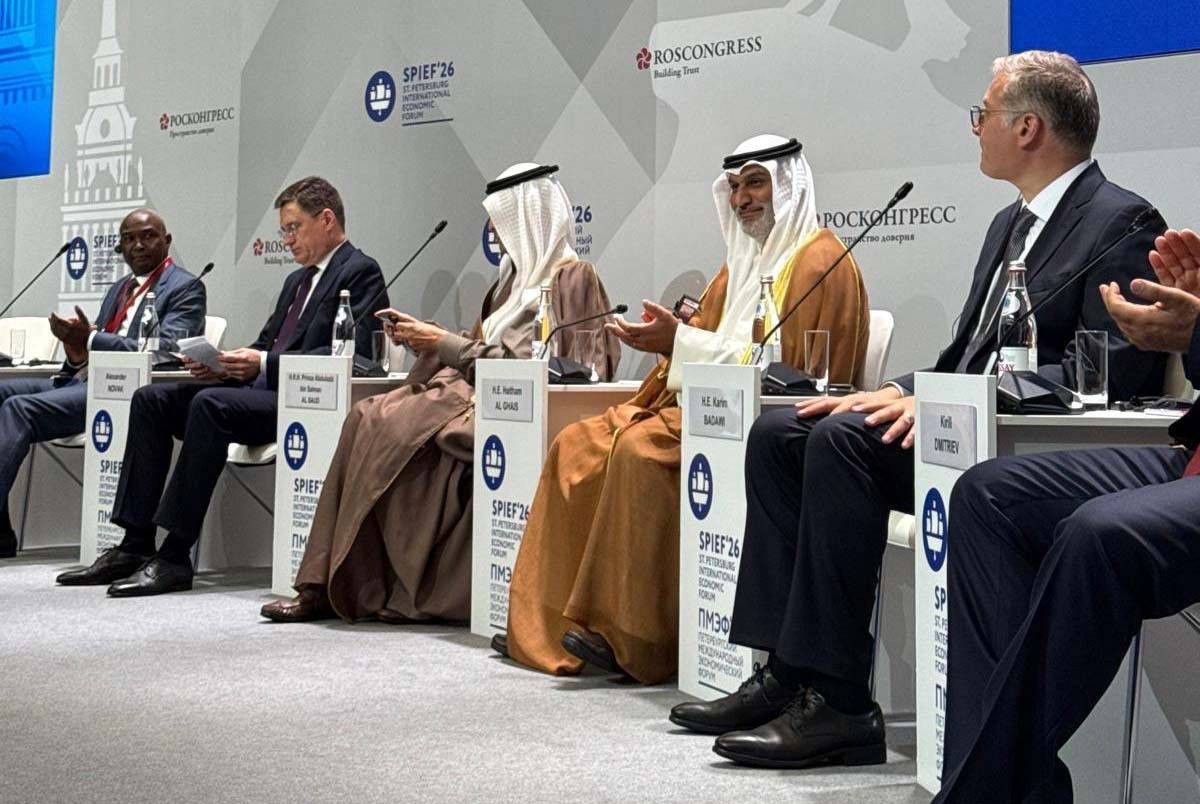
OPEC expects robust oil demand growth and is not changing its estimates, Secretary General Haitham Al Ghais said on Thursday at the St Petersburg International Economic Forum, despite the Middle East conflict and closure of the Strait of Hormuz.
“Despite all the commentary out there that oil demand is declining, we have not registered signs of that yet,” Al Ghais said.
“We still see robust demand growth at 1.2 million barrels a day for this year,” he said.
He also said that investments in the oil industry should not be affected by “one-off events” that happen anywhere in the world.
“We need to invest well ahead of time to be prepared for the demand that we see in the future,” he said.
Speaking on the sidelines of the St. Petersburg International Economic Forum 2026, Al-Ghais said the fundamentals of the oil market remain “strong,” adding that OPEC continues to see steady demand growth despite geopolitical uncertainty and supply disruptions.
He confirmed that the group has maintained its forecast for global oil demand growth at around 1.2 million barrels per day for the year, saying current conditions do not justify revising projections.
Al-Ghais said the conflict in the Middle East has had only a limited impact on demand growth, describing it as a temporary factor within a still-resilient global consumption pattern, the news agencies report.
He also warned against underinvestment in the oil and gas sector, arguing that delaying projects due to short-term geopolitical shocks could undermine future supply stability and market balance.
The OPEC chief reiterated that long-term investment is essential to ensure energy security and meet projected demand, emphasizing that markets must prepare in advance for future consumption needs.
On the sidelines of the forum, Al-Ghais held meetings with key energy officials, including Saudi Energy Minister Prince Abdulaziz bin Salman and Russian Deputy Prime Minister Alexander Novak, focusing on market stability and coordination among producers.
He also met Venezuelan officials and representatives from the Gas Exporting Countries Forum to discuss cooperation, data sharing, and strengthening institutional coordination between energy-producing nations.
Al-Ghais said the OPEC+ cooperation framework, approaching its tenth anniversary in 2026, remains a key mechanism for maintaining stability in global oil markets and balancing supply and demand.
He reaffirmed that OPEC will continue monitoring market developments closely in coordination with its partners to ensure stability across global energy markets.