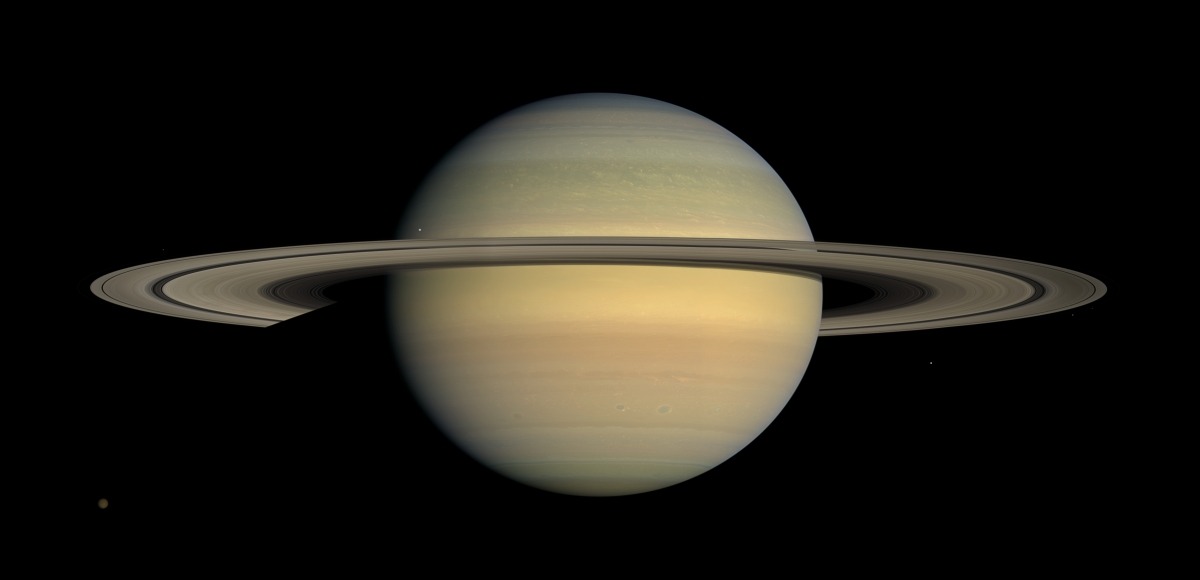
Astronomers have achieved a landmark breakthrough in planetary science, resolving a decades-long mystery surrounding Saturn’s rotation through groundbreaking observations made by the James Webb Space Telescope.
The findings reveal that the long-reported variations in Saturn’s rotation rate were not the result of actual changes in the planet’s spin, but rather the outcome of complex and powerful interactions between its magnetic field and upper atmospheric dynamics.
Published in the Journal of Geophysical Research: Space Physics, the study shows that intense auroral activity at Saturn’s north pole generates a continuous and self-sustaining cycle of heating, high-speed winds, and electrical currents. These processes, in turn, distort the radio signals used to measure the planet’s rotation, creating the illusion of fluctuating spin rates.
The scientific puzzle dates back decades and gained renewed attention in 2004, when NASA’s Cassini spacecraft recorded inconsistencies in Saturn’s rotation data that defied conventional explanation.
Led by Professor Tom Stallard of Northumbria University, researchers used the James Webb Space Telescope to conduct an in-depth observation of Saturn’s northern auroral region over a full planetary rotation. The team analysed emissions from the trihydrogen ion, a critical tracer of temperature variations in the upper atmosphere.
The resulting data produced the most detailed thermal and particle-density maps ever recorded of Saturn’s polar regions, confirming that auroral energy drives powerful atmospheric circulation in a self-reinforcing loop.
Scientists described the phenomenon as a “planetary heat engine,” in which auroral energy fuels atmospheric motion, which in turn sustains the very electrical currents powering the auroras themselves.
The discovery not only resolves a long-standing inconsistency in Saturn’s measured rotation but also provides critical new insight into the interaction between magnetic fields and atmospheric systems on giant planets, with broader implications for understanding other worlds across the solar system.