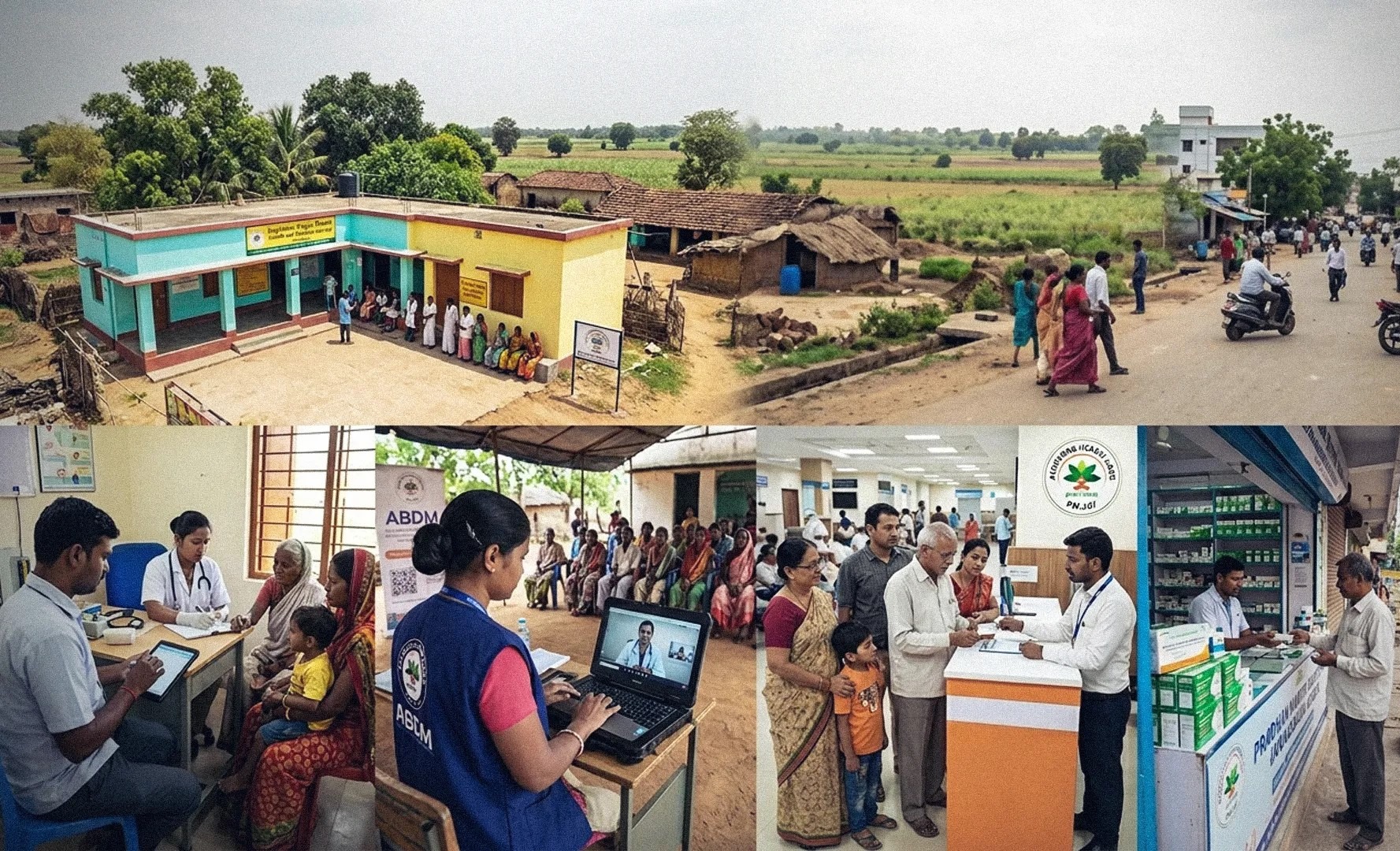
India’s health sector reforms over the past decade have positioned the country as a leading example in the global pursuit of Universal Health Coverage (UHC), offering a potentially scalable model for low- and middle-income countries across the Global South.
At the centre of this transformation is Ayushman Bharat, a comprehensive health initiative that integrates financial protection, primary healthcare strengthening, digital innovation, and pharmaceutical self-reliance.
Designed as a rights-based framework rather than a welfare scheme, it redefines healthcare as a public good and constitutional entitlement.
The flagship insurance component, Pradhan Mantri Jan Arogya Yojana (PM-JAY), is the world’s largest publicly funded health assurance program. It provides coverage of up to 5 lakh rupees (approx. $6,000) per family per year for secondary and tertiary care, targeting the most economically vulnerable sections of society.
Since its launch in 2018, the scheme has facilitated over 7.8 crore hospital admissions and generated estimated household savings exceeding 1.25 lakh crore rupees ($15.1 billion approx.)
Recent expansions have further strengthened its inclusivity, including coverage for all citizens aged 70 and above regardless of income, supported by digital enrolment systems and elimination of exclusions for pre-existing conditions. The scheme has also contributed to a decline in out-of-pocket healthcare expenditure, reducing financial burden on households.
The health infrastructure under Ayushman Bharat has also undergone large-scale expansion through Ayushman Arogya Mandirs (AAMs), which now number over 1,84,000 across rural, urban, and tribal regions.
These centres deliver preventive, promotive, curative, rehabilitative, and palliative care, bringing healthcare closer to communities and strengthening primary care delivery.
Digital integration has played a major role in scaling access. In 2025 alone, AAMs facilitated over 426 million teleconsultations, while the Ayushman Bharat Digital Mission has created more than 863 million digital health accounts, enabling secure and interoperable health records.
India has also expanded tele-mental health services through Tele MANAS, which provides 24/7 counselling support across multiple languages and has handled millions of calls since its launch.
Innovations such as drone-based medical logistics under the i-DRONE initiative have further improved last-mile healthcare delivery, supporting vaccine distribution, diagnostic transport, and emergency medical supply chains in remote areas.
Equity remains a central pillar of the program. Nearly half of all Ayushman cards have been issued to women, while targeted interventions aim to address geographic, social, and economic disparities in healthcare access.
Complementary schemes such as the Pradhan Mantri Bhartiya Janaushadhi Pariyojana (PMBJP) and AMRIT pharmacies have significantly reduced medicine costs, improving affordability for millions.
India’s domestic reforms are also closely linked to its growing global role as a pharmaceutical hub, supplying a significant share of the world’s generic medicines and vaccines. The country has emerged as a key global supplier to developing nations, particularly in essential medicines and immunisation programs.
During the COVID-19 pandemic, India’s rapid vaccine development and distribution efforts further highlighted its capacity as a global health provider, with domestically developed vaccines such as Covaxin and Covishield playing a critical role worldwide.
Experts note that Ayushman Bharat represents a structural shift in healthcare governance by combining decentralized primary care, large-scale insurance coverage, and digital health infrastructure within a unified rights-based framework. This integrated model is increasingly being viewed as a reference point for countries seeking to build equitable and financially sustainable health systems.
By embedding healthcare within a rights-based and technology-driven architecture, India’s approach demonstrates that Universal Health Coverage can be achieved even in resource-constrained settings, provided there is strong political commitment and system-wide reform.
The model’s emphasis on prevention, affordability, and inclusivity positions it as a potential blueprint for the Global South, where governments continue to face challenges in balancing limited resources with growing healthcare demands.