France and UK offer to lead post-war naval mission to secure Strait of Hormuz shipping routes
A coalition of nonbelligerent states led by France and the UK has said it is ready to lead an international mission to restore navigation in the Strait of Hormuz. But that won't be happen before the Iran war is over.

France and the United Kingdom have said they are ready to lead a multinational mission to help restore freedom of navigation and trade in the Strait of Hormuz, only to be deployed once peace had been agreed in the region.
But at a meeting of the coalition of nonbelligerent states in Paris on Friday, the mood remained one of caution. A temporary ceasefire has put fighting between Iran and a US-Israeli coalition on hold until April 22. On Thursday, a 10-day ceasefire was also announced between Israel and Lebanon, the stronghold of Iranian-backed militia Hezbollah.
And on Friday, both Iran and the US said the Strait of Hormuz was now “open” to commercial shipping, though the US said its blockade of Iranian ports would remain in place until a peace deal with Tehran was reached.
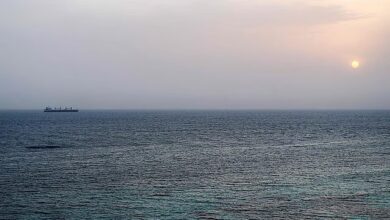
Maritime traffic there had ground to a halt since the start of the war on February 28, with Iranians threatening to bomb merchant ships attempting to pass through the key waterway. About 20% of the world’s oil and gas normally passes through the strait.
“The ceasefires in Lebanon and Iran, as well as Iran’s statement on the Strait of Hormuz, are steps in the right direction,” French President Emmanuel Macron said at a press conference after Friday’s meeting. “But we consider these developments with prudence.”
UK Prime Minister Keir Starmer, who co-chaired the meeting, said the opening of the strait must be “both lasting and a workable proposal.”
Alongside Macron and Starmer were both the German and Italian leaders, Friedrich Merz and Giorgia Meloni, and representatives from about 50 European, Asian, African and South American countries and international organizations, with many joining remotely.
Ian Ralby, maritime and international affairs expert and head of US-based NGO Auxilium Worldwide, seconded that view, stressing that the coalition of nonbelligerent states was right to show restraint.
“The war first needs to completely end and even then, the potential for things going wrong or even a friendly fire incident kicking off is very high,” he told DW. “The irrationality and sporadic escalatory activities of all three belligerent parties have been so extreme that Europe will be very keen to avoid getting itself embroiled in a mess that it had no choice in starting.”
Michelle Wiese Bockmann, senior maritime intelligence analyst at UK-based maritime AI company Windward, said a recent claim by Iran to be laying mines in the Strait of Hormuz had added further pressure.
“That threat alone has prevented traffic from picking up again once the ceasefire was announced,” she said.
“It is unclear, if there are indeed any mines, but 832 tanker vessels and cargos are blocked in the strait right now,” she added, underlining that the blockade had also pushed up insurance premiums.
Nonbelligerent countries have said they could escort vessels through the strait and help to clear mines.
“We could provide mine-clearance vessels — we are good at that,” German Chancellor Merz said Friday, adding that a “sound legal basis” would be needed for such an intervention.
Jean-Paul Palomeros, the former NATO Supreme Allied Commander Transformation, thinks it’s crucial for the coalition to use this expertise as a trump card. The partner countries are keen to show the US their goodwill, after Trump expressed anger at European nations for not joining in to support the US in the Iran war.
“They should try to calm Trump down, as the US are a cornerstone of NATO after all,” said Palomeros. “We need the alliance to be strong in order to deflect or react to attacks on member states in the future — for example, if Russia attacks one of the Baltic states after the end of the war in Ukraine.”
Leaders at Friday’s meeting seemed aware of the need to keep Trump onside. Several, including Italy’s Meloni, mentioned Operation Aspides, an EU mission to protect shipping in the Red Sea. Merchant vessels there have been facing attacks from the Houthis, an Iran-backed Shiite Muslim in Yemen.
“They were right to underline that mission, sending the message to the Americans that these countries are sticking their necks out to secure another stretch of sea,” said Palomeros.