The Times Kuwait Report
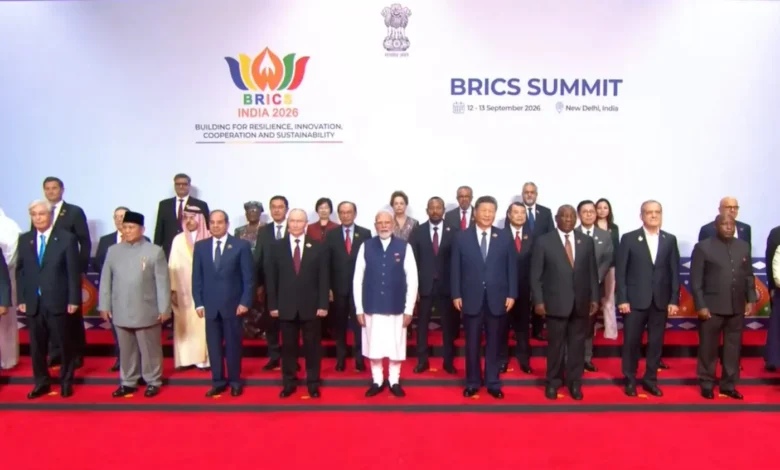
Leaders of the expanded BRICS grouping met in New Delhi on September 12–13 for the 18th BRICS Summit, with India using its chairmanship to place development, economic resilience, technological cooperation and reform of global institutions at the centre of discussions.
Held under the theme “Building for Resilience, Innovation, Cooperation and Sustainability,” the summit comes at a time of heightened geopolitical tensions, conflicts in the Middle East and Ukraine, disruptions to global trade and supply chains, and growing debate over the future of the international economic and political order.
The New Delhi gathering also represents an important moment in BRICS’ evolution. The grouping, originally established around Brazil, Russia, India, China and South Africa, has expanded substantially in recent years. India’s official BRICS 2026 materials list 11 members — Brazil, China, Egypt, Ethiopia, India, Indonesia, Iran, Russia, Saudi Arabia, South Africa and the UAE — collectively accounting for about 49.5 percent of the world’s population, 40 percent of global GDP and 26 percent of global trade.
India’s fourth BRICS chairmanship
India assumed the BRICS chairmanship on January 1, 2026, for the fourth time, following earlier chairmanships in 2012, 2016 and 2021. The year also marks two decades since the establishment of BRICS.
Throughout its chairmanship, India has sought to make BRICS more focused on practical cooperation rather than allowing it to become solely a forum for geopolitical positioning. More than 350 meetings and high-level engagements have been conducted across more than 25 Indian cities during the year, covering political and security issues, economic and financial cooperation, and cultural and people-to-people exchanges.
The Indian presidency has framed the agenda around resilience, innovation, cooperation and sustainability, with an emphasis on what New Delhi describes as a “Humanity First” approach.
New Delhi Declaration adopted
One of the principal outcomes of the summit has been the adoption of the New Delhi Declaration, covering a broad range of geopolitical, economic, developmental and technological issues.
The declaration reaffirms the BRICS principles of sovereign equality, mutual respect, solidarity, inclusiveness, consensus and cooperation. It also calls for stronger collaboration across the grouping’s three traditional areas — political and security cooperation, economic and financial cooperation, and cultural and people-to-people exchanges.
The declaration comes against the backdrop of major differences among BRICS members on several international conflicts. Nevertheless, members reached agreement on a common text, including language calling for restraint and diplomatic efforts to address the worsening situation in the Middle East.
Middle East crisis dominates geopolitical discussions
The continuing conflict involving Iran and the wider instability in the Middle East has emerged as one of the most difficult issues confronting the expanded BRICS grouping. Iran and the UAE, despite their differing positions and regional interests, signed onto the joint BRICS statement calling for restraint and diplomatic efforts to reduce tensions. The ability of the group to issue a common declaration was significant because the expanded membership brings together countries with increasingly divergent foreign-policy positions.
BRICS leaders expressed serious concern over escalating violence in the Middle East and opposed unilateral measures that they argue have implications for international trade and developing economies. The declaration emphasised dialogue, consultation and diplomatic resolution of disputes.
The Middle East crisis has also acquired an economic dimension for BRICS, particularly because disruptions to energy markets and shipping routes can have consequences far beyond the region. The conflict has already placed pressure on global oil markets and supply chains.
BRICS and the changing global economic order
Economic cooperation remains at the heart of the BRICS agenda. The expanded grouping represents a significant share of global population, economic output and trade, giving its members greater collective weight in debates about global finance and economic governance.
One major area of discussion has been the use of local currencies in trade and investment. Rather than immediately pursuing a common BRICS currency, the New Delhi discussions have focused more heavily on improving cross-border payments, strengthening national payment systems and facilitating settlements in members’ own currencies.
The BRICS Payment Task Force is examining ways of integrating national payment mechanisms, while the New Development Bank is being encouraged to expand local-currency financing.
This approach reflects the practical difficulties involved in creating a single currency or unified monetary system among economies with very different financial structures, monetary policies and levels of development.
Push for reform of global institutions
Reform of international institutions has been another major priority for India. New Delhi has repeatedly argued that global governance structures established decades ago do not adequately reflect the economic and demographic realities of the 21st century.
At the summit, Indian Prime Minister Narendra Modi called for greater representation and reform within the United Nations Security Council and international financial institutions. The broader BRICS position seeks greater participation by developing and emerging economies in global decision-making. The issue is particularly important for India, which has long campaigned for permanent membership of the UN Security Council.
The BRICS declaration also supports a more representative and reformed multilateral system, linking institutional reform with the broader interests of developing countries.
AI emerges as a major BRICS priority
Artificial intelligence has also moved prominently onto the BRICS agenda. The New Delhi discussions have emphasised the need for AI development that is ethical, inclusive, secure and responsive to the needs of the Global South.
Among the initiatives highlighted during the 2026 chairmanship are a proposed BRICS Digital Public Infrastructure Repository, cooperation in smart manufacturing and the establishment of an India Centre for BRICS Industrial Competencies.
The summit has also highlighted health-sector cooperation, including a proposed training hub network with India’s National Institute of Mental Health and Neuro Sciences (NIMHANS) playing a leading role.
Trade, tariffs and sanctions
Trade tensions have also figured prominently in the summit. BRICS members have raised concerns over unilateral tariffs, non-tariff barriers and economic sanctions, arguing that such measures can disrupt international trade and disproportionately affect developing economies.
The New Delhi Declaration expresses opposition to unilateral economic coercive measures and highlights the importance of an open, predictable and rules-based international trading system.
However, BRICS countries do not share identical economic interests. Their trading relationships with the United States, Europe and other major markets vary significantly. This makes consensus on economic policy more complicated than a simple division between BRICS and Western economies.
A more diverse but more complicated BRICS
The expansion of BRICS has significantly increased its geographical reach and economic weight, but it has also made consensus more difficult. The group now includes major energy producers, manufacturing powers, rapidly growing emerging markets and countries facing different geopolitical circumstances.
These differences mean that BRICS is not a conventional military or political alliance. Instead, it functions as a platform where countries with different political systems and foreign-policy priorities attempt to identify areas of common interest.
The New Delhi summit has demonstrated both sides of this equation: the members have been able to agree on issues such as development, institutional reform and economic cooperation, while geopolitical disagreements continue to shape negotiations.
Global South at the centre
For India, perhaps the broader objective of the summit is to position BRICS as an important voice for the Global South. The grouping’s expansion has increased the number of countries seeking greater influence over global financial institutions, international trade rules, technology governance, climate policy and development financing.
India’s presidency has therefore emphasised practical cooperation in areas such as food security, health, climate resilience, technology, education, entrepreneurship and sustainable development. The objective is not simply to create another geopolitical bloc, but to provide developing economies with greater representation and additional mechanisms for cooperation.
A summit shaped by a changing world
The New Delhi BRICS Summit is taking place at a moment when the international system is undergoing significant change. Wars and regional conflicts are disrupting trade and energy markets. Strategic competition between major powers is reshaping global diplomacy. Artificial intelligence is transforming economies and raising new questions about governance. Developing countries are demanding greater representation in institutions that determine global economic and political rules.
Against this backdrop, BRICS is attempting to define what an expanded Global South platform can accomplish. India’s 2026 chairmanship has placed the emphasis on resilience, innovation, cooperation and sustainability, while the New Delhi Declaration provides a broad framework for future collaboration.
Whether BRICS can convert its growing economic and demographic weight into sustained institutional influence will depend largely on its ability to overcome internal differences and translate summit commitments into practical programmes.
For India, the New Delhi summit offers an opportunity to demonstrate that its diplomacy can bridge relationships across competing geopolitical camps while keeping development and the interests of emerging economies at the centre of the conversation.
The 18th BRICS Summit’s most important legacy may therefore lie not only in the declarations adopted by its leaders, but in whether the expanded grouping can turn its increasingly diverse membership into effective cooperation on trade, technology, development, energy, climate and global governance.