- Kuwait joins Bahrain, Qatar and Muscat in full GCC trading access
- Kuwait strengthens regional market integration with 100 percent GCC trading access
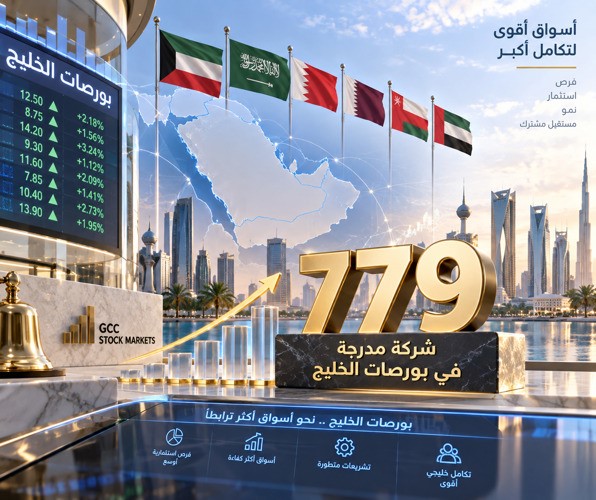
- GCC stock markets reach 779 listings, record $618 billion trading in 2025
Kuwait is among four Gulf markets where 100 percent of listed companies are available for trading by GCC nationals, highlighting the country’s relatively open equity market and its role in strengthening regional investment integration.
The Kuwait Stock Exchange is part of a wider Gulf capital-market landscape that comprised 779 listed companies at the end of 2025, according to a report by the Statistical Center of the Gulf Cooperation Council.
Across the GCC, 756 listed companies, or about 97 percent of the total, had shares available for trading by GCC nationals. Kuwait, Bahrain, Muscat and Qatar were the four markets where the proportion reached 100 percent.
Gulf stock markets recorded strong trading activity in 2025, with about 401.7 billion shares changing hands at a combined value of approximately $618 billion, up 19.5 percent from 2024.
Despite the increase in trading value, total GCC stock-market capitalisation stood at around $3.9 trillion, down 6.2 percent from the previous year. The composite Gulf market index also declined 3.8 percent to about 165.2 points at the end of 2025.
For Kuwait, the full accessibility of listed companies to GCC investors strengthens the market’s position within the region and supports greater cross-border participation. It also complements wider efforts to deepen Gulf capital-market integration and improve investment flows between member states.
The GCC markets continued to introduce regulatory and structural reforms during 2025, including changes to capital-market and investment-fund regulations, listing and offering rules, corporate governance and trading practices.
The markets also expanded market-making mechanisms and digital financial services, while regulators strengthened risk-based supervision and modernised financial-market infrastructure and capital-adequacy frameworks.
Another area of development was sustainability reporting, alongside efforts to enable electronic securities issuance and improve the efficiency of market operations.
At the regional level, the Inter-GCC Registration Regulation for Investment Funds came into force, creating the first unified regulatory framework for a financial product across GCC markets.
Gulf authorities are also working on initiatives to facilitate the listing and trading of bonds and sukuk, encourage dual listings, improve electronic links between stock exchanges and introduce unified investor identification numbers for GCC citizens, reports Al-Anba.
These measures are intended to make Gulf capital markets more connected and accessible, with Kuwait’s full GCC trading access placing it among the region’s more integrated equity markets.