Outgoing ICRC chief praises Kuwait, ‘Beacon of Humanity’
After serving for four exceptional years, Mamadou Sow highlights Kuwait’s leadership in the missing persons file and its global humanitarian role as a key partner in international relief efforts.
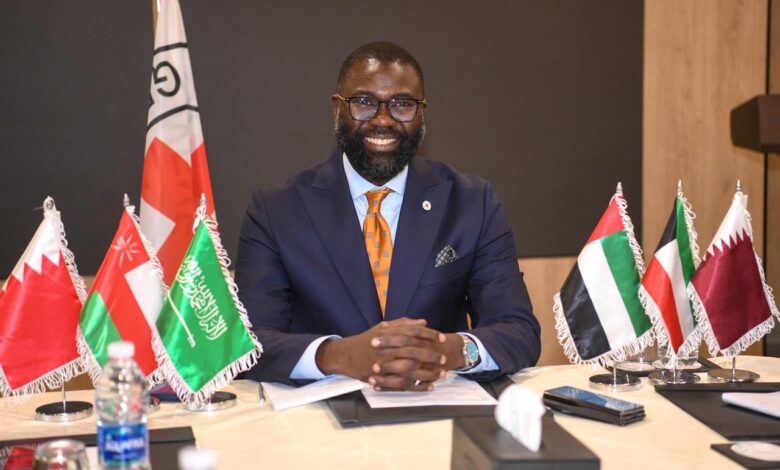
The Head of Delegation for the International Committee of the Red Cross (ICRC) to the Gulf Cooperation Council (GCC) Mamadou Sow, has announced that he will be leaving Kuwait after what he described as four “exceptional years,” expressing pride in the humanitarian cooperation achieved with Kuwait, alongside sadness at parting with colleagues and friends he built relationships with during his tenure, including government officials, the Ministry of Foreign Affairs, and media representatives.
Sow said his four-year mission coincided with major regional and global crises, including the war in Gaza and subsequent developments in Lebanon, Syria, and Sudan, noting that Sudan has become one of the world’s largest humanitarian catastrophe zones, with more than 11 million displaced people, including four million outside the country.
He stressed that Kuwait emerged during this period as a key supporter of the ICRC and international humanitarian law, describing the country as a “humanitarian beacon” in a region facing severe challenges. He said this support had a significant impact on the organization’s ability to assist people affected by conflicts.
He explained that Kuwait’s backing enabled humanitarian operations in Sudan, Lebanon, Syria, and Somalia, in addition to flexible funding that allowed the ICRC to respond to other global crises.
On the evolution of relations with Kuwait, Sow said the partnership was already strong upon his arrival but has become even stronger, highlighting the high-level strategic dialogue held with Kuwait last year, visits by senior ICRC leadership, and several cooperation agreements signed with the Kuwait Red Crescent Society.
He noted that these agreements contributed to improving healthcare and humanitarian services in Sudan, as well as supporting affected communities in Syria and Somalia, adding that ongoing discussions with Kuwait continue to identify global humanitarian priorities.
Regarding the issue of missing persons, Sow emphasized that it remains a core priority for the ICRC, noting that while wars may end for many when fighting stops, they do not end for families still searching for answers.
He said the organization continues to work with Iraqi authorities and international partners, including the United States, United Kingdom, France, Saudi Arabia, and Kuwait, using advanced technologies and modern search tools to locate missing persons.
He also revealed discussions with Kuwait aimed at leveraging its 35-year experience in the missing persons file, with the goal of transferring expertise to other countries, particularly in the Arab world, noting Kuwait’s advanced use of DNA technology and legal frameworks in this field.
Sow further highlighted Kuwait’s global role in advancing this issue, particularly its push for UN Security Council Resolution 2474 on missing persons in armed conflict, adding that technical work on related initiatives is still ongoing.
On his next assignment, he said he will move to Geneva to oversee ICRC operations in Africa, which covers 25 conflict-affected countries representing more than 43% of the organization’s budget and employing around 6,000 staff.
He added that the ICRC operates 16 orthopedic and rehabilitation centers across Africa and visits nearly half a million detainees annually, noting he will return to Kuwait in the future in his new capacity to continue cooperation on humanitarian work.
He praised Kuwait’s long-standing humanitarian legacy since the 1970s, stressing that Kuwaiti institutions continue this role to the present day.
He also pointed to growing global humanitarian challenges, including rising conflicts, declining funding for humanitarian aid, and increasing geopolitical divisions, as well as the impact of emerging warfare technologies such as drones and cyber warfare.
Sow confirmed that his successor will be Swiss national Anne Montavon, the first woman to head the ICRC delegation in Kuwait, expressing confidence in her ability to strengthen ties with Kuwaiti society.
He encouraged her to engage with local culture, participate in traditional gatherings, and experience Kuwaiti life, noting Kuwait’s openness and ease of engagement with its society.
He concluded by reaffirming Kuwait’s central role in humanitarian work globally and reiterated the ICRC’s preference that Kuwaiti support be directed toward beneficiaries worldwide rather than infrastructure, noting that its current office in Jabriya remains sufficient to maintain proximity to communities.