Nepal-Tibet flash flood tragedy raises new alarm over Himalayan climate risks
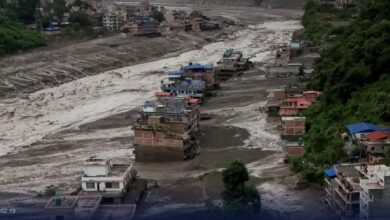
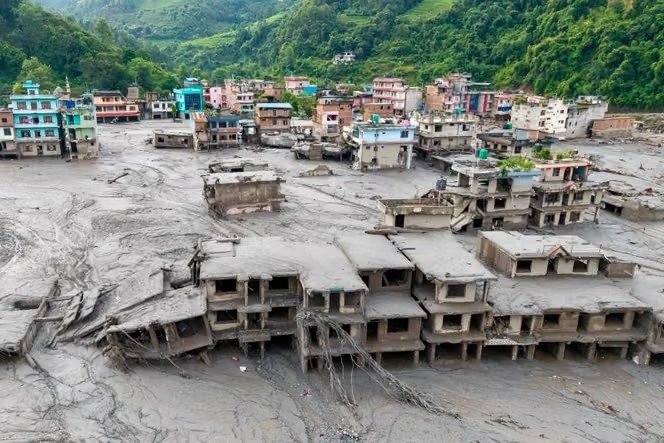
The disaster has taken a heavy toll in Nepal, where the death toll has risen to 489, officials said more than 48 hours after the flood tore through the Himalayan border region. The flood wave, caused by a collapsed glacier, surged through communities with enormous force, destroying homes and roads and wiping out a key Nepal-Tibet border crossing.
- USGS analysis suggests melting glacier collapse highlights growing climate, infrastructure risks
- The central message is simple and sobering: glaciers, rivers and geological hazards do not respect borders, and ignoring that reality could turn future Himalayan disasters into failures of both climate adaptation and diplomacy.
- No conclusive evidence that a specific Chinese infrastructure project caused the August 26 glacier collapse
The catastrophic flash flood that struck the Tibet-Nepal border on August 26 was not simply another Himalayan natural disaster. It highlighted the growing dangers created by a rapidly changing mountain environment, where climate change, geological instability, infrastructure expansion and weak cross-border environmental cooperation are increasingly interacting.
Initial reports suggested that an earthquake had triggered the disaster, but subsequent analysis indicated that the seismic signal was generated by the collapse itself. A large section of a glacier at about 5,200 meters broke away and plunged roughly 1,200 meters, creating an ice-and-rock avalanche that carried huge amounts of debris and appears to have temporarily blocked the Lhende Khola River before releasing a destructive surge downstream.
The event was therefore a complex high-altitude disaster rather than a conventional rain-driven flood. Ice, rock, water, gravity and steep terrain combined to produce a rapidly moving mass of water, sediment and boulders through narrow Himalayan valleys, leaving communities downstream with little time to react.

The disaster comes amid significant changes across the Hindu Kush Himalayan cryosphere. Glaciers are retreating, snow patterns are changing and permafrost is degrading, increasing the vulnerability of mountain slopes. These changes can contribute to avalanches, landslides, debris flows and glacial lake outburst floods, creating a pattern of interconnected and cascading hazards.
The August disaster also echoes a deadly flood in Nepal’s Bhotekoshi River in July 2025. Satellite analysis linked that event to the drainage of a supraglacial lake in Tibet; the resulting flood destroyed the Friendship Bridge connecting Nepal and China and caused deaths and major infrastructure damage. These incidents demonstrate that environmental hazards originating in the high mountains can quickly cross political boundaries.
The Tibetan Plateau is particularly important because it is a major source region for Asian rivers. Changes to its glaciers, lakes, permafrost and slopes can affect communities well beyond China’s borders. At the same time, roads, railways, hydropower projects, mining operations, settlements and border infrastructure are expanding across an increasingly unstable high-altitude environment.

There is no conclusive evidence that a specific Chinese infrastructure project caused the August 26 glacier collapse, and researchers are still examining the combination of temperature changes, snowmelt, glacier dynamics, permafrost degradation, slope instability and geological factors. However, infrastructure in fragile mountain areas can itself be exposed to hazards, while poorly planned construction, excavation, tunnelling, blasting and mining can potentially increase vulnerability.
For Nepal, the disaster underscores the importance of receiving timely information about dangerous changes upstream. Kathmandu has strong reasons to seek greater cooperation with China, including real-time hydrological information, glacier and glacial-lake monitoring, advance notification of major upstream projects, joint disaster-risk assessments and emergency communication systems. Such cooperation is presented primarily as a public-safety necessity rather than an anti-China position.
The need for cooperation extends to India, Bhutan and other downstream Himalayan countries. China and its neighbors need stronger systems for environmental-data sharing, glacier monitoring, satellite-based early warnings, infrastructure-risk assessments and disaster preparedness. International climate institutions should also give greater attention to the Himalayan cryosphere, including climate adaptation, loss and damage, mountain ecosystems and transboundary disaster risks.

Ultimately, the flood was a human tragedy as well as a warning. The article argues for precaution, transparency and accountability rather than alarmism or unsupported claims about the causes of the disaster. Major infrastructure projects in exceptionally fragile Himalayan areas should undergo credible scientific assessments of their potential downstream effects, while countries sharing the region must improve early-warning and disaster-preparedness systems.
The central message is simple and sobering: glaciers, rivers and geological hazards do not respect borders, and ignoring that reality could turn future Himalayan disasters into failures of both climate adaptation and diplomacy.
Meanwhile, the Chinese authorities have resumed rescue operations near the Nepal-Tibet border after temporarily suspending efforts over fears that a newly formed lake could burst its banks. State media reported that water had been trickling through the lake on the Tibet side but has now stopped, allowing rescue teams to return to the area. The development comes as rescuers continue searching for people missing after the devastating flash flood.
The disaster has taken a heavy toll in Nepal, where the death toll has risen to 489, officials said more than 48 hours after the flood tore through the Himalayan border region. The flood wave, caused by a collapsed glacier, surged through communities with enormous force, destroying homes and roads and wiping out a key Nepal-Tibet border crossing.
The scale of the disappearance is particularly painful for families waiting for news. The Nepali government has released the names of 500 missing foreign nationals, including 178 Indians, 65 Americans and 33 Britons. In Tibet, Chinese state media reported five deaths and more than 558 people missing, although it remains unclear whether the latest figures overlap with other casualty counts. Tens of thousands of tourists visit the region each year, adding to the uncertainty and anguish surrounding those still unaccounted for.
Behind the growing numbers are families desperately hoping for the return of loved ones. Relatives of missing tourists have described the unbearable wait for news, with two sisters whose parents are missing telling the BBC: “We just love them a lot and want them to come home.” As rescue teams return to the search, the immediate priority remains finding survivors and accounting for the missing, while authorities on both sides confront the devastating aftermath of a glacier collapse that turned a Himalayan river into a deadly flood wave within minutes.