As the United Nations prepares for the election of non-permanent members to the Security Council in June 2026, Kyrgyz President Sadyr Zhaparov has launched a strong diplomatic appeal positioning the Kyrgyz Republic as a credible, independent and principled voice for global peace, conflict prevention and equitable international representation.
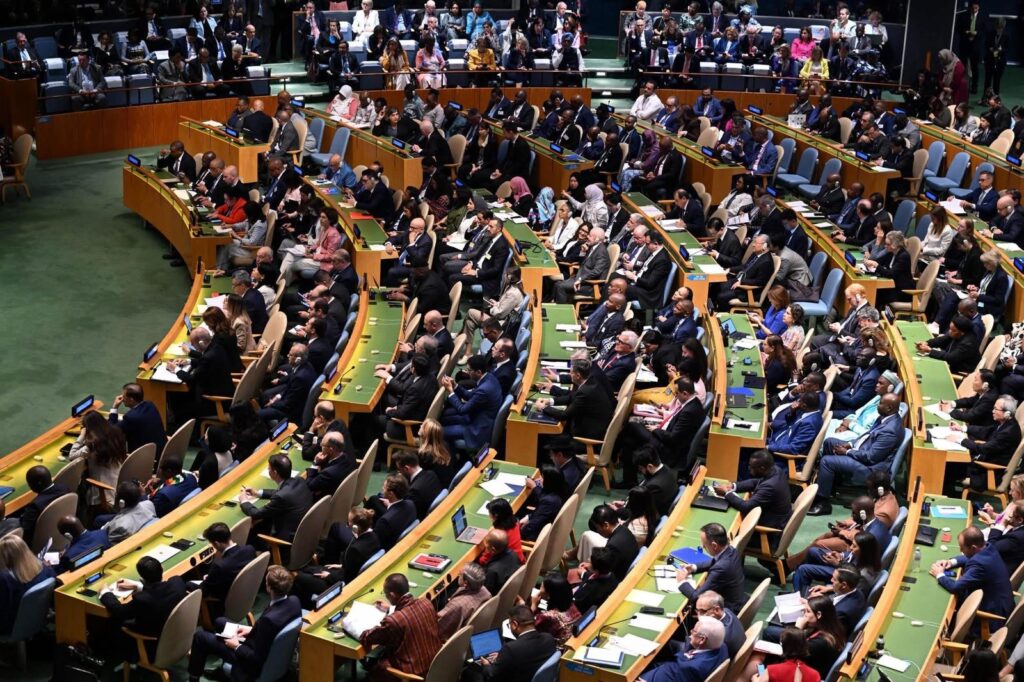
In a formal address to heads of state ahead of the vote, President Zhaparov presented Kyrgyzstan’s candidacy not merely as a national aspiration, but as part of a broader call for reform in global governance, arguing that smaller, developing and landlocked nations remain underrepresented in the world’s most powerful decision-making body.
A World in Crisis
Framing his message against a backdrop of escalating geopolitical instability, President Zhaparov described a world increasingly shaped by rivalry, armed confrontation and weakening respect for international law.
Conflicts across Europe, the Middle East and Africa, he noted, continue to strain the international system, while military spending worldwide has surpassed an estimated $3 trillion — resources he suggested could instead be directed toward fighting hunger, protecting the environment and improving human welfare globally.
The Kyrgyz leader argued that such conditions make it imperative for the Security Council to become more representative, balanced and legitimate in the eyes of the international community.
The Case for Representation
A central theme of Kyrgyzstan’s campaign is the structural imbalance in the Security Council’s composition.
President Zhaparov asserted that insufficient participation by smaller and developing nations undermines the resilience of the global collective security framework. Expanding meaningful representation, he argued, is not a political convenience but an objective necessity in an increasingly fragmented world.
Kyrgyzstan’s bid also draws attention to historical inequities in UN representation. The country has never served on the Security Council, while its competitor for the seat, the Philippines, has already held membership four times.
Zhaparov framed Kyrgyzstan’s election as an opportunity for the international community to correct that imbalance and reaffirm the principle of equal participation among nations.
A Neutral and Independent Voice
Kyrgyzstan is presenting itself as a country free from bloc politics and major geopolitical alignments.
According to President Zhaparov, this independence would allow the country to serve as a balanced and pragmatic actor capable of reducing polarization within the Council.
He emphasized that Kyrgyzstan’s foreign policy is grounded in adherence to the UN Charter, opposition to double standards and resistance to the politicization of humanitarian issues.
This positioning is designed to appeal to nations seeking a less ideologically driven and more consensus-based Security Council.
A Regional Model for Peaceful Conflict Resolution
One of the strongest pillars of Kyrgyzstan’s argument is its own regional experience.
President Zhaparov highlighted the country’s successful completion of border delimitation issues with neighboring states through peaceful negotiations, describing it as a practical demonstration that even highly sensitive security disputes can be resolved through diplomacy and mutual understanding rather than confrontation.
In a region historically marked by complex transitions and occasional instability, this experience is being offered as proof of Kyrgyzstan’s capacity to contribute constructively to international peace and security.
Democracy and Domestic Reform
The president also pointed to domestic governance reforms to reinforce Kyrgyzstan’s credentials as a responsible international actor.
He cited the country’s three terms on the UN Human Rights Council and outlined legislative reforms adopted in 2025 aimed at increasing political inclusion.
These measures include quotas for women, youth, ethnic minorities and persons with disabilities in parliamentary representation, alongside new gender balance rules for executive and judicial appointments.
By highlighting these reforms, Kyrgyzstan seeks to project itself as a nation committed to democratic governance, inclusivity and international norms.
Security Priorities on the Global Stage
If elected, Kyrgyzstan says it will focus on a set of practical global security priorities.
These include strengthening preventive diplomacy, enhancing mediation mechanisms, promoting nuclear non-proliferation, supporting disarmament efforts and institutionalizing the relationship between climate change and security within the UN agenda.
The emphasis reflects a broader shift in global security thinking, where environmental stress and resource instability are increasingly viewed as catalysts for conflict.
Championing Nuclear Disarmament
A significant part of Kyrgyzstan’s foreign policy identity lies in its anti-nuclear stance.
President Zhaparov reaffirmed the country’s complete rejection of weapons of mass destruction and highlighted its role in establishing the Central Asian Nuclear-Weapon-Free Zone.
He also pointed to Kyrgyzstan’s 2025 signing of the Treaty on the Prohibition of Nuclear Weapons as evidence of its commitment to a world free of nuclear arms.
This places Kyrgyzstan among countries advocating for stronger disarmament frameworks at a time of renewed strategic tensions between major powers.
Climate Security and Environmental Diplomacy
Kyrgyzstan is also attempting to broaden the definition of international security.
Despite being landlocked, the country joined the BBNJ Agreement on marine biodiversity in 2025, underscoring its commitment to global ecological stewardship.
President Zhaparov promoted the concept of “from mountains to the ocean,” emphasizing the interconnected nature of environmental systems and the indivisibility of ecological resilience.
This reflects a growing effort by smaller nations to shape international debates on climate security and sustainable development.
Focus on Afghanistan
Kyrgyzstan’s regional priorities also include Afghanistan, which President Zhaparov described as inseparable from Central Asian security.
He stressed continued humanitarian support for the Afghan people, including women and children, while endorsing the country’s gradual economic and political integration into the international community.
This position aligns with broader regional concerns about instability, migration and extremism spilling across borders.
Backed by Central Asia
A notable strength in Kyrgyzstan’s campaign is the unanimous support it claims from other Central Asian states.
Zhaparov described this as evidence of growing regional cohesion and a sign that Kyrgyzstan would bring a coordinated and responsible voice representing wider regional interests rather than narrow national concerns.
Such backing may enhance its diplomatic credibility during the election process.
A Bid for Reform and Responsibility
Ultimately, Kyrgyzstan’s campaign is about more than securing a seat.
It is a broader statement about reforming international governance, empowering underrepresented nations and restoring faith in multilateral institutions during a period of global uncertainty.
President Zhaparov’s message portrays Kyrgyzstan as a bridge-builder: a country with regional diplomatic experience, non-aligned credibility and a policy agenda focused on prevention rather than confrontation.
Whether UN member states embrace that vision in June remains to be seen, but Kyrgyzstan has clearly positioned itself as a candidate seeking not simply representation, but relevance in shaping the future of international peace and security.