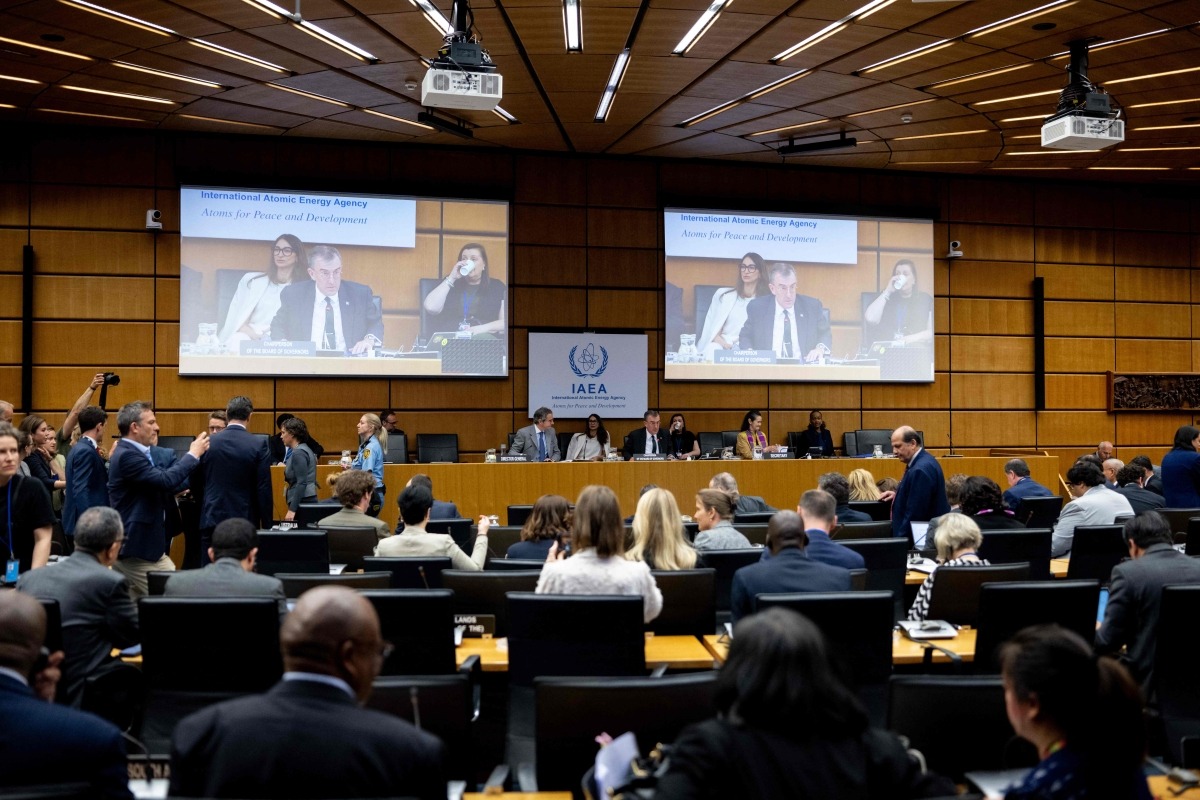
The Board of Governors of the International Atomic Energy Agency (IAEA) on Wednesday approved a US-backed resolution demanding that Iran declare its remaining stockpiles of enriched uranium and allow inspectors to verify them, a move that could complicate Washington’s talks with Tehran.
Diplomats who attended the closed meeting said the resolution was submitted by the United States, Britain, France and Germany and was approved by a majority of 21 votes, with three votes against and 10 abstentions.
The council has 35 member states.
Meanwhile, the IAEA says it is closely monitoring the fallout from Israeli strikes on Iran’s nuclear facilities, warning that continued attacks could trigger serious radiological and environmental risks inside Iran and across the wider region.
IAEA Director General Rafael Mariano Grossi stressed that nuclear sites in Iran have come under repeated attack over the past week, including facilities in Natanz, Esfahan, Tehran, and Arak. While no major radioactive leak has been detected outside the sites so far, the agency warned that the danger of contamination remains significant.
The most serious damage was reported at Iran’s Natanz Fuel Enrichment Plant, where Israeli strikes destroyed above-ground enrichment facilities and critical power infrastructure. The IAEA said the loss of electricity likely damaged underground centrifuges used for uranium enrichment, including operations involving uranium enriched up to 60% purity.
Satellite analysis later indicated that underground enrichment halls at Natanz may also have been directly impacted. The agency reported radioactive and chemical contamination inside the facility, though radiation levels outside the site remain normal, according to news agencies.
The IAEA warned that uranium compounds released inside Natanz could pose health risks if inhaled or ingested, while toxic fluoride chemicals created during the incident are also a major concern for workers and emergency teams inside the facility.
At Iran’s Esfahan nuclear complex, four buildings were damaged, including a uranium conversion plant and facilities connected to reactor fuel production and uranium metal processing. Radiation levels outside the site have not changed, according to the agency.
Iran’s centrifuge production network was also hit. The IAEA confirmed strikes on the TESA Karaj workshop and the Tehran Research Center, both previously monitored under the 2015 nuclear agreement (JCPOA). Buildings used to manufacture and test advanced centrifuge components were reportedly destroyed.
The Khondab Heavy Water Research Reactor, still under construction, was also struck. Because the reactor was not operational and contained no nuclear material, the IAEA said no radiological impact is expected, although nearby heavy water production infrastructure sustained damage.
Grossi emphasized that the IAEA remains present in Iran and intends to continue inspections under Iran’s Nuclear Non-Proliferation Treaty obligations as soon as security conditions allow. He urged “maximum restraint” and warned that further military escalation increases the risk of a nuclear accident and undermines diplomatic efforts aimed at ensuring Iran does not develop nuclear weapons.
The IAEA also renewed calls for urgent cooperation and information-sharing with Iranian authorities to prevent any potential radiological emergency and keep the international community informed.