A quarter century in public life has taken Narendra Modi from the political landscape of Gujarat to the centre of India’s national and global story
By Rajpal Tyagi
Twenty-five years is a long time in the life of a nation. It is long enough for a generation to grow up, for cities to change, for technology to transform the way people live and communicate, and for a country to redefine how it sees itself and its place in the world.
For Narendra Modi, 25 years in government is also the story of an extraordinary personal journey from a modest childhood in Vadnagar, Gujarat, to the highest elected office in India.
On 7 October 2001, Narendra Modi took oath as Chief Minister of Gujarat. Few could have imagined then that the relatively little-known political organiser would go on to become one of India’s most recognisable political leaders and serve as Prime Minister for more than 12 years.
On 7 October 2026, that journey reaches a remarkable milestone: 25 uninterrupted years at the head of a government. The significance of the moment lies not simply in the number of years. It lies in the distance travelled.
Born on 17 September 1950 in Vadnagar, Modi grew up in a modest family and worked at his family’s tea stall while continuing his education. His early years, as described in his public life, were shaped by discipline, reading, debate and an engagement with India’s social and cultural traditions.
Those beginnings are important because they remain central to the story of the man who would eventually occupy India’s highest political office. His journey was not one of instant national prominence. It was built over decades through organisational work, political campaigns, setbacks, responsibilities and an increasingly prominent role within the Bharatiya Janata Party.
Then came October 2001.
The BJP leadership selected Modi to take over as Chief Minister of Gujarat, and on 7 October he took the oath of office. The next 13 years would change both his political standing and the scale of his ambitions, eventually taking him from Gujarat to the national stage.
From Gujarat to New Delhi
In 2013, the BJP named Modi its prime ministerial candidate for the 2014 Lok Sabha election.The election transformed the political landscape. The BJP won an absolute majority and, on 26 May 2014, Narendra Modi became Prime Minister of India.
What followed was an effort to reshape the relationship between the Indian citizen, the state and the economy. Swachh Bharat put sanitation and cleanliness at the centre of a national campaign. Jan Dhan sought to bring millions into the formal banking system. Make in India placed manufacturing and investment at the heart of the economic narrative, while Digital India sought to expand digital infrastructure and government services.
Ujjwala sought to bring cleaner cooking fuel to eligible households. Ayushman Bharat expanded the focus on public healthcare. GST attempted to create a nationwide indirect-tax framework. Infrastructure development accelerated across roads, railways, airports and digital networks. UPI and digital payments became a defining feature of India’s rapidly expanding digital economy.
For supporters, these initiatives represent an India becoming more connected, more digitally enabled and more confident about its economic future. But the Modi years have also been defined by major political decisions and moments of intense national debate.
His second term, beginning after another BJP majority in 2019, saw the abrogation of the special status under Article 370 for Jammu and Kashmir, the passage of the Citizenship Amendment Act and the enormous challenge of managing the COVID-19 pandemic.
In 2024, the political equation changed again. The BJP did not secure an individual majority, but remained the largest party, while the National Democratic Alliance secured a majority. Modi subsequently took oath for a third consecutive term as Prime Minister on 9 June 2024.
His third-term vision has increasingly been expressed through the idea of ‘Viksit Bharat’ a developed India with an emphasis on economic growth, infrastructure, technology, manufacturing, innovation and India’s expanding role in the global economy.
A journey watched closely from Kuwait
For the Indian community in Kuwait, however, Narendra Modi’s story is not simply one of Indian domestic politics. It is also a story of a changing India that millions of Indians living abroad have watched, discussed and experienced from a distance.
For the Indian diaspora, India’s growing international profile has often carried a personal significance. The country’s global standing is not an abstract idea when one’s family, business, culture and future remain connected to India.
That makes Modi’s relationship with the Indian diaspora an important part of his 25-year journey. I had the opportunity to meet Modi on four occasions as part of Indian Business Council Kuwait delegations, first during his years as Chief Minister of Gujarat and later as Prime Minister of India.
But perhaps the most emotional chapter came in December 2024.
The day Modi came to Kuwait
On 21–22 December 2024, Narendra Modi made his first official visit to Kuwait at the invitation of His Highness Sheikh Meshal Al-Ahmad Al-Jaber Al-Sabah. For India and Kuwait, it was more than a diplomatic visit. It was historic. No Indian Prime Minister had visited Kuwait for 43 years.
For the Indian community, the emotional centre of the visit was undoubtedly ‘Hala Modi’, where the Prime Minister addressed a large gathering of Indians at the Sheikh Saad Al-Abdullah Indoor Sports Complex.
The visit also brought together the people-to-people dimensions of India-Kuwait relations. Modi attended the opening ceremony of the 26th Arabian Gulf Cup as Guest of Honour and held high-level meetings with Kuwait’s leadership.
Then came another historic moment. H H the Amir of Kuwait conferred upon Prime Minister Narendra Modi the Order of Mubarak Al-Kabeer, Kuwait’s highest national award. For Indians in Kuwait, the significance was difficult to miss.
A relationship that had been sustained for generations by ordinary people workers, professionals, entrepreneurs, doctors, engineers, teachers and business leaders was being reflected at the highest diplomatic level.
Twenty-five years — and an India still in motion
The story of Narendra Modi’s 25 years at the head of government is ultimately inseparable from the story of an India undergoing profound change. From a small town in Gujarat to the Prime Minister’s Office in New Delhi, the journey has been marked by political organisation, perseverance, electoral success and an enduring engagement with public life.
But statistics and political milestones tell only part of the story. Behind every programme are people. Behind digital payments are families and small businesses discovering new ways to transact. Behind financial inclusion are people entering the formal banking system.
Behind roads, airports and digital infrastructure are communities experiencing a more connected India. Behind India’s growing global profile are millions of Indians abroad who watch their country from afar and carry its story with them. That is perhaps why the 25-year milestone resonates beyond politics.
For India’s supporters, it is a story of national transformation and renewed confidence. For India’s critics, it is a period that has also raised difficult political, constitutional and social questions.
But whatever one’s political perspective, 25 years at the head of a government is an extraordinary chapter in contemporary Indian public life. And for the Indian community in Kuwait, there is another reason to reflect on the milestone.
India’s relationship with the world has become more visible, more ambitious and more deeply connected to its diaspora. Under Modi’s leadership, India’s engagement with countries around the world has, according to the account, reached a new level of friendship and engagement.
Twenty-five years is therefore not simply a point at which to look back. It is a moment to pause, remember how far India has travelled and ask where it wants to go next. The journey from Vadnagar to New Delhi may have taken 25 years.
The journey towards a developed India has only just begun.
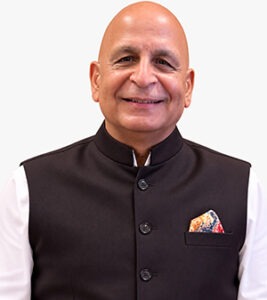
Rajpal Tyagi is Partner and Managing Director of M/s International Interiors, and a respected member of the Indian business community. A longstanding professional with extensive experience in the interiors and business sector, he has contributed significantly to strengthening India’s presence and engagement overseas. In recognition of his distinguished contribution to the Indian diaspora and his achievements, he was honoured with the prestigious Pravasi Bharatiya Samman Award in 2019 by the Government of India, one of the highest honours conferred on overseas Indians.