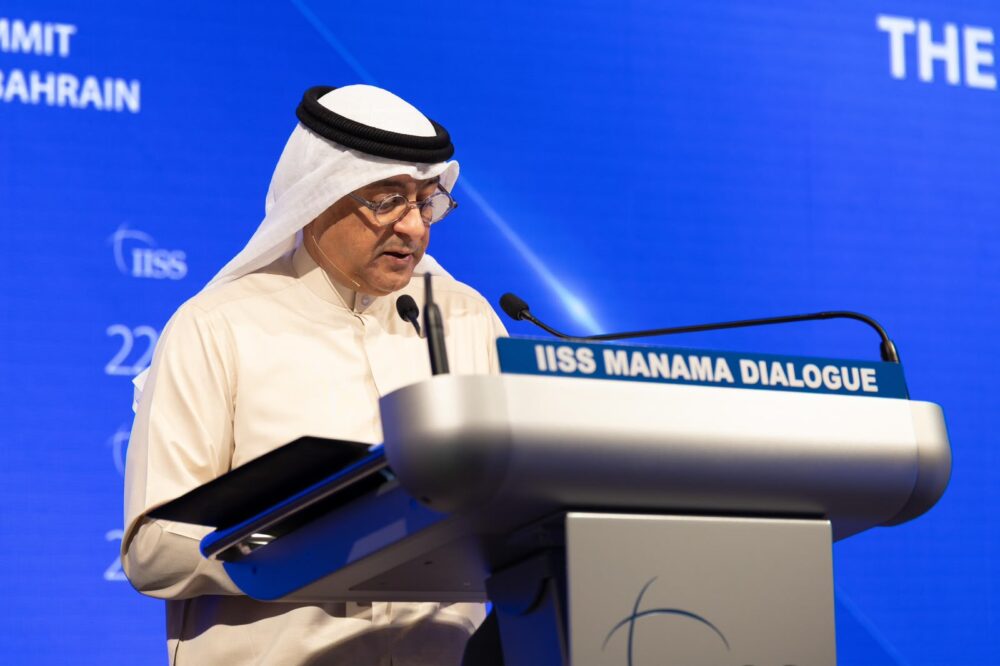
Gulf Cooperation Council (GCC) Secretary-General Jasem Al-Budaiwi has stressed that establishing a stable and sustainable regional security framework requires strict adherence to international law, respect for state sovereignty and stronger collective defence capabilities.
Addressing the third plenary session, titled “Pillars of Regional Security,” at the 22nd Regional Security Summit (IISS Manama Dialogue 2026) on Saturday, Al-Budaiwi said GCC security was indivisible and that stability in the Arabian Gulf remained a fundamental pillar of international peace. He thanked Bahrain for hosting the annual forum and the International Institute for Strategic Studies (IISS) for organizing the summit amid exceptional regional challenges.
Al-Budaiwi said the foundations of regional security had been seriously tested by Iranian attacks targeting GCC countries and vital civilian infrastructure. He noted that Gulf states had exercised maximum diplomatic restraint despite not being parties to the conflict, while disruptions to navigation through the Strait of Hormuz had affected global energy prices, shipping operations and international supply chains.
He also condemned repeated attacks by Yemen’s Houthi militia against Saudi Arabia, particularly strikes reaching Makkah and Madinah, describing them as unacceptable violations involving the Islamic holy cities and a dangerous escalation.
Outlining five essential pillars for a sustainable regional security framework, Al-Budaiwi identified respect for international law, state sovereignty and territorial integrity, non-interference in internal affairs, rejection of the use of force and peaceful settlement of disputes as fundamental principles. He cited UN Security Council Resolution 2817, introduced by Bahrain on behalf of GCC countries and Jordan and co-sponsored by 136 nations, stressing the importance of its full implementation.
The second pillar, he said, was strengthening collective defence and military integration among GCC states. He praised the readiness of Gulf armed forces and referred to directives issued at the 19th Consultative Summit in Jeddah to accelerate the establishment of a joint ballistic missile early-warning system.
He identified strategic diplomacy as the third pillar, emphasizing the importance of leveraging GCC partnerships with the United States, Europe, China, India and regional neighbours to bridge differences, promote dialogue and ease tensions through political cooperation.
The fourth pillar concerned protecting maritime navigation and uninterrupted energy supplies as a shared international responsibility under the 1982 United Nations Convention on the Law of the Sea. Al-Budaiwi stressed that closing the Strait of Hormuz or Bab el-Mandeb would constitute a violation of international law.
The fifth pillar, he said, was promoting regional stability through economic development and international partnerships. He noted that the GCC’s combined economic base of $4.2 trillion provided the region with greater resilience in facing crises and security challenges.
Concluding his address, Al-Budaiwi reaffirmed the GCC’s support for Yemen’s legitimate government and efforts to strengthen stability in Iraq, Syria and Lebanon. He also reiterated the Council’s commitment to a just two-state solution to the Palestinian issue.
Source: KUNA