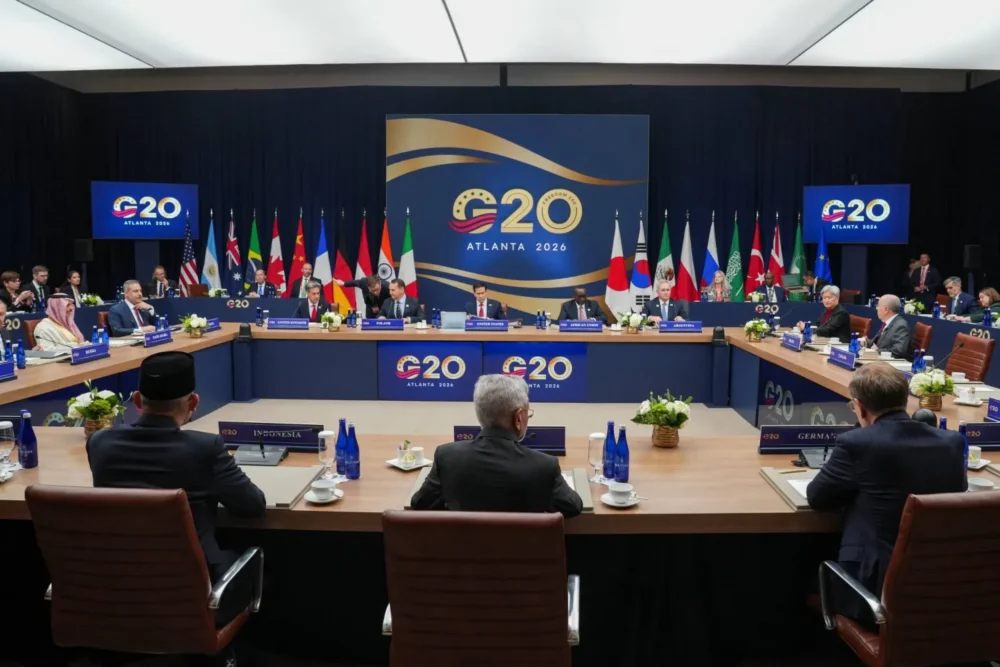
Foreign ministers of the Group of Twenty (G20) concluded two days of talks in Atlanta, Georgia, on Saturday without reaching consensus on a joint declaration, as deep divisions over major international security and geopolitical issues, particularly Russia’s war in Ukraine and Middle East tensions, overshadowed the meeting.
Instead, the United States, which holds the G20 presidency, relied on a chairman’s statement summarizing the discussions, reflecting persistent differences among member states. The meetings were chaired by US Secretary of State Marco Rubio, who had called for unity at the opening session despite the challenging international environment, according to news agencies.
According to the US Department of State, discussions focused on key economic priorities, energy security, supply chain resilience and escalating geopolitical tensions. Particular attention was given to threats to freedom of navigation and maritime stability, including developments in the Strait of Hormuz, the Bab el-Mandeb Strait, the Red Sea, the Black Sea and the South China Sea.
Participants stressed the importance of maintaining secure and uninterrupted global energy supplies, protecting commercial shipping through international waterways and safeguarding critical energy infrastructure.
However, disagreements over the Russia-Ukraine conflict, the US-Israeli war against Iran, US tariffs and China’s activities in the South China Sea prevented the ministers from agreeing on a common position. These tensions have also contributed to uncertainty in global energy markets and international trade.
The divisions were evident even before the formal discussions began. Rubio cancelled the traditional group photograph of foreign ministers on Friday after European diplomats objected to the presence of Russian Foreign Minister Sergey Lavrov and threatened to boycott or walk out of the photo session, according to The Associated Press.
Polish Foreign Minister Radosław Sikorski, attending a G20 ministerial meeting for the first time as a guest, said he was not surprised by the failure to reach consensus, noting that the presence of countries involved in ongoing wars made it difficult to agree on a common position.
Diplomats familiar with the closed-door discussions said participants had nevertheless agreed to work towards overcoming their differences and ensuring the success of the G20 leaders’ summit scheduled to be hosted by US President Donald Trump in Florida in December. They added that the absence of a joint communique had been anticipated given the deep disagreements among members.
Russia’s participation remained a major source of friction, with several G20 countries questioning its invitation amid intensified attacks on Ukraine. The issue was further complicated by Washington’s recent decisions concerning military and intelligence assistance to Kyiv and its approach towards sanctions on Moscow. However, the US State Department announced on Friday that it had approved a proposed $2.1 billion sale of Patriot air defence interceptors for Ukraine.
Lavrov, meanwhile, maintained Moscow’s position on the conflict, saying Russia would not accept a situation in which Ukraine posed a military threat to what he described as the Russian Federation’s legitimate security interests.
Middle East security also featured prominently in the discussions, particularly concerns over freedom of navigation and the potential impact of renewed military escalation involving Iran. Rubio held separate meetings on the sidelines with Saudi Foreign Minister Prince Faisal bin Farhan and Turkish Foreign Minister Hakan Fidan, whose country has played a mediation role in regional diplomacy.
The prospect of renewed US military action against Iran added to concerns over regional stability. According to reports by The Associated Press, US officials had urged several Middle Eastern countries and regional allies to prepare for the possibility of further military strikes against Iran after the US midterm elections, as well as potential Iranian retaliation.
Despite the absence of agreement on several major geopolitical questions, the discussions underscored shared concerns over maritime security, energy supply stability and the protection of international trade routes, issues with significant implications for the global economy.