- From easier food exports to student exchanges and work opportunities for young people, the agreements seek to restore practical benefits of cooperation without reversing Britain’s departure from the EU.
- The United Kingdom and the European Union have agreed on a series of landmark measures to strengthen trade, expand opportunities for young people and rebuild relations a decade after Britain voted to leave the bloc.
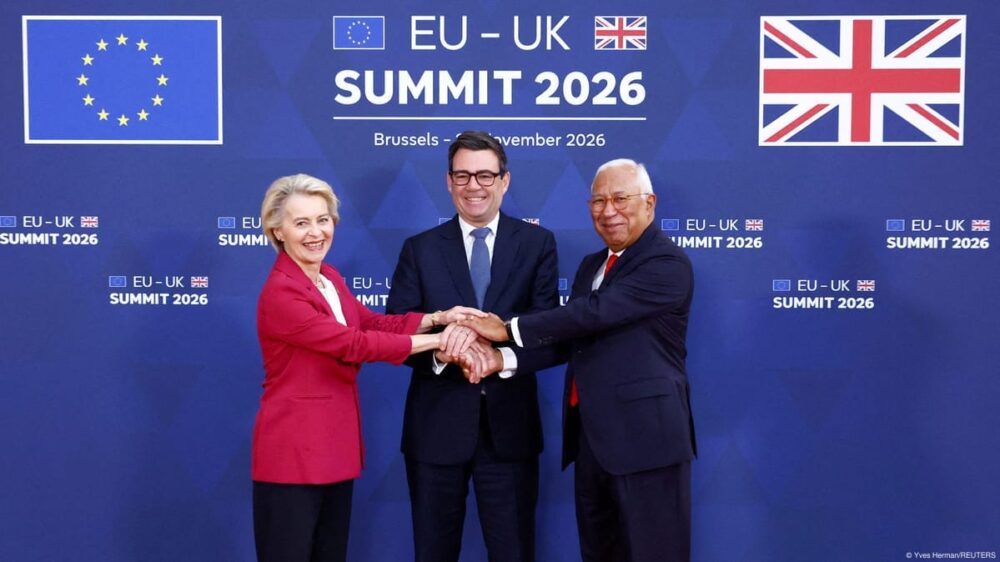
The agreements, announced at a summit in Brussels on Friday, cover food trade, carbon emissions and youth mobility, marking a significant step towards closer cooperation between the two sides while maintaining Britain’s position outside the European Union.
British Prime Minister Andy Burnham described the agreement as a landmark achievement, saying it would create new opportunities, particularly for younger generations.
European Commission President Ursula von der Leyen called it a turning point in EU-UK relations, while European Council President Antonio Costa said the bloc respected Britain’s decision to leave and its subsequent choice to pursue closer ties.
One of the most significant elements is a proposed youth experience scheme that would allow up to 100,000 people under the age of 30 from each side to live in the other’s territory for up to three years for work, study or travel, without being subject to existing visa requirements. The arrangement is expected to restore some of the opportunities for cross-border experiences that young people lost following Brexit.
The UK will also rejoin the European Union’s Erasmus+ programme, reopening opportunities for British students to participate in educational exchanges and mobility schemes across Europe. Von der Leyen welcomed Britain’s return, saying the bloc had missed its participation.
However, the two sides have yet to reach agreement on university tuition fees for EU students studying in Britain. The European Union has called for these students to pay the same tuition rates as British students, but the issue remains unresolved. Burnham said further discussions would take place, while von der Leyen expressed confidence that a solution could be reached in the coming month.
On trade, the agreement seeks to simplify the movement of food and animal products by removing certificates and border checks that have complicated post-Brexit exports. In return, Britain will align more closely with EU food safety and animal health regulations, reducing administrative burdens for businesses and easing trade between the two markets.
The two sides also agreed to link their emissions-trading systems, enabling mutual recognition of carbon allowances and exempting traded goods from carbon border taxes. The arrangement is expected to support industrial trade, reduce costs for exporters and encourage investment in cleaner industries.
London estimates that the agreement could generate an additional £3.8 billion annually for the British economy and exempt £6.5 billion worth of steel, aluminium and other industrial exports from additional taxation.
Beyond trade and mobility, the UK and EU agreed to establish a structured dialogue on migration, including cooperation with third countries and arrangements for returns. They will also begin formal discussions on economic security, with greater coordination on export controls and supply chains.
Burnham said the agreements represented the maximum progress Britain could achieve under the current Parliament, given the work required to implement them. He nevertheless stressed the importance of closer European cooperation, arguing that Britain and Europe shared common values and interests and were stronger together in an increasingly uncertain world.
The agreements come amid growing debate in Britain over the consequences of Brexit. Recent YouGov polling showed that 60 percent of respondents believed the decision to leave the EU had been wrong, reflecting sustained public dissatisfaction with the outcome of the 2016 referendum.
While the new arrangements do not reverse Brexit or restore Britain’s EU membership, they mark an effort by both sides to rebuild practical cooperation and recover some of the economic, educational and mobility opportunities disrupted by the separation.