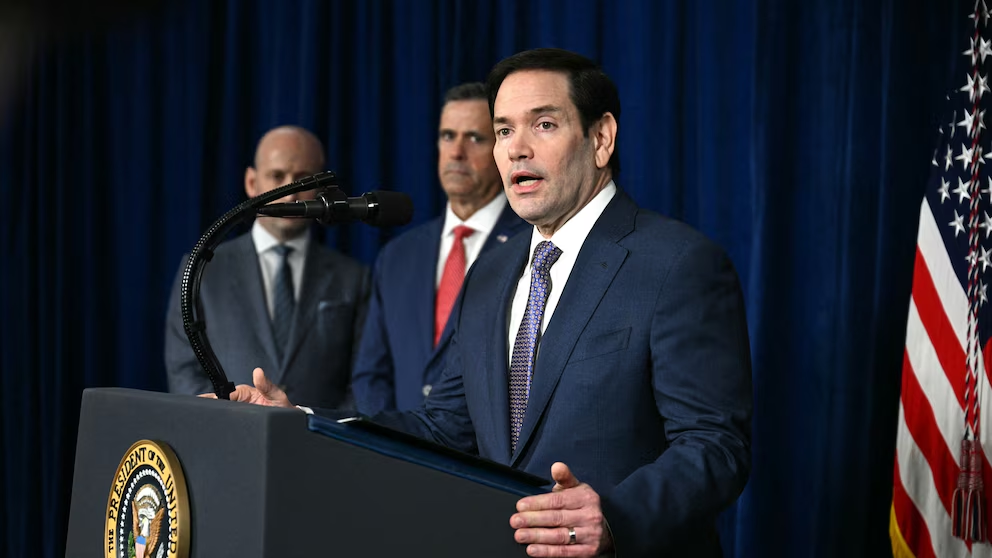
- US Secretary of State Marco Rubio said President Donald Trump’s decision to suspend sanctions and tariffs targeting Russia would provide a 60-day period to assess their potential impact on the global and US economies, amid mounting criticism in Washington and concern in Ukraine that the move could ease economic pressure on Moscow.
Rubio said Saturday that the temporary pause would allow the administration to evaluate the broader consequences of imposing economic restrictions that extend beyond Russia and affect multiple countries. He pointed to the interaction of international conflicts, including the US war on Iran and Houthi attacks on Saudi Arabia, as factors contributing to volatility in global energy markets and increasing pressure on national economies.
“These conflicts around the world are starting to crash into each other,” Rubio said, noting that their consequences were being felt not only in global oil and diesel prices but also across wider economic activity. Trump said his decision would benefit the United States, describing it as a move he believed would be good for the country and the world. However, questions remained over the administration’s longer-term approach to the restrictions, according to news agencies.
The decision has drawn criticism from lawmakers in both parties after Trump signed an executive order on Friday exempting Russia from sweeping sanctions and tariffs adopted by Congress in September. The legislation targeted Russian officials, oligarchs and financial institutions and authorised sanctions against major purchasers of Russian oil and gas, with the aim of restricting revenue streams supporting Russian President Vladimir Putin and Moscow’s war in Ukraine.
Trump’s waiver came shortly before the measures were due to take effect and followed an agreement with Putin allowing Russian diesel exports in exchange for easing sanctions. The administration’s move comes as higher diesel prices linked to the conflict involving Iran begin to affect the US economy, adding to concerns about living costs ahead of next month’s midterm elections.
Diesel is a critical fuel for road transport, agriculture and construction, making its price a significant factor in operating costs and broader economic activity. Rubio argued that Russian diesel would reach global markets regardless, with the key question being how much of the supply would be available to the United States. The administration has presented the issue in the context of energy availability and domestic economic pressures.
The decision, however, has exposed divisions within the Republican Party. Senator Thom Tillis criticised the move as “beyond irresponsible”, arguing that addressing the conflict involving Iran would be a more appropriate way to ease energy prices. Senator Ted Cruz also described the decision as a mistake in comments aired on Fox News. Ukraine has expressed concern that the waiver could signal a broader easing of pressure on Moscow. President Volodymyr Zelensky warned that Washington might lift additional restrictions on Russia and argued that the decision rewards Putin.
The 60-day review places the administration’s Russia policy at the intersection of energy security, economic pressures and the continuing war in Ukraine. Its outcome will help clarify whether the pause remains a limited reassessment of the restrictions or signals a wider change in Washington’s approach to economic pressure on Moscow.