Kuwait marks World Humanitarian Day with sustained global relief efforts
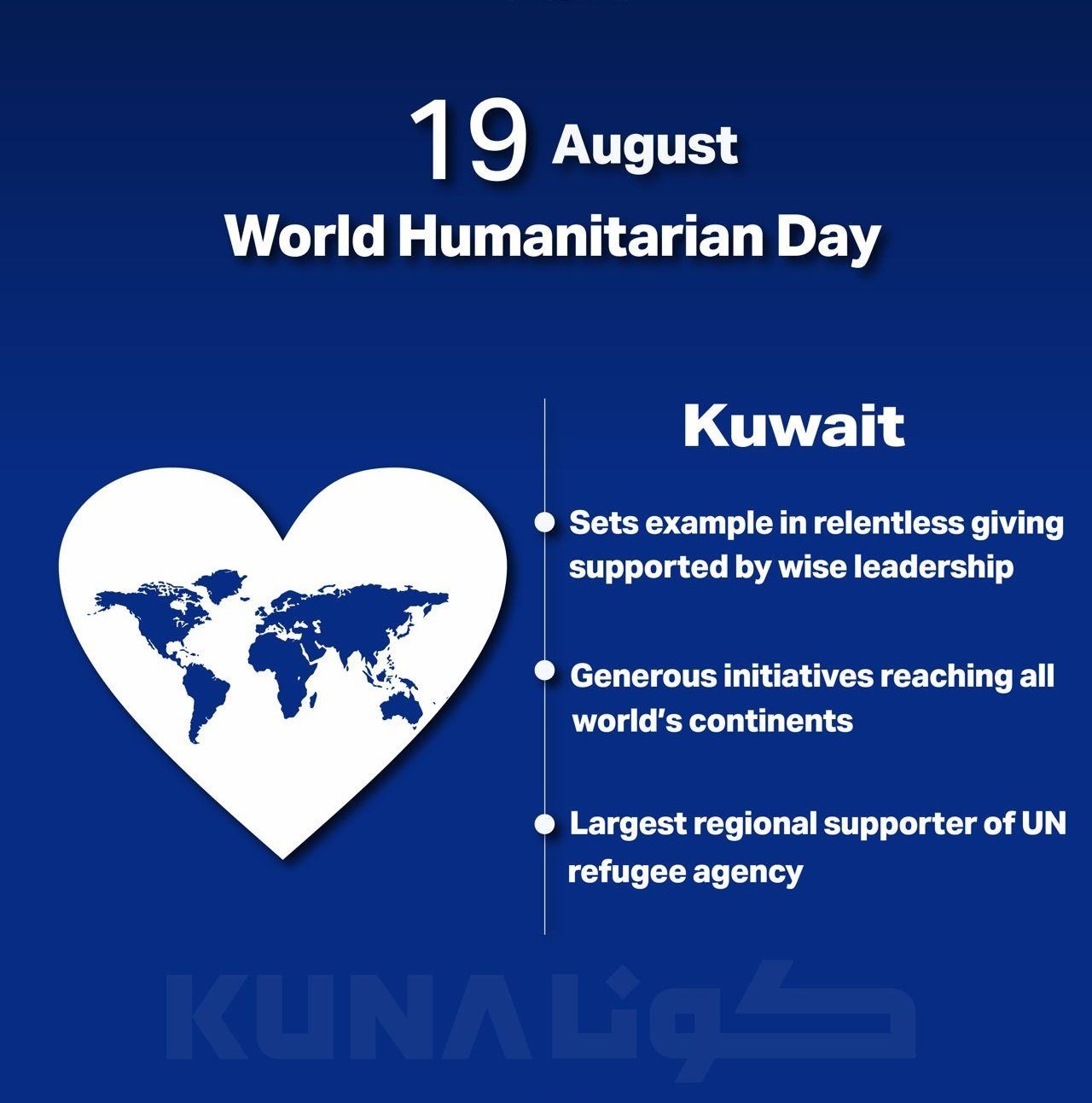
Kuwait joins countries around the world on Wednesday in marking World Humanitarian Day, observed annually on August 19, reaffirming its support for people affected by conflicts, disasters and humanitarian crises and its commitment to providing assistance to those in need.
The 2026 campaign, led by the United Nations Office for the Coordination of Humanitarian Affairs (OCHA), carries the message, “The time for concern is over. The time for consequence is now,” highlighting the need to honor humanitarian workers and support communities affected by crises worldwide.
The campaign emphasizes respect and protection for civilians, humanitarian and medical personnel, as well as the need to ensure safe, rapid and unhindered humanitarian access to those in need in accordance with international humanitarian law.
Kuwait has, over decades, provided substantial humanitarian assistance to countries affected by conflicts, disasters and crises through government institutions and civil society organizations, while also hosting international conferences and initiatives focused on reconstruction and humanitarian aid.
In May 2024, His Highness the Amir Sheikh Meshal Al-Ahmad Al-Jaber Al-Sabah reaffirmed Kuwait’s commitment to its longstanding approach of supporting international humanitarian efforts during a meeting with UN Secretary-General Antonio Guterres, who praised Kuwait’s pioneering initiatives in the field.
Kuwait’s humanitarian role was also formally recognized by the United Nations in 2014, when the late Amir Sheikh Sabah Al-Ahmad Al-Jaber Al-Sabah was honored as a “Humanitarian Leader” and Kuwait was recognized as a Humanitarian Center at a ceremony held at UN Headquarters.
Kuwait’s humanitarian assistance is delivered through government institutions, public-benefit organizations and other partners, including the Kuwait Fund for Arab Economic Development (KFAED), Kuwait Society for Relief, Kuwait Red Crescent Society and Kuwait Patients Helping Fund Society.
In recent months, KFAED has signed several agreements and memoranda of understanding to provide grants and assistance. These include a $2.5 million grant to the World Health Organization to support polio vaccination campaigns in Gaza, Lebanon, Syria, Iraq and Jordan; a $1 million grant to the Islamic Development Bank for a technical education and training institute in Yemen; and a $3 million grant to the United Nations Development Programme to support a solar-energy project aimed at strengthening public services in Lebanon.
The Kuwait Patients Helping Fund Society, in partnership with UNICEF, established a model health centre to serve people displaced from Al-Fashir in western Sudan. Meanwhile, the Kuwait Red Crescent Society, in cooperation with the Ministries of Foreign Affairs and Defense, sent a relief aircraft to Lebanon carrying 40 tons of assorted supplies.
The Kuwait Red Crescent Society, Sheikh Abdullah Al-Nouri Charity Society and Direct Aid Society also signed a cooperation agreement with the UNDP to support emergency access to clean drinking water for affected and displaced communities in Gaza.
Rahma Global Society signed an agreement with UNHCR to provide essential relief supplies to about 428 Sudanese refugee families in Chad, while Nama Charity Society launched sustainable water projects in six countries expected to benefit more than 500,000 people, particularly in Gaza, Yemen and Sudanese refugee camps in Chad.
Kuwait’s humanitarian efforts have also included domestic initiatives. In March 2026, the Ministry of Justice concluded a donation campaign to settle the debts of indebted citizens, raising 16,539,585 dinars from 138,328 donors, according to the report.
Late last month, the Cabinet approved a draft decree-law to introduce legislation regulating charitable and humanitarian work, with the aim of unifying and organizing charitable and humanitarian activities in Kuwait under a modern legal framework.
Kuwait continues to place humanitarian action among its priorities through sustained support for the United Nations and its specialized agencies, reaffirming its role in international relief and humanitarian efforts.
— KUNA