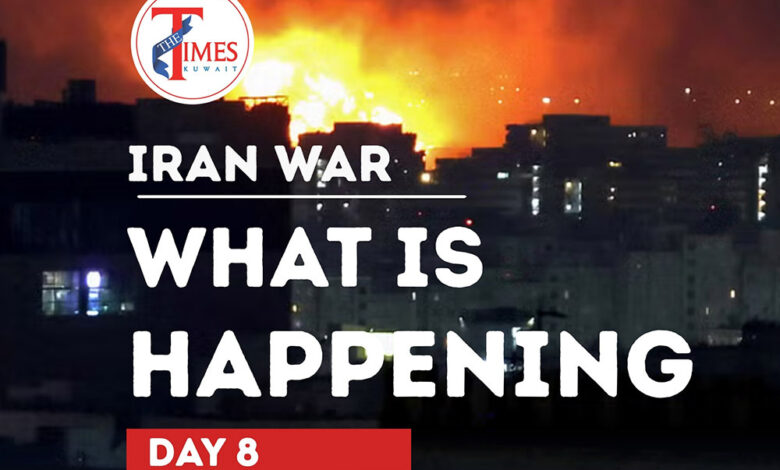
The war between the United States, Israel and Iran has now entered its eighth day, with fighting expanding across multiple fronts in the Middle East and continuing missile and drone exchanges across the region. Fresh air strikes hit Iran overnight, while Iran and allied groups launched new attacks across Israel and Gulf countries.
At least 1,332 people have been reported killed in Iran since the United States and Israel launched their military campaign on February 28. The conflict is widening regionally, with missile threats across the Gulf, clashes in Lebanon, and diplomatic tensions involving Europe and Russia.
In Iran
Intensifying air campaign
The US and Israeli militaries say they have struck more than 3,000–3,400 targets across Iran since the war began.
Around 7,500 munitions have been dropped, targeting missile launch sites, command centres, and infrastructure linked to Iran’s military and the Islamic Revolutionary Guard Corps (IRGC).
Overnight, more than 80 Israeli fighter jets carried out a new wave of strikes on Tehran and central Iran.
Tehran and key facilities hit
Explosions were reported across multiple neighbourhoods of Tehran, including near military installations.
Mehrabad Airport, one of Tehran’s main airports, was reportedly targeted, with fires seen near parts of the facility.
Iranian officials say residential areas, hospitals and schools have also been damaged in the bombing.
Rising casualties
Iranian authorities say at least 1,332 people have been killed in the attacks, including civilians.
Thousands more have reportedly been injured as infrastructure and government facilities continue to be struck.
US demands “unconditional surrender”
US President Donald Trump has insisted that any negotiations with Iran would require “unconditional surrender.”
Iran’s interim leadership rejected the demand, saying the country “will never surrender.”
Iranian response and strategy
Iran continues to launch ballistic missiles, drones, and possibly cluster-type munitions at Israel and US-allied targets.
Analysts say the strategy appears aimed at:
overwhelming air defences, stretching interceptor supplies, expanding the conflict regionally.
Russia’s involvement
Russia’s president spoke with Iran’s leadership, offering condolences for the casualties and discussing developments.
US officials say Russia may be sharing intelligence about US military positions with Iran.
Iran apologises to neighbours
Iran’s president Masoud Pezeshkian apologised to neighbouring countries for missile attacks across the region, saying Iran would avoid striking neighbours unless attacks originate from their territory.
In Gulf nations
Missiles and drones across the region
Countries hosting US bases have reported incoming missiles and drones.
Qatar: Air defence systems intercepted nine out of ten Iranian drones.
United Arab Emirates: UAE air defences intercepted 15 ballistic missiles and 119 drones in a single day. Since the war began, the UAE says it has detected 221 ballistic missiles and over 1,300 drones, most of which were intercepted. A Pakistani driver was killed in Dubai after debris from an air-defence interception fell onto his vehicle amid the ongoing regional conflict.
Emirates flights experienced delays and disruptions today as the ongoing regional conflict continued to affect airspace across the Middle East. Operations at Dubai International Airport remain limited, with overall traffic running at around 25% of normal levels as airlines gradually resume flights.
Saudi Arabia: Saudi authorities said they intercepted drones near Riyadh and around strategic facilities.
Kuwait: Kuwait has reportedly begun cutting production at some oil fields after storage facilities filled up due to disruptions in exports.
-
Bomb squad operations: Specialized explosive disposal teams have responded to 229 reports across Kuwait so far.
-
Missile interceptions: Kuwait’s air-defence systems have dealt with 14 ballistic missiles in the last 48 hours.
-
Drone threats: The Kuwait Armed Forces announced that their air-defense systems successfully intercepted seven hostile drones that entered the country’s airspace.
-
Security response: The Ministry of Interior continues to coordinate with the military and other security agencies to monitor threats and secure key sites.
-
Air travel update: Jazeera Airways is preparing to resume flights.
-
Regional connectivity: The airline plans to reconnect Kuwait with GCC destinations, as regional airspace conditions gradually stabilize.
-
Operational planning: Flight schedules will depend on airspace safety approvals and regional security assessments.
In Israel: Continued Iranian strikes. Iran is still launching missiles and drones toward Israeli cities, triggering air-raid sirens across: Tel Aviv, northern Israel, areas near Beersheba in the Negev desert.
Air defence pressure
Military analysts say Iran is attempting to: exhaust Israel’s interceptor missiles, overwhelm systems such as Iron Dome and Arrow through repeated waves of attacks.
Hezbollah joins fighting
Hezbollah fighters have fired rockets toward northern Israel. Clashes were reported between Hezbollah and Israeli forces in the Bekaa Valley in eastern Lebanon.
Accusations at the UN
Iran’s ambassador to the United Nations accused the US and Israel of war crimes and crimes against humanity, saying they recognise “no red line.”
In Lebanon and Iraq
Israeli strikes in Lebanon, Israeli air strikes have hit southern and eastern Lebanon. Lebanon’s health ministry says at least 217 people have been killed since the escalation began.
Displacement crisis
Thousands have fled areas including: Tyre, Beirut’s southern suburbs, Schools and public buildings in Beirut are now being used as shelters.
Drone attack in Iraq
A drone struck the Erbil Arjaan by Rotana hotel in Iraqi Kurdistan, after warnings that Iran-aligned militias could target locations used by foreigners.
In the United States
War timeline unclear, The White House says the campaign could last four to six weeks, though the Pentagon has not confirmed a timeline.
Massive cost of the war
The first 100 hours of “Operation Epic Fury” cost about $3.7 billion, or roughly $891 million per day.
Weapons production surge
Trump says US defence manufacturers will quadruple weapons production to sustain the war effort.
New arms for Israel
The US has approved $151.8 million in additional munitions for Israel, bypassing normal congressional review because of the conflict.
Intelligence assessment
A classified US intelligence report says even a major military campaign is unlikely to topple Iran’s leadership, which has strong institutional continuity.
Military deployments expanding
The United States is reinforcing forces across the region. A B-1 strategic bomber has arrived at a US-allied airbase in the United Kingdom. The United Kingdom has pledged fighter jets, helicopters and a destroyer to help defend Saudi Arabia if needed. Additional Typhoon jets are being deployed to Qatar for air patrols.
Aviation and evacuation
Regional airspace closures continue to disrupt travel: Qatar’s Hamad International Airport is reopening limited routes using emergency air corridors. Qatar Airways announced repatriation flights to: London, Paris, Madrid, Rome & Frankfurt
Several airlines have suspended flights to countries across the conflict zone until late March.
One week since the war began
Key figures since February 28:
- 1,332+ killed in Iran
- 200+ killed in Lebanon
- 11 killed in Israel
- 6 US servicemen killed in Kuwait 2 Army Soldiers and One Girl Child
- 330,000 people displaced across the region
- The conflict has also triggered a major energy shock, with oil prices rising as shipping disruptions threaten the Strait of Hormuz, through which about 20 % of global oil supply passes.
Overall situation:
The war has now spread across Iran, Israel, Lebanon, Iraq and multiple Gulf states, with increasing involvement from global powers and growing fears that the conflict could evolve into a wider regional war.
With inputs from The Indian Expressm Gulf News, Business Standard, Al Jazeera and The Washington Post