- India’s strategic international engagements strengthened trade resilience.
- Landmark agreements such as the India–UK CETA, India–Oman CEPA, and India–EFTA TEPA have diversified market access, reduced customs duties, and facilitated collaboration in sectors including renewable energy, AI, ICT, and EVs.
- Partnerships with ASEAN nations like the Philippines and Thailand have deepened regional integration and created new export opportunities.
- Digital transformation initiatives, including Trade eConnect and the Trade Intelligence & Analytics (TIA) portal, have enhanced trade facilitation and data-driven insights.
- India’s ability to absorb global trade shocks and sustain export growth highlights the importance of market diversification, consistent government support, and strong bilateral and multilateral cooperation in achieving economic resilience and growth.
In recent months, the global economy has witnessed the widespread use of tariffs as “extra-economic” tools aimed at pressuring nations pursuing economic sovereignty.
While trade tariffs traditionally serve domestic purposes — protecting nascent industries, raising revenue, or securing favorable trade deals — many nations, notably the U.S., have increasingly used them for diplomatic leverage.
The U.S. tariff impositions on goods from numerous countries illustrate this misuse, straining relations with allies and disrupting global trade.
Despite such challenges, India’s 2025 trade performance demonstrates remarkable resilience. Export promotion reforms, digital transformations, bilateral and regional trade agreements, and overall trade facilitation have helped India achieve unprecedented growth.
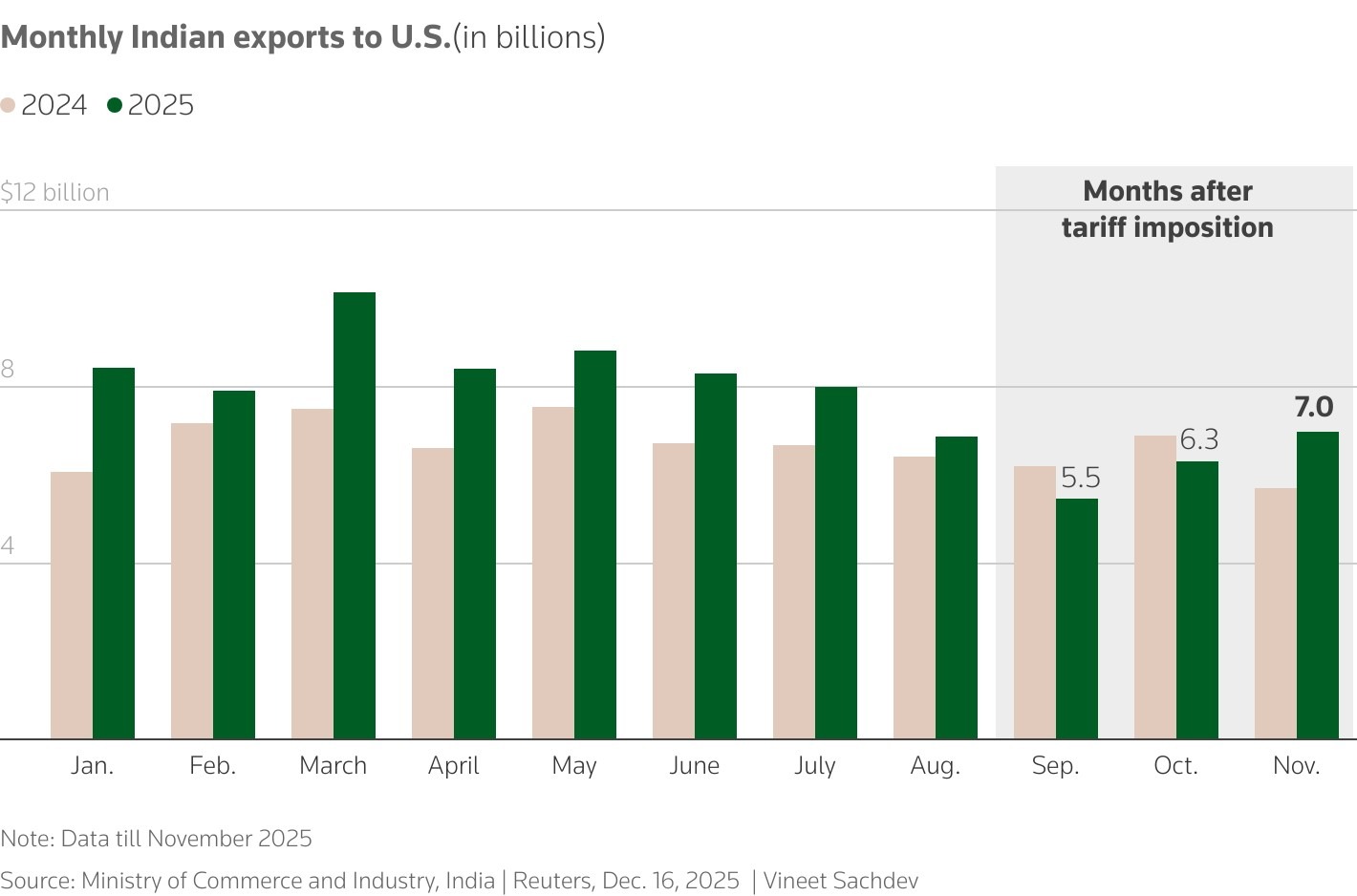
Total merchandise and services exports reached US $825.25 billion in 2024 25, growing 6.05 percent year-on-year. In the first half of FY 2025 26 (April–September 2025), exports rose to US $418.91 billion, marking a record high for any half-year period with a 5.86 percent increase.
Key sectors driving growth include electronics, engineering goods, pharmaceuticals, marine products, and rice, with major export destinations spanning the UAE, China, Spain, and Hong Kong.
Non-petroleum exports alone reached a historic US $374.32 billion, up 6.07 percent. Domestic initiatives, such as the Export Promotion Mission (EPM), provided financial and non-financial support, including credit guarantees, trade finance, compliance assistance, and international branding.
India’s strategic international engagements further strengthened trade resilience. Landmark agreements such as the India–UK CETA, India–Oman CEPA, and India–EFTA TEPA have diversified market access, reduced customs duties, and facilitated collaboration in sectors including renewable energy, AI, ICT, and EVs.
Partnerships with ASEAN nations like the Philippines and Thailand have deepened regional integration and created new export opportunities.
Digital transformation initiatives, including Trade eConnect and the Trade Intelligence & Analytics (TIA) portal, have enhanced trade facilitation and data-driven insights.
Consequently, India’s trade resilience lessens the strategic need for a dedicated India U.S. trade deal, as the country has diversified markets, upgraded its export basket with manufacturing and technology-intensive goods, and expanded high-value global linkages.
In summary, India’s ability to absorb global trade shocks and sustain export growth highlights the importance of market diversification, consistent government support, and strong bilateral and multilateral cooperation in achieving economic resilience and growth.