New Personal Status Law Must Balance Tradition with Women’s Rights and Social Change
Modernising Personal Status Law While Preserving Justice, Islamic Principles and Women’s Rights

By Bibi Ahmad Alsunni
Special to The Times Kuwait
The family in today’s society is no longer the same as the family known to previous generations. Kuwaiti society has undergone significant social, cultural, economic, and educational transformations. Women have become active partners in shaping society, with an increasingly prominent presence in the fields of employment, education, scientific research, and leadership. Their role is no longer confined to traditional social expectations.
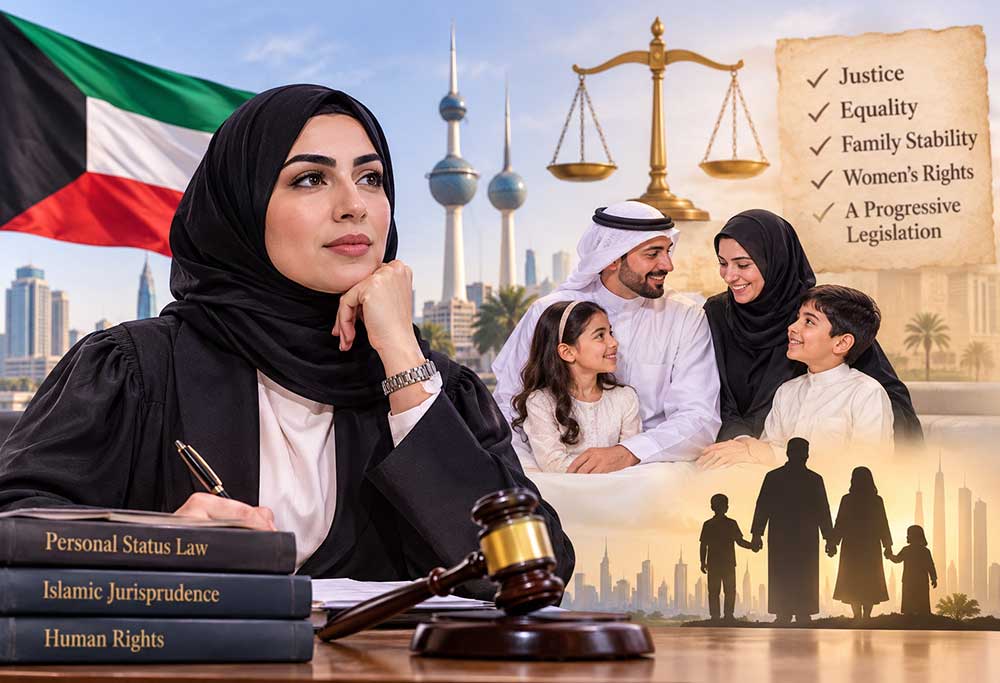
Accordingly, any review of the Personal Status Law must begin with a fundamental recognition: legislation is not a rigid set of provisions detached from society’s reality. Rather, it is an instrument designed to regulate relationships, protect rights, and achieve justice. The success of any legislative reform should therefore be measured by its ability to respond to social developments and address contemporary challenges.
The discussion surrounding the proposed new Personal Status Law raises an important legal question: to what extent do the proposed provisions reflect the transformations taking place within society, and do they genuinely achieve a balance between the rights and obligations of spouses?
It is difficult to speak of legislative development while certain approaches remain rooted in traditional social roles that may no longer reflect the realities of modern family life or recognise the educational, professional, and economic independence women have achieved.
Women today are not on the margins of family or social development; they are essential participants in both. It is therefore inconsistent for society to advance across different fields while certain legislative approaches remain confined to perceptions that no longer adequately reflect contemporary life.
One of the most important issues requiring careful consideration concerns the regulation of marital rights and obligations. Marriage should not become a relationship based on the exercise of authority or the restriction of either spouse’s freedom.
Rather, it should be founded on affection, mercy, cooperation, and shared responsibility. Marriage is both a legal and human relationship, not a relationship of subordination. The regulation of family obligations must never be interpreted in a manner that undermines human dignity or the independent legal personality of women.
In this context, it is essential to recognise that Islam historically affirmed the status and dignity of women. It recognised their independent financial capacity, their right to own and dispose of property, and their rights concerning marriage, dowry, and inheritance.
It also established affection, mercy, and good treatment as fundamental principles governing marital relationships. The Holy Qur’an states: “And women shall have rights similar to those exercised against them, according to what is fair” (Al-Baqarah, 2:228), and “And live with them in kindness” (An-Nisa, 4:19).
Accordingly, reliance on Islamic Sharia in developing Personal Status legislation should be guided by its fundamental objectives: justice, mercy, the prevention of harm, and the preservation of human dignity. These principles should not be reduced to isolated interpretations or provisions detached from their broader purposes and context. The dignity of women is not a concept introduced by modern international conventions or recent social developments; it is an established principle within Islamic teachings.
With regard to child custody, the governing standard should be the best interests of the child, rather than the mere attainment of a specific age or the mechanical application of a predetermined order without considering the child’s individual circumstances and psychological, social, and educational needs. A child should never be treated as an object of dispute between parents, but rather as an independent rights-holder whose interests require legal and judicial protection.
Meaningful legislative reform also requires consideration of social and psychological research, alongside consultation with legal professionals, judges, academics, and specialists in family studies. Addressing contemporary family issues through a purely traditional perspective, without considering their broader implications, may result in legislation that fails to respond adequately to present-day realities.
It is equally important to emphasise that advocating for the development of women’s legal rights does not mean promoting one social model at the expense of another, nor does it seek to weaken the family institution or diminish the importance of marriage. Rather, it recognises that family stability cannot be achieved at the expense of the dignity of any of its members. Protecting the family must begin with protecting the rights of everyone within it.
The younger generation today differs from previous generations in terms of education, awareness, aspirations, and the nature of social relationships. Legislation that fails to recognise these transformations risks becoming inadequate in addressing the very realities it was designed to regulate.
In my view, what is required is not simply the introduction of a new law, but the development of a more responsive legislative philosophy: one that balances established religious principles with evolving social realities and preserves the identity of society without using that identity as a justification for restricting rights or overlooking the changing nature of modern life.
A successful law is neither one that takes society backwards under the pretext of preserving tradition, nor one that abandons its identity in the name of modernisation. Rather, it is one that combines the authenticity of principles, the fairness of legal provisions, and the ability to respond to the demands of the future.
Ultimately, family justice must remain the central objective. Women are not in opposition to men, the family is not in opposition to progress, and Islamic Sharia is not in opposition to women’s rights. The real challenge lies in developing legislation that recognises that justice is indivisible, and that human dignity and fundamental rights must remain present in every legal provision.
Bibi Ahmad Alsunni is Kuwaiti lawyer with a strong interest in legal affairs, social issues, and legislative development. My interests include criminal law, international law, aviation law, women’s rights, and human rights. She is passionate about legal research and exploring the relationship between law and contemporary societal challenges.