US, Denmark reach Greenland security deal after months of tensions

The United States and Denmark have reached a security agreement covering Greenland, easing a diplomatic dispute that escalated after US President Donald Trump repeatedly threatened to take control of the semi-autonomous Danish territory.
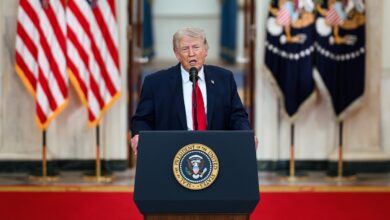
Trump said the agreement would give the United States “permanent control over security” and other security-related needs in Greenland. He said it would allow Washington to take whatever measures it considers necessary to protect the territory and US security, while adding that the deal would come at “no cost” to the United States.
The full text of the agreement has not yet been released, and its provisions have so far been outlined mainly by Trump and an unnamed US State Department official. The agreement is expected to be signed at the UN General Assembly next week, after which it will have to undergo the necessary parliamentary procedures before entering into force.
Danish Prime Minister Mette Frederiksen and Greenland Prime Minister Jens-Frederik Nielsen welcomed the agreement, saying it would strengthen security in the Arctic and North Atlantic while recognising the sovereignty and territorial integrity of the Kingdom of Denmark and the right of the Greenlandic people to self-determination.
According to the US State Department official, the agreement would remain in effect even if Greenland were to become independent in the future. The United States would also have unilateral authority to construct additional military facilities in Greenland without requiring approval from Greenland or Denmark.
The proposed arrangement would provide the US with permanent access, basing and overflight rights, according to the official. It would also prevent non-NATO countries from establishing military bases in Greenland and restrict investments by countries considered adversaries in sensitive sectors that could pose a threat to US security.
The official specifically cited Russia and China, saying the agreement would prevent them from deploying troops or making investments in sensitive areas of Greenland. The US argues that such restrictions are necessary because the current arrangements have allowed foreign investment in sensitive sectors without sufficient screening.
However, the precise difference between the proposed agreement and the existing 1951 US-Denmark defence agreement remains unclear because the new text has not been published. Under the 1951 arrangement, Washington already has extensive military rights in Greenland, including the ability to deploy troops there.
The United States currently maintains more than 100 military personnel at the Pituffik Space Base in northwestern Greenland. The strategically located territory is considered important to US defence planning because of its position between North America and Europe and its proximity to the Arctic.
Trump has argued that Greenland is essential to US national security and to his proposed “Golden Dome” missile-defence system, which is intended to protect the United States from potential missile attacks, particularly from Russia and China, the BBC reports.
The dispute intensified after Trump repeatedly discussed purchasing or annexing Greenland and refused to rule out military action to gain control of the territory. His comments triggered strong opposition in Denmark and concern among other NATO allies.
US Secretary of State Marco Rubio described the new arrangement as a “historic deal”, saying it would address US national security concerns in Greenland.
Beyond its strategic location, Greenland is also of growing economic importance because it possesses large, largely untapped deposits of rare-earth minerals and other resources used in technologies including mobile phones, electric vehicles and advanced defence systems.
For now, the agreement’s precise legal and practical implications remain uncertain because the official text has yet to be made public. The next major steps will be its expected signing at the UN General Assembly and subsequent parliamentary approval procedures in Denmark and Greenland.