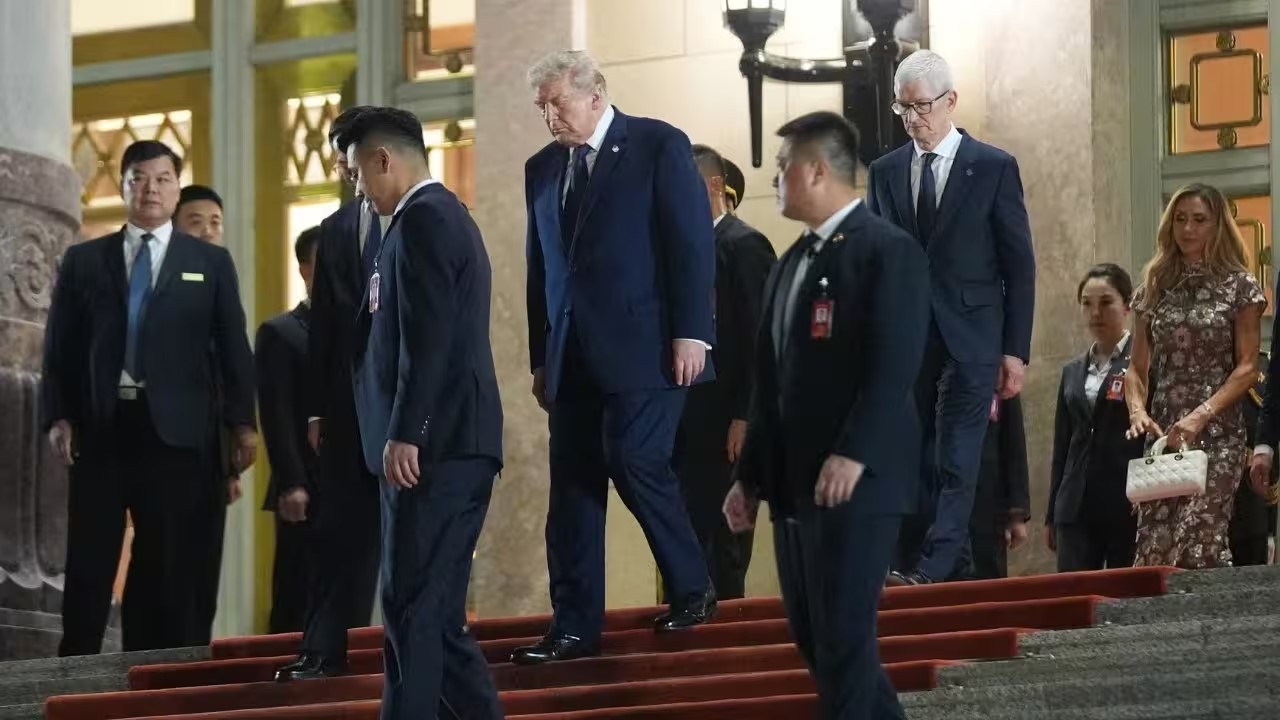
Following President Donald Trump’s official visit to China, the US delegation reportedly implemented unusually strict security procedures upon departure, amid heightened concerns over potential espionage and cyber intrusions.
According to journalist Emily Goodin, who accompanied the delegation, the security team carried out a comprehensive “security sweep” before members boarded Air Force One for the return journey.
The measures included confiscating all gifts and items received by officials during the visit, as well as collecting accreditation badges issued for access during the trip.
In addition, temporary mobile phones used by the delegation while in China were disposed of as part of the security protocol. Reports indicate that these items were discarded in designated waste containers at the base of the aircraft stairs prior to departure.
The precautions were reportedly taken due to concerns that devices or personal items could potentially be used for surveillance, tracking, or cyber intrusion.
The unusual steps highlight ongoing security sensitivities between Washington and Beijing, particularly amid long-standing allegations of cyber espionage, data breaches, and digital surveillance risks.
Cybersecurity experts note that high-level diplomatic missions often rely on temporary communication devices to reduce exposure to hacking risks, especially when visiting countries considered high-risk intelligence environments.
Such protocols typically include restricted device usage, controlled communication channels, and strict handling of any electronic equipment used during official engagements.
Experts further warn that even seemingly harmless souvenirs or accessories can, in rare cases, be modified to contain tracking components or malicious software.
As a result, security teams sometimes opt for extreme precautionary measures, particularly during visits involving senior government officials and sensitive geopolitical discussions.
The reported disposal of devices and materials reflects the broader security doctrine adopted by US protection services during foreign travel.
These measures are designed to minimize any possibility of data leakage or unauthorized surveillance after leaving high-risk jurisdictions.
While such protocols are not always publicly disclosed, they are widely understood to be part of standard operating procedures for top-level diplomatic missions.
The incident underscores the deepening technological and intelligence rivalry between the United States and China, where cybersecurity remains a central point of tension in bilateral relations.