
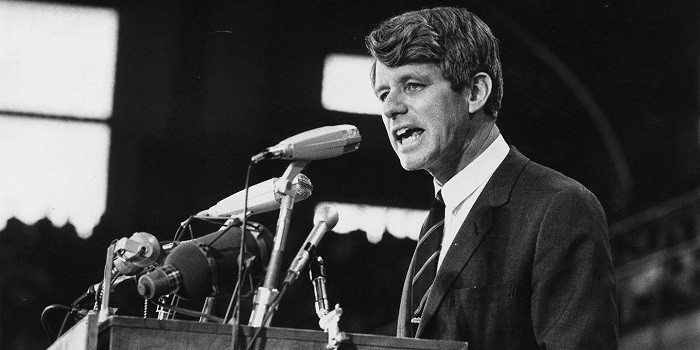
That March, US Senator Robert F. Kennedy, running for president, delivered his second campaign address. His words ring no less true today. “Even if we act to erase material poverty, there is another greater task,” he said to an overflow crowd at the University of Kansas’s Allen Fieldhouse. “It is to confront the poverty of satisfaction – purpose and dignity – that afflicts us all. Too much and for too long, we seemed to have surrendered personal excellence and community values in the mere accumulation of material things.”
Kennedy’s words still resonate. They revealed a simple truth that the COVID-19 pandemic also has laid bare: our emphasis on wealth and material culture at any cost reflects values that impede efforts to contain the virus’s spread.
The paradoxes are obvious. Americans are aghast at their country’s poor response to the pandemic. Yet we have spent decades underinvesting in public-health infrastructure and preparedness. Public health accounts for only 2.5% of US health-care spending. Novelist Arundhati Roy recently wondered whether there would be a shortage of equipment if the US required bombs, not masks. Her question is borne out by fully equipped militarized police units deployed on the streets of the same cities where nurses wore garbage bags as personal protective equipment. And the scientific expertise Americans need now more than ever is being politicized by those for whom the economy and partisanship comes first.
Kennedy would not have been surprised. In his Kansas speech, he lamented Americans’ cultural obsession with economic growth above all else. “Our Gross National Product … counts air pollution and cigarette advertising,” he said. “It counts the destruction of the redwood and the loss of our natural wonder in chaotic sprawl. It counts napalm and counts nuclear warheads and armored cars for the police to fight the riots in our cities.”
One reason Kennedy ran for president was his despair at the poverty and inequality he witnessed in the Mississippi Delta, Appalachia, and Bedford-Stuyvesant. Since then, the US has become even more unequal. Our reverence for GNP, without attention to how growth is distributed, has driven inequality to its highest levels in 50 years.
To those of us on the front lines of the fight against COVID-19, the effects are obvious: the indigent and people of color are shouldering a disproportionate burden of disease. Black Americans are dying at three times the rate of white Americans. Yet, in America, the irony is that the protest refrain “I can’t breathe” has nothing to do with COVID-19. Rather, it is the cry of an entire people suffocating under the collective knee of racism.
Kennedy’s cultural diagnosis remains accurate. By fixating on GNP, Americans have chosen a metric that “does not allow for the health of our children, the quality of their education, or the joy of their play,” much less “the beauty of our poetry or the strength of our marriages, the intelligence of our public debate or the integrity of our public officials.” Here was a metric, he continued, that “measures neither our wit nor our courage, neither our wisdom nor our learning, neither our compassion nor our devotion to our country” – a metric that “measures everything, in short, except that which makes life worthwhile.”
Within three months of Kennedy’s Kansas speech, both he and Martin Luther King, Jr., were assassinated. In August, confrontations between protesters and police marred the Democratic National Convention in Chicago. And today, more than 50 years later, the wrongs that Kennedy and King (who delivered one of his most memorable speeches – to the striking Memphis sanitation workers – the night before he was killed) sought to address remain a feature of American life.
Now, as then, the tenor of our current national conversation is a zero-sum game premised on a false dichotomy between public health and economic salvation, as if they weren’t two vital signs of the very same patient. Regarding COVID-19, we lack a broad consensus that public health and safety is the only path to a swift economic recovery. Regarding our culture, many Americans seem more concerned with the isolated looting of stores than with the centuries-long looting of Black America.
America’s pathology extends beyond biology. Healing beyond the virus requires a cultural reconstruction that addresses our priorities and the divisions among us. To echo Kennedy’s words, we must urgently rebuild with a renewed sense of what’s truly meaningful, while also tending to our deepest vulnerabilities – metrics of our own intention rather than those imposed by an outgrown culture.
We could start by highlighting our public-health institutions and the expertise of our scientific communities, something impossibly partisan. As we remain socially distant, we might also recognize that marginalized communities and communities of color have long lived at a social and economic distance. And when we come back together, we must seize the opportunity to reimagine a different way forward.

Akash Goel
Assistant Professor of Medicine at Weill Cornell Medicine and a Robert F. Kennedy Young Leader, has been recognized by the UN and awarded a Cannes Lion for his work in human rights advocacy.
Copyright: Project Syndicate, 2020.