- IndiGo has acknowledged the crisis, blaming it on a combination of crew shortage, winter congestion, and operational miscalculations under new aviation safety norms.
- The airline issued a public apology, assuring customers that teams were working with aviation authorities to restore normal operations.
- Officials within the airline warn that returning to full punctuality will not be an “easy target.”
Airports across India descended into chaos as IndiGo, the country’s largest airline, cancelled more than 500 flights, leaving thousands of passengers stranded without luggage, food, or clear communication, NDTV reports.
At Delhi Airport, NDTV witnessed piles of unclaimed suitcases scattered across terminals while frustrated travelers waited for over 12 hours with no updates from the airline.

Many passengers were seen sleeping on the floor, while others broke down in anger, chanting slogans and demanding answers. IndiGo counters remained largely unmanned, compounding the confusion.
One passenger described the ordeal as “mental torture,” saying he had been stuck for 12 hours with no clarity on delays. “We were going to a wedding but don’t even have our luggage. IndiGo staff is not telling us anything,” he said.
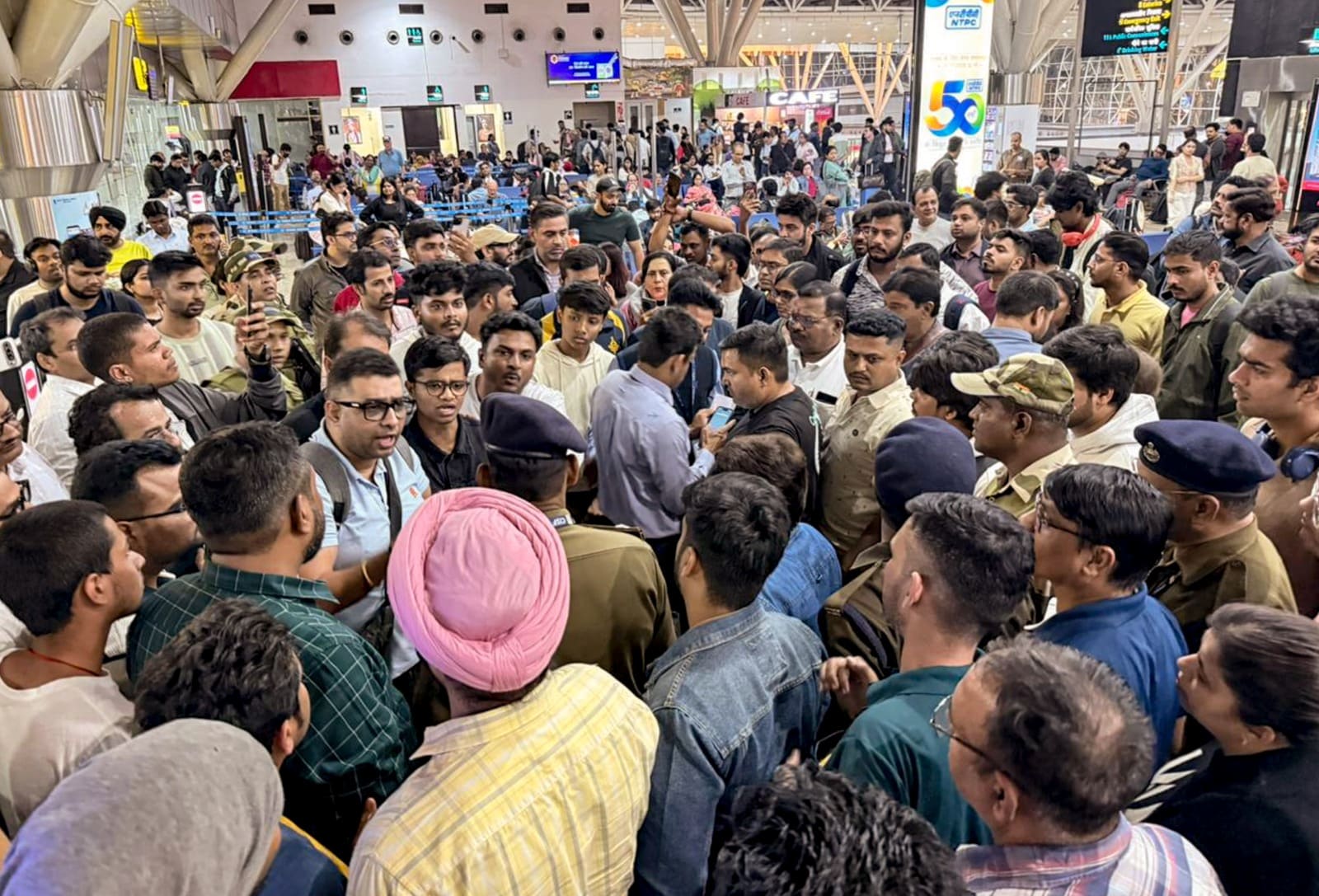
Similar scenes unfolded at airports in Hyderabad, Goa, Chennai, Visakhapatnam, and Pune, where passengers were left without assistance, food coupons, or accommodation. In Hyderabad, a group of travelers even blocked an Air India flight in protest.
At Chennai Airport, the CISF restricted entry to IndiGo passengers due to overcrowding. Meanwhile, Pune Airport reported severe parking bay congestion as IndiGo aircraft remained grounded, waiting for available crew.
IndiGo has acknowledged the crisis, blaming it on a combination of crew shortage, winter congestion, and operational miscalculations under new aviation safety norms.
The airline admitted to underestimating crew requirements and said disruptions would continue for another two to three days.
IndiGo issued a public apology, assuring customers that teams were working with aviation authorities to restore normal operations. However, officials within the airline warn that returning to full punctuality will not be an “easy target.”
IndiGo’s nationwide disruption intensified today, with Delhi’s IGI Airport hit the hardest, recording 135 cancelled departures and 90 cancelled arrivals—the highest of any airport in India. Bengaluru Airport reported 52 arrivals and 50 departures cancelled, while Hyderabad saw 92 cancellations, deepening the travel chaos.
In just four days, IndiGo has cancelled over 1,000 flights, stemming from a cascading operational collapse. The crisis began after an Airbus A320 software advisory delayed several flights into late-night hours.
Once the stricter Flight Duty Time Limitations (FDTL) rules took effect—mandating longer crew rest and limiting night operations—large numbers of pilots were automatically grounded, triggering a domino effect across IndiGo’s tight, high-frequency network.
The airline was already dealing with a pilot shortage that caused around 25 daily cancellations even before this week. The winter schedule, which increased flight frequencies, further strained operations.
New FDTL rules now require — 48 hours of weekly rest (up from 36); Maximum two night landings per week; Only two consecutive night duties; Maximum 8 flight hours for flights touching the night window
DGCA inspections have found inadequate passenger-handling as terminals grew overcrowded. IndiGo has admitted to “misjudgment and planning gaps” in crew forecasting and says the network will remain unstable for several more days. Flight reductions will continue as the airline attempts to reset its schedule.
Passengers nationwide continue to face long delays, lack of updates, and limited alternatives. IndiGo has issued an apology and urged travelers to check flight status before heading to airports.