Kuwait warns Israeli nuclear ambiguity, Iran’s nuclear program undermine Middle East stability
The State of Kuwait warned that persistent ambiguity surrounding Israeli Occupation nuclear capabilities, coupled with mounting concerns over Iran’s nuclear program, elevates the risk of miscalculation and escalation while eroding the mutual trust required for regional security and stability in the Middle East.
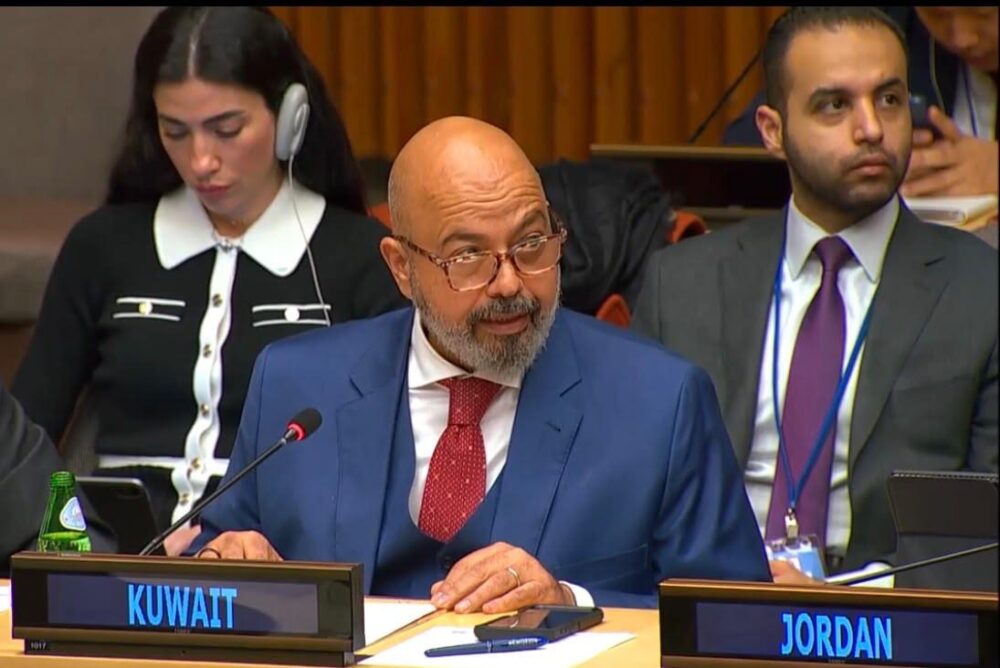
The remarks came in an official statement delivered Monday evening by Kuwait’s Permanent Representative to the United Nations, Ambassador Tariq Al-Bannai, before the seventh session of the Conference on the Establishment of a Middle East Zone Free of Nuclear Weapons and Other Weapons of Mass Destruction, held at UN Headquarters and chaired by the Sultanate of Oman.
Ambassador Al-Bannai noted that the region confronts two primary proliferation challenges that actively fuel instability. The first challenge involves the continued ambiguity surrounding the nuclear capabilities of the Israeli occupying entity, which remains outside the Treaty on the Non-Proliferation of Nuclear Weapons (NPT) and comprehensive international safeguards.
The second challenge, he added, concerns Iran’s nuclear activities and programs, where unresolved questions regarding their nature and transparency are compounded by insufficient cooperation with international verification mechanisms.
Al-Bannai emphasized that regional security cannot rest upon capabilities shielded from verification or assurances unsupported by tangible compliance, underscoring the need for transparent commitments, effective international oversight, and the nonselective application of non-proliferation obligations to all parties without exception.
He reiterated Kuwait’s call for the occupying entity to accede to the NPT and place all its nuclear facilities and activities under the comprehensive safeguards regime of the International Atomic Energy Agency (IAEA). Additionally, the Kuwaiti envoy urged the resolution of all outstanding issues to verify the strictly peaceful nature of Iran’s nuclear program in accordance with international law and IAEA frameworks.
Al-Bannai noted that the Middle East currently endures acute security conditions marked by the intersection of armed conflict and proliferation risks at a time of waning confidence in international compliance mechanisms, making a WMD-free zone more urgent than ever.
In this context, Ambassador Al-Bannai condemned in the strongest terms Iranian attacks targeting the State of Kuwait, Arab Gulf states, and Jordan, striking populations and vital infrastructure, noting that the vast majority of the international community has condemned these aggressive acts. He explained that these attacks and ongoing regional confrontations stem directly from leaving critical root issues unresolved.
Al-Bannai warned that expanding confrontations, originating from nuclear-related disputes, to encompass direct Iranian strikes against Arab Gulf states uninvolved in the escalation has destabilized the global economy and weaponized international waterways.
He added that this escalation has provided a pretext for rogue militias and factions operating outside state authority, particularly in Iraq, to launch hostile acts against Kuwait and Gulf states in pursuit of their own agendas, thereby widening the scope of conflict.
Al-Bannai stressed that establishing a Middle East zone free of nuclear weapons and other weapons of mass destruction represents an urgent imperative to reinforce regional security through clear, transparent, and legally binding international commitments.
He expressed Kuwait’s hope that the current session will broaden consensus on the core elements of a future treaty, building upon the technical groundwork established by the working committee over its previous three meetings regarding obligations, prohibitions, declarations, and verification.
Ambassador Al-Bannai reaffirmed Kuwait’s steadfast commitment to advancing practical steps toward realizing this zone as an essential pillar for regional stability and international peace and security.
Source: KUNA