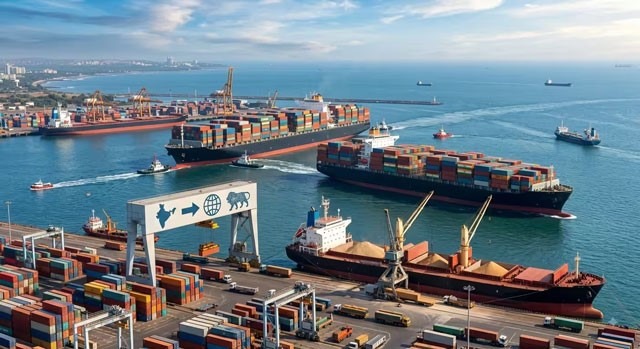
- India’s exports to key trade partners rose sharply in April-June 2026, led by Sri Lanka (+123.8 percent), Singapore (+101.2 percent), ASEAN (+61.6 percent) and Malaysia (+75.2 percent).
- India recorded its highest-ever combined exports of US$863.1 billion in FY2025-26, including US$441.8 billion in merchandise and US$421.3 billion in services.
- Indian merchandise exports to the UAE reached US$37.36 billion in FY2025-26, while Australia accounted for US$7.28 billion. Under the Australia ECTA, all Indian exports became eligible for zero-duty access from January 2026.
- The India-EFTA agreement provides concessions covering 99.6 percent of India’s exports, while the India-Oman CEPA offers duty-free access to 99.38 percent of India’s exports to Oman by value.
- The India-UK CETA, effective from July 15, 2026, provides duty-free or reduced-tariff access for 99 percent of Indian goods entering the UK.
- FTAs are increasingly supporting manufacturing: The agreements are opening opportunities for textiles, pharmaceuticals, chemicals, engineering products, electronics, agriculture, leather and footwear, while government export initiatives are supporting finance, logistics, compliance, branding and market access.
India’s expanding network of free trade agreements (FTAs) is increasingly translating into higher exports, with shipments to several key partner markets recording strong growth during the first quarter of fiscal 2026-27.
Commerce Ministry data show that Indian exports to Singapore more than doubled, rising 101.2 percent year-on-year to US$6.52 billion during April-June 2026. Exports to Sri Lanka surged 123.8 percent to US$2.35 billion, while shipments to the ASEAN region increased 61.6 percent to US$14.61 billion.
Exports to the South Asian Free Trade Area (SAFTA) region rose 36.6 percent to US$8.40 billion. Among individual partners, exports to Malaysia climbed 75.2 percent to US$2.54 billion, while shipments to Australia increased 25.2 percent to US$2.68 billion. Exports to South Korea and Japan rose 22.6 percent and 22.4 percent respectively, reaching US$1.95 billion and US$1.75 billion.
Exports to Oman increased 26.4 percent to US$1.39 billion, while shipments to Nepal rose 18.1 percent to US$2.28 billion. Bhutan recorded 16.1 percent growth and Thailand 6 percent.
The latest figures come after India recorded its highest-ever combined exports of US$863.1 billion in FY2025-26, comprising US$441.8 billion in merchandise exports and US$421.3 billion in services.
From agreements to actual market access
India has significantly expanded its trade-agreement network in recent years, including the India-UAE CEPA, India-Australia ECTA, India-EFTA TEPA, India-Oman CEPA and India-UK CETA. An agreement with New Zealand has also been concluded and is awaiting ratification, while negotiations with the European Union were concluded in January 2026.
The focus is increasingly shifting from signing agreements to measuring how effectively Indian businesses use the preferential access they provide. Under the India-UAE CEPA, 4.45 lakh Certificates of Origin had been issued since the agreement took effect in May 2022. The number of Indian tariff lines exported to the UAE at the eight-digit HS level increased from 7,546 in FY2021-22 to 8,053 in FY2025-26, with exports across those lines valued at US$37.3 billion.
Australia has shown a similar trend. Since the India-Australia ECTA came into force in December 2022, 2.73 lakh Certificates of Origin have been issued. Indian tariff lines exported to Australia increased from 5,396 to 5,668 over the same period, with exports across those lines reaching about US$7.2 billion.
UAE and Australia emerge as major markets
The UAE has become one of the strongest examples of India’s preferential trade strategy. Indian merchandise exports to the UAE reached US$37.36 billion in FY2025-26, while Singapore accounted for US$11.86 billion and Australia US$7.28 billion. ASEAN as a bloc received US$38.42 billion in Indian merchandise exports.
Australia’s market access also deepened from January 1, 2026, when all Indian exports became eligible for zero-duty access under the ECTA. Indian exports to Australia had already increased from US$4 billion in FY2020-21 to US$8.5 billion in FY2024-25, with textiles, pharmaceuticals, chemicals and agricultural products among the sectors registering gains.
New agreements widen opportunities
The India-EFTA Trade and Economic Partnership Agreement, covering Switzerland, Norway, Iceland and Liechtenstein, entered into force on October 1, 2025. EFTA offered concessions covering 92.2 percent of tariff lines and 99.6 percent of India’s exports, including all non-agricultural products.
By July 2026, India had issued 7,885 Certificates of Origin under the agreement. The EFTA states have also committed to an investment objective of US$100 billion over 15 years and to facilitate the creation of one million direct jobs in India.
The India-Oman CEPA entered into force on June 1, 2026, providing duty-free access to 99.38 percent of India’s exports to Oman by value. Exports under the agreement’s covered tariff lines reached US$622.8 million in June, up 189.6 percent from US$215.1 million a year earlier.
The India-UK Comprehensive Economic and Trade Agreement entered into force on July 15, 2026, giving 99 percent of Indian goods entering the UK either duty-free or reduced-tariff access. Indian exports to the UK had already risen 11.1 percent year-on-year to US$3.69 billion during April-June.
Trade deals increasingly support manufacturing
The agreements are also being positioned as part of India’s broader manufacturing and export strategy. Labour-intensive sectors such as textiles and apparel, leather and footwear, gems and jewellery, marine products, carpets, handicrafts and agricultural goods are expected to benefit from wider market access, alongside pharmaceuticals, engineering products, chemicals and electronics.
Beyond tariffs, newer agreements include provisions covering rules of origin, customs procedures, technical standards, sanitary and phytosanitary measures, services, digital trade, intellectual property and investment.
The government has also introduced Trade e-Connect and the Trade Intelligence and Analytics portal to provide exporters with information on tariffs, rules of origin, regulations, buyers and market opportunities. Its US$2.8 billion Export Promotion Mission for FY2025-26 to FY2030-31 is aimed at strengthening export finance, quality and compliance, branding, logistics, warehousing and market access.
The latest figures suggest India’s FTA strategy is entering a more measurable phase, with the emphasis moving beyond the number of agreements signed to their actual use by exporters. Rising shipments, expanding product lines and increasing use of Certificates of Origin indicate that preferential trade arrangements are becoming an increasingly important channel for Indian companies seeking to expand internationally.