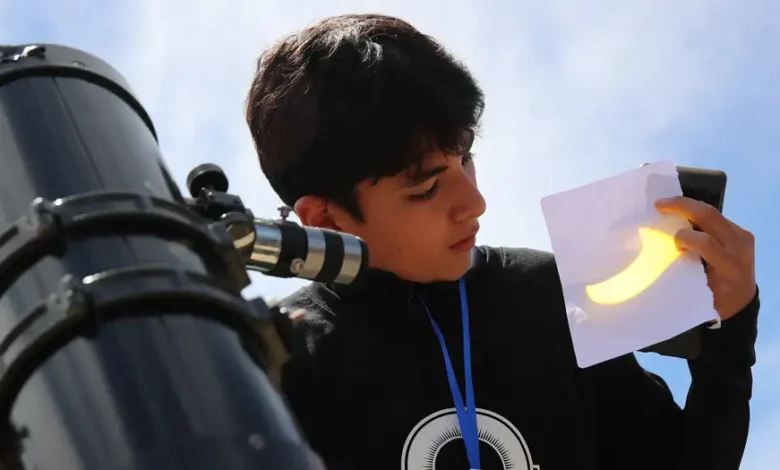
- August 12, 2026 solar eclipse will not be visible from Kuwait, and according to local visibility data, the eclipse begins at 6:34 PM Kuwait (approximately 15:34 GMT time).
- The solar eclipse will be followed by a lunar eclipse on August 27-28, when Earth passes between the Sun and Moon, while the next solar eclipse is expected on February 2, 2027, with visibility across much of Africa and South America and parts of Antarctica
A rare solar eclipse is visible across parts of the Northern Hemisphere on Wednesday, giving an estimated 980 million people the opportunity to witness the celestial event, while researchers prepare to use the brief period of darkness to study the Sun’s outer atmosphere.
The event is particularly significant for Europe, where the last solar eclipse widely visible from the mainland occurred in 1999.
What happens during a solar eclipse?
A solar eclipse occurs when the Moon passes between Earth and the Sun, casting its shadow across parts of the planet and temporarily reducing sunlight. During totality, the Moon completely covers the Sun’s visible disk, revealing the Sun’s outer atmosphere, known as the corona.
As the eclipse progresses, observers may notice a drop in temperature, unusual crescent-shaped shadows, changes in wind conditions and altered animal behavior. Just before totality, viewers may also see Baily’s beads, bright points of sunlight that pass through valleys along the Moon’s surface and appear as a string of glowing spots around its edge.
When the sky becomes dark during totality, some stars may become visible, and depending on local conditions, observers could potentially spot meteors or auroras. The eclipse will also temporarily reduce solar power generation. In Germany, the resulting decline in solar output is expected to contribute to a short-term rise in electricity prices.
Where will the eclipse be visible?
A total solar eclipse will be visible from Greenland, Iceland, northern Russia, northern Spain and northeastern Portugal. A partial eclipse will be visible across much of Western Europe, as well as parts of northern Africa and North America.
Although solar eclipses occur relatively regularly, total eclipses visible from populated areas are comparatively rare. For mainland Europe, the current event is especially notable because of the long gap since the 1999 eclipse.
What time will the eclipse occur?
For the August 12, 2026 solar eclipse, the worldwide eclipse begins at 6:34 PM Kuwait (approximately 15:34 GMT time). However, the eclipse will not be visible from Kuwait, according to local visibility data.
Around two hours later, at approximately 17:46 GMT, the eclipse will reach totality, which is expected to last for about two minutes. The exact timing will vary by location. In Iceland, totality is expected at around 17:48 GMT, while observers in Spain will see totality at approximately 18:27 GMT.
More eclipses to come
The solar eclipse will be followed by a lunar eclipse on August 27-28, when Earth passes between the Sun and Moon, while the next solar eclipse is expected on February 2, 2027, with visibility across much of Africa and South America and parts of Antarctica.
For viewers in Europe, however, this week’s event offers a particularly rare opportunity to witness totality, making proper preparation and safe viewing essential.