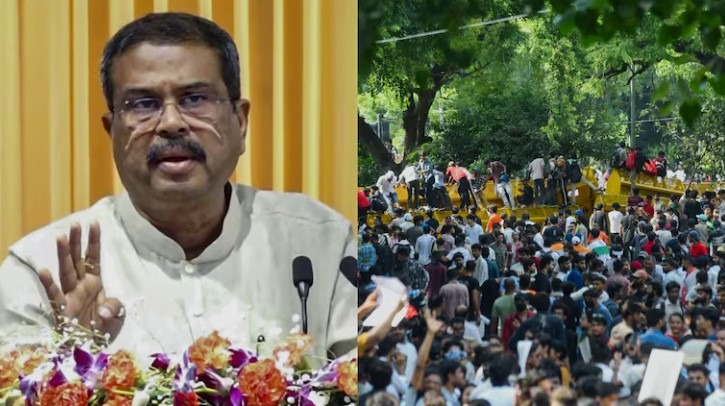
India’s Education Minister Dharmendra Pradhan has resigned from his post, a move that comes amid weeks of protests led by the youth-backed Cockroach Janta Party (CJP) over allegations of national examination paper leaks.
Pradhan announced his resignation on his X handle shortly before the third round of talks between the CJP and the Centre. His resignation was the main demand of protesters who had been camping at Delhi’s Jantar Mantar for over a month, demanding accountability over examination irregularities.
The standoff between the government and protest leaders had remained unresolved over the demand for Pradhan’s removal. On Saturday morning, CJP representatives had said that discussions could not move forward unless the government agreed to remove the education minister.
With Pradhan’s resignation, the government has addressed the key demand raised by the protesters. The CJP’s other demands included an assurance that no criminal cases would be filed against student demonstrators and compensation for families of students who died by suicide following examination paper leaks and cancellations.
The government had already assured the CJP during Friday’s talks that it would consider the concerns regarding legal action against protesters and compensation, but had not responded to the demand for the minister’s resignation at that stage.
In his resignation message, Pradhan said he respected the aspirations and expectations of the country’s youth and expressed gratitude to Prime Minister Narendra Modi for the opportunity to serve the nation.
The development followed talks held in New Delhi between senior government ministers and CJP representatives on Friday in an attempt to resolve the prolonged dispute over examination paper leaks. The meeting raised hopes of progress after weeks of nationwide student demonstrations.
Before the resignation announcement, CJP leaders had said the government sought time until Saturday afternoon to respond to their demand for Pradhan’s resignation. CJP spokesperson Saurav Das had earlier stated that the group would explain its demands in detail and hoped the government would respond positively.
A senior government minister had also said that the Centre remained open to dialogue and would not allow differences over the issue to prevent negotiations.
The CJP, which has emerged as the leading voice of the student movement, has demanded reforms in the examination system, arguing that stronger punishment alone would not prevent future leaks. The group has called for structural changes to ensure greater transparency and accountability.
The protests gained nationwide attention following the cancellation of a national medical entrance examination in May after a question paper leak affected nearly two million candidates. What began as an online campaign involving a small group of young activists later expanded into demonstrations in cities including New Delhi, Mumbai, Bengaluru and Patna.
Several protesters had said they would continue their campaign until the government addressed their concerns. Protester Vakil Yadav, who suffered hand injuries during police intervention while marching towards Parliament, said students wanted their concerns to be heard and reforms to be implemented.
Another protester, Sudesh Singh, said students would continue seeking accountability, arguing that the future of millions of candidates depended on restoring confidence in the examination system.
Meanwhile, the government has been working on proposed legal measures aimed at strengthening action against those responsible for examination paper leaks. Protest leaders have maintained that preventing leaks through systemic reforms remains essential alongside legal action.