Airstrikes targeting two of Iran’s largest steel producers, Mobarakeh Steel in Isfahan and Khuzestan Steel in Ahvaz, have sparked intense debate inside the country, with questions mounting over whether the facilities constituted legitimate military targets or vital civilian infrastructure.
The strikes have divided opinion. Some analysts argue the plants are tied, directly or indirectly, to state-linked economic networks and the Islamic Revolutionary Guard Corps, potentially justifying their inclusion in strategic targeting. Others view the attacks as a direct hit on civilian industry at a time when Iran is already grappling with mounting pressure from ongoing US-Israeli military operations.
Yet beyond the immediate controversy, a deeper concern is emerging: the long-term damage to Iran’s steel sector, a cornerstone of its non-oil economy, dw.com reports.
Despite its reliance on oil revenues, Iran ranked among the world’s leading crude steel producers in 2025, with output estimated at 31.8 million tons, according to the World Steel Association. Mobarakeh Steel alone generated approximately $860 million in export revenues over a ten-month period spanning 2025–2026, underscoring the sector’s critical role in sustaining foreign currency inflows under sanctions.
Strategic Industry Takes a Hit
The impact of the strikes extends far beyond military considerations. Damage to facilities of this scale disrupts supply chains, threatens industrial employment, and weakens one of the few sectors of the Iranian economy that continues to operate with relative resilience despite international sanctions.
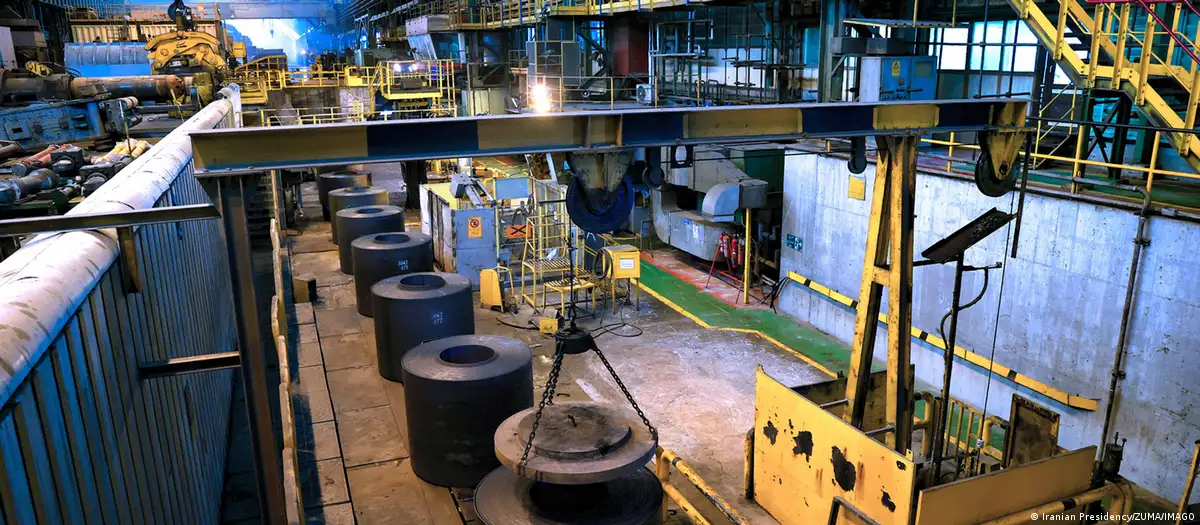
While independent verification remains limited, multiple reports suggest significant damage to storage units and power infrastructure at both plants. Khuzestan Steel is said to have halted operations entirely, while Mobarakeh continues to function at reduced capacity.
Steel production is heavily dependent on uninterrupted electricity supply, meaning even partial damage to power systems can trigger cascading disruptions across entire production lines.
Economic Fallout Deepens
Economists warn that the longer the conflict persists, the more Iran will be forced to divert financial resources toward military needs, further straining an economy already burdened by inflation, sanctions, and structural inefficiencies.
Initial estimates suggest direct losses from the strikes could range between $5 billion and $6 billion. However, the broader economic impact is expected to be far more severe, with ripple effects extending into construction, manufacturing, and other downstream industries reliant on steel.
The sector’s importance is well established. For years, Iran has leaned on metals exports as a key source of revenue, a fact reflected in previous US sanctions targeting steel producers and related entities.
Uncertain Path to Recovery
Experts say some damaged facilities could be repaired within months, depending on the extent of destruction. However, deeper structural challenges loom.
Parts of Iran’s steel industry operate on tight profit margins, raising doubts about the economic viability of rebuilding heavily damaged units. In some cases, importing steel may prove more cost-effective than restoring production capacity, a shift that could permanently alter the sector’s landscape.
The long-term risk lies not only in visible destruction, but in the possibility that damaged infrastructure may never be fully restored, leading to sustained declines in output and weakening industrial networks.
Human Cost and Wider Impact
The consequences are also expected to be felt on a social level. Khuzestan Steel alone employs around 10,000 workers, many on short-term contracts with limited job security. A prolonged shutdown would affect not just employees, but also contractors and a wide ecosystem of dependent businesses.
For many in Iran, the strikes represent more than a tactical military move. They are seen as an assault on a critical pillar of the national economy, one that supports exports, employment, and state revenues.
As the conflict continues, the damage to Iran’s steel industry may prove to be one of its most enduring economic scars, with consequences that extend far beyond the factory floor.