- India, a beacon of resilience and leadership in a changing global order, is strengthening strategic partnerships, economic cooperation and indo-pacific stability through a visionary global outlook
- India is translating economic strength into global leadership through strategic partnerships with ASEAN, expanded trade, maritime cooperation, technological innovation, and constructive diplomacy, India is helping to shape a peaceful, stable, and prosperous global order.
- By promoting dialogue, mutual respect, regional integration and shared prosperity, India is increasingly positioning itself as a key force in shaping the emerging global order and contributing to international stability.
India is steadily strengthening its position as a rising global economic power and influential strategic player, combining domestic economic resilience with expanding international partnerships and a more proactive role in shaping regional and global affairs.
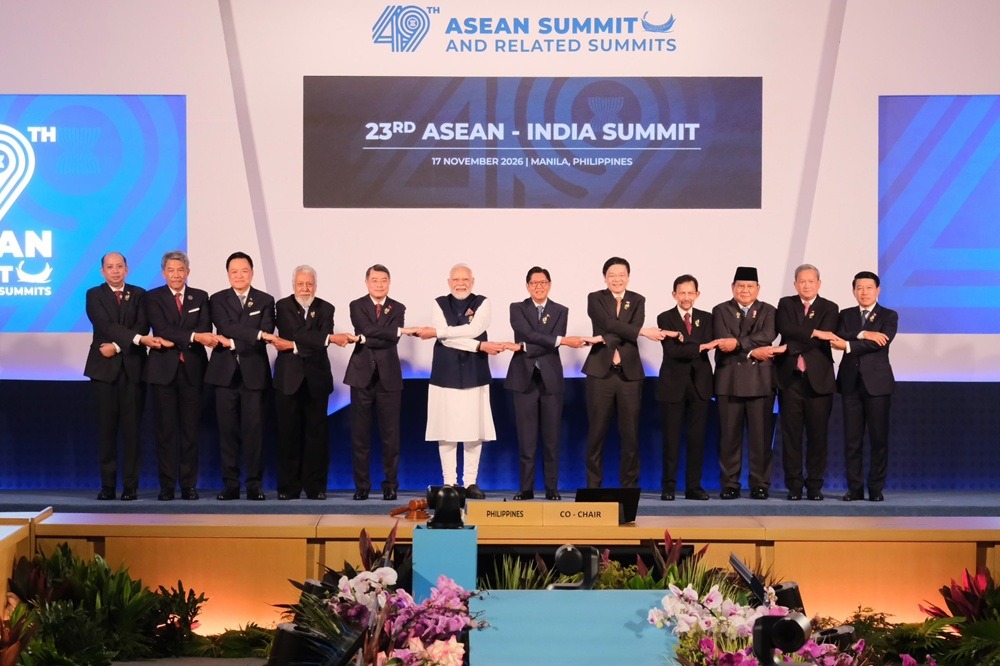
Its growing influence was highlighted at the 23rd ASEAN-India Summit and 21st East Asia Summit in Manila, Philippines, on November 17, 2026, where Prime Minister Narendra Modi reaffirmed India’s commitment to economic cooperation, regional stability and a peaceful, prosperous Indo-Pacific.
At a time of geopolitical conflicts, economic uncertainty, shifting trade patterns and technological disruption, India’s ability to maintain economic momentum and pursue long-term development priorities reflects the strength of its economic fundamentals and strategic vision.
Its ambition to become a developed nation by 2047 under the Viksit Bharat vision is increasingly supported by partnerships aimed at expanding trade, investment, manufacturing and technological capabilities.
A major pillar of India’s growing international influence is its partnership with ASEAN, which lies at the heart of its Act East Policy and broader MAHASAGAR vision. Bilateral trade reached $128.38 billion in 2025-26, representing 10.55 percent of India’s total global trade.
Modi called for stronger economic integration and a balanced review of the ASEAN-India Trade in Goods Agreement to improve market access, strengthen business confidence and expand regional supply chains.
India is also seeking to deepen its strategic influence through maritime cooperation, recognising the importance of secure sea routes to international trade, energy transportation and regional stability.
Its proposed long-term cooperation framework with ASEAN covers maritime connectivity, scientific research, disaster management, Coast Guard cooperation and seafarers’ safety.
Technology and innovation are emerging as other important areas of India’s international engagement. Initiatives proposed at the Manila summit include joint cyber forensics training, nuclear energy technical exchanges, a space hackathon and greater cooperation in critical minerals.
Youth exchanges, scholarships and academic partnerships are also intended to strengthen human-resource development and people-to-people ties. India’s growing leadership is further reflected in its efforts to promote collective action on disaster management, cybersecurity and cross-border crime.
Its bilateral engagement with the Philippines has also expanded across defence, space, railway infrastructure, financial technology, trade and investment. As India advances towards its 2047 development goal, its expanding economic and strategic partnerships demonstrate an ambition that extends beyond domestic growth.
By promoting dialogue, mutual respect, regional integration and shared prosperity, India is increasingly positioning itself as a key force in shaping the emerging global order and contributing to international stability.