Venezuela at crossroads — caught between internal division, external control, unpredictable geopolitical future
The arrest of President Nicolas Maduro by U.S. forces has thrust Venezuela into its most dramatic political rupture in decades. As Washington claims operational control, installs pressure on a new interim leadership, and signals sweeping access to Venezuela’s oil sector, the country -- and the wider region -- now faces a volatile and uncertain future.
- Power shifts in Caracas as Washington tightens grip: What Maduro’s arrest means for Venezuela and the region
- Trump declares U.S. control over Venezuela after Maduro’s capture, warns new leader of severe consequences
- Do what’s right — or pay the price’: Trump draws red lines for Venezuela’s interim government
- The European Union has called for calm, restraint, and a peaceful resolution, stressing respect for international law and Venezuela’s sovereignty; while the EU does not recognize Maduro as the country’s legitimate leader, it emphasizes that Venezuela’s future must be determined by its people, not imposed by force.
- Legal experts and former diplomats have raised concerns over the precedent set by Maduro’s seizure, even as some acknowledge that his removal followed years of disputed elections and political repression.
- Analysts warn that while the military operation was executed with precision, Washington’s long-term strategy remains unclear.
Venezuela has entered a new and perilous chapter following the dramatic capture of President Nicolas Maduro and his transfer to the US to face federal criminal charges.
Venezuela has entered a new and perilous chapter following the dramatic capture of President Nicolas Maduro by U.S. forces and his transfer to the United States to face federal criminal charges.
U.S. President Donald Trump has since declared that Washington is now “in charge” of the oil-rich South American nation, issuing a blunt warning to Venezuela’s interim leadership: comply with U.S. demands or face consequences even harsher than those imposed on Maduro himself.
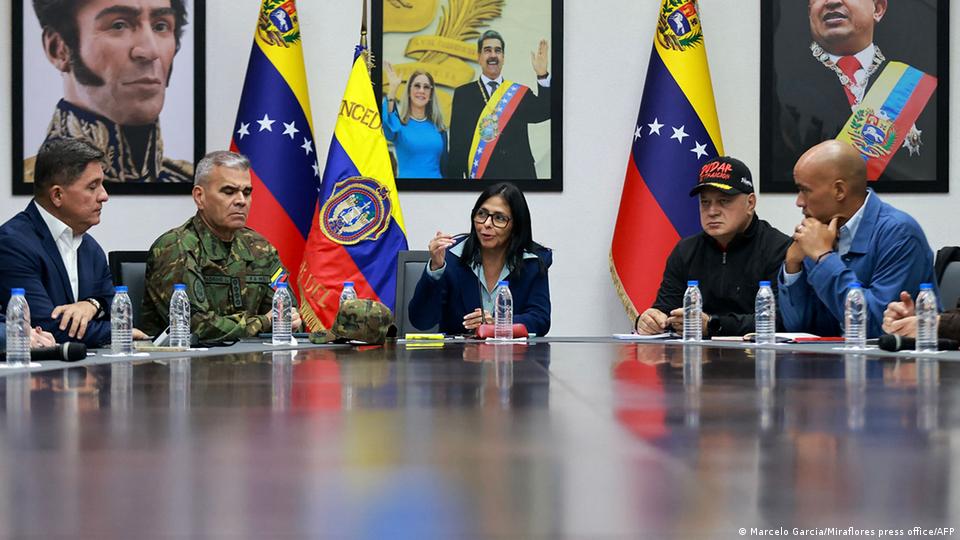
In the immediate aftermath of Maduro’s ouster, Venezuela’s military and top court endorsed his former vice president, Delcy Rodriguez, as interim president, DW.COM reports.
Rodriguez convened her first cabinet meeting on Sunday and called for a “balanced and respectful” relationship with the United States, proposing cooperation focused on shared development.
Despite these conciliatory words, Trump has made clear that patience will be limited. Speaking aboard Air Force One, he said Rodriguez was currently “cooperating,” but warned she would face “a situation probably worse than Maduro” if she failed to “do what’s right.” Trump has not publicly detailed those demands, but repeatedly emphasized U.S. access to Venezuela’s oil infrastructure as a priority.
When pressed by reporters on who now governs Venezuela, Trump responded unequivocally: “It means we’re in charge.” He added that American oil companies are prepared to enter Venezuela to restore and expand production, reinforcing the administration’s view that economic and strategic interests are central to its intervention.
U.S. Secretary of State Marco Rubio has sought to frame the operation as a law enforcement mission rather than a war, stating that the United States is fighting drug trafficking networks, not Venezuela as a nation.
Maduro is being held in federal custody in Brooklyn and was scheduled to appear before a judge in Manhattan on Monday at 12 p.m. (5 p.m. GMT). U.S. authorities have charged him and his wife, Cilia Flores, with a sweeping list of offenses, including — narco-terrorism conspiracy; cocaine importation conspiracy; possession of machine guns and destructive devices and conspiracy to deploy weapons against the United States
The indictment describes Maduro as the leader of a “corrupt, illegitimate government” that used state power to protect and promote drug trafficking, and alleges he remained in power despite losing recent elections.
In a swift response, interim President Rodriguez has formed a high-level commission to pursue the release of Maduro and his wife. The body is co-chaired by her brother Jorge Rodriguez, president of the National Assembly, and Foreign Minister Yvan Gil, with Information Minister Freddy Nandez also included.
Inside Venezuela, armed Maduro supporters blocked roads in Caracas following his capture, underscoring the risk of unrest.
Meanwhile, opposition leader Edmundo Gonzalez Urrutia, speaking from exile in Spain, welcomed Maduro’s removal as “an important step,” but warned it was “not enough” to restore normalcy.
Gonzalez insisted that Venezuela’s crisis would only truly end when all political prisoners are released and the results of the disputed 2024 election — which the opposition says he won by a landslide — are respected.
Cuba, a close ally of Maduro, says 32 Cuban military and police officers were killed during the U.S. operation. Havana declared two days of national mourning, stating that its personnel died resisting the attack or during bombings of facilities.
Rubio and Trump both confirmed that Cuban security forces were guarding Maduro at the time of his capture.
Trump later suggested that Cuba’s government could collapse without subsidized Venezuelan oil, saying the regime appeared “ready to fall” without U.S. military action.
The crisis has rippled across the region. Colombia reinforced border security following the strikes, while its president Gustavo Petro condemned the U.S. operation as a violation of Latin American sovereignty.
Trump responded with sharp rhetoric, accusing Colombia’s leadership of fueling cocaine trafficking and remarking that U.S. military action against Colombia “sounds good.”
The European Union has called for calm, restraint, and a peaceful resolution, stressing respect for international law and Venezuela’s sovereignty.
While the EU does not recognize Maduro as the country’s legitimate leader, it emphasized that Venezuela’s future must be determined by its people, not imposed by force.
Legal experts and former diplomats have raised concerns over the precedent set by Maduro’s seizure, even as some acknowledge that his removal followed years of disputed elections and political repression. Analysts warn that while the military operation was executed with precision, Washington’s long-term strategy remains unclear.
Trump has openly suggested the United States could temporarily “run” Venezuela, fueling uncertainty about governance, sovereignty, and regional stability.
As pressure mounts on Rodriguez’s interim government, Venezuela now stands at a crossroads — caught between internal division, external control, and an unpredictable geopolitical future.
For ordinary Venezuelans, the stakes could not be higher: peace or escalation, recovery or deeper crisis, and a future shaped either by democratic restoration — or by foreign power.