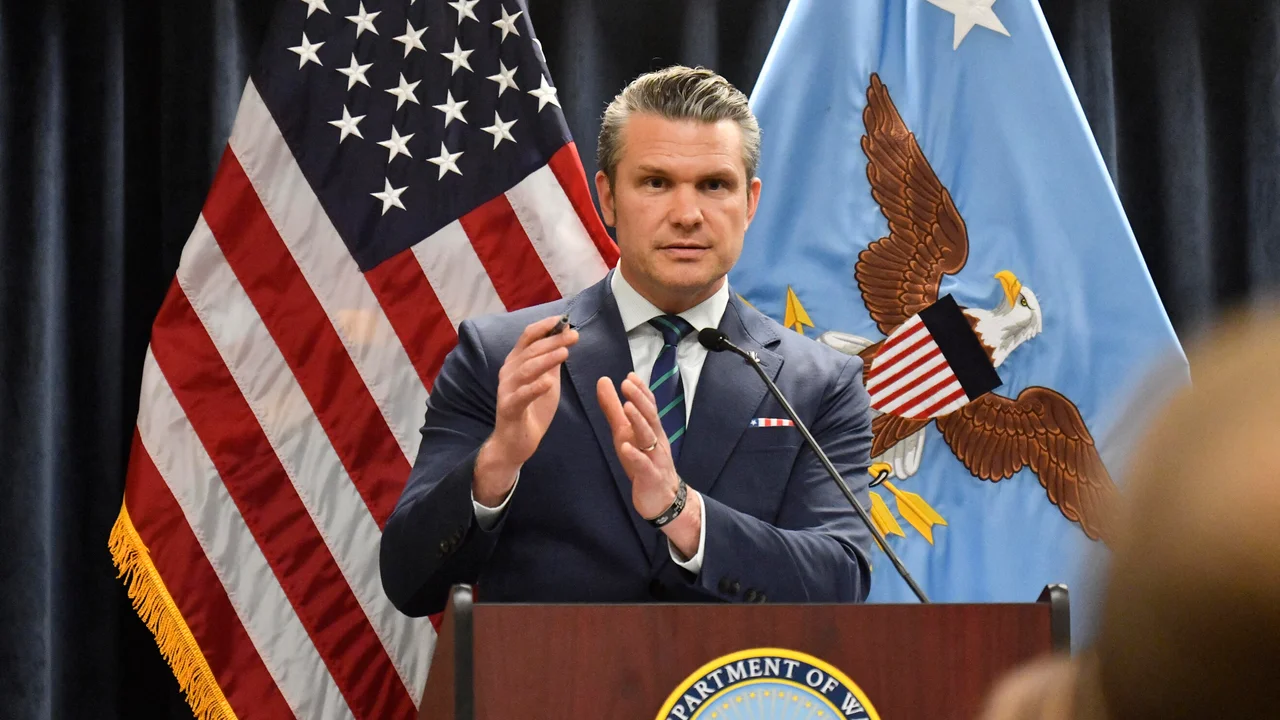
US Secretary of Defense, Pete Hegseth and Chairman of the Joint Chiefs of Staff Gen Dan Caine held a press briefing Tuesday as fighting in the Middle East intensified, with Iran launching fresh attacks and the United States continuing its airstrike campaign.
Opening the briefing, Hegseth delivered a strongly worded message against the Iranian leadership, accusing the regime of decades of attacks through proxy groups and warning of its pursuit of nuclear weapons.
“Our generation understands this fight,” Hegseth said, describing the Iranian leadership as responsible for years of violence against U.S. forces and allies.
Despite the escalating conflict, Hegseth insisted that Iranian leaders were “desperate and scrambling,” asserting that the United States and its allies were gaining the upper hand, according to CBS News.
He also stressed that the current campaign would not resemble prolonged wars in the past, saying the strategy would avoid the type of “endless nation-building” seen during earlier conflicts.
Meanwhile, Iran signaled its determination to continue military operations. Abbas Araghchi told PBS News that Iran would keep launching missile attacks against Israel “as long as needed.”
According to U.S. military officials, American forces have struck more than 3,000 Iranian targets during the first week of operations. The conflict has already claimed the lives of seven U.S. service members, a loss the Pentagon described as a sacrifice that would not be forgotten.
Donald Trump said in remarks to CBS News that he believes the war is largely complete from a military perspective, stating there was “nothing left in a military sense.”
However, messaging from the U.S. Department of Defense suggested the campaign may continue, with a social media post declaring: “We have only just begun to fight.”
In a separate interview, Hegseth explained that Trump’s call for “unconditional surrender” means the United States intends to dictate the terms of the conflict.
“This is war. This is bringing your enemy to their knees,” he said.
Amid the intensifying tensions, Trump also raised the possibility of the United States taking control of the strategic Strait of Hormuz if Iran attempts to block the vital waterway, through which roughly 20 percent of global oil supplies pass.