- GCC warns that Iranian attacks threaten regional security and global food supplies, urges the UN Security Council to hold Tehran accountable, ensure reparations for victims and restore freedom of navigation through the Strait of Hormuz.
- Al-Budaiwi condemned attacks on Saudi Arabia, including a deadly strike on King Khalid International Airport in Riyadh in October that killed 14 people
The Gulf Cooperation Council (GCC) has accused Iran of launching more than 7,000 missiles and drones against its six member states since February 28, warning that attacks on vital infrastructure and disruptions to shipping through the Strait of Hormuz pose serious regional and global security threats.
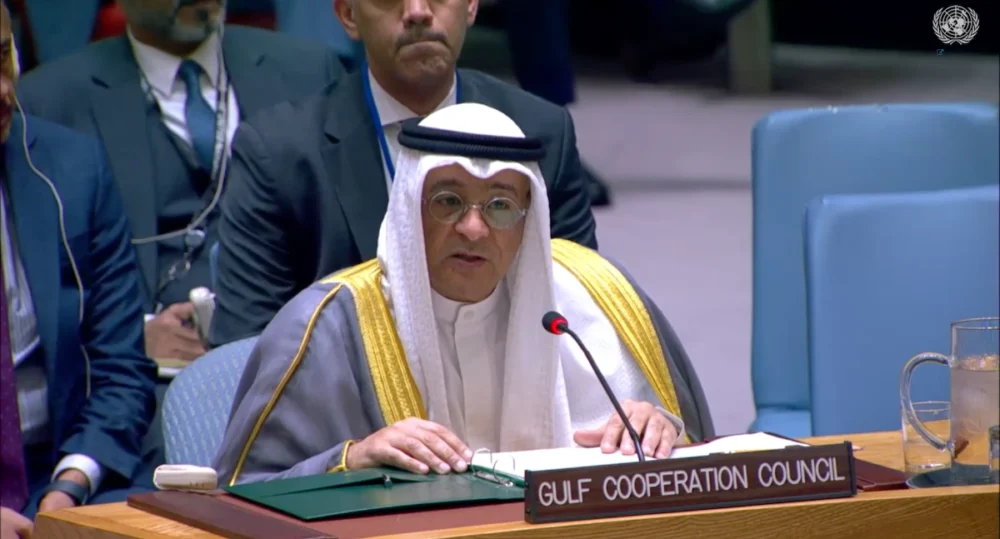
GCC Secretary-General Jasem Mohammed Al-Budaiwi delivered the warning before the UN Security Council on Friday, saying Iranian strikes had targeted airports, seaports, oil and gas facilities, power stations, desalination plants and residential areas across the Gulf. The attacks caused deaths and injuries, extensive infrastructure damage and harm to the waters of the Arabian Gulf, Arab News reports.
Al-Budaiwi warned that the disruption of maritime traffic through the Strait of Hormuz had developed into a humanitarian crisis beyond its economic consequences. Restrictions on shipping have interrupted supplies of food, fertilizers and ammonia, threatening global food security and increasing the risk of famine in vulnerable developing countries.
He called on the Security Council to ensure implementation of Resolution 2817, adopted in March, which condemned Iranian attacks on GCC states and Jordan and demanded their cessation. He also cited Human Rights Council Resolution 61/1, which called on Iran to provide full and prompt compensation to victims. Al-Budaiwi said Tehran must be held fully responsible for the attacks, stressing that Gulf countries were not parties to the war and had made diplomatic efforts to prevent escalation.
He reaffirmed that the security of GCC countries was indivisible and that member states retained their right to self-defence under Article 51 of the UN Charter. He also rejected any attempt to close the Strait of Hormuz or impose unlawful restrictions and transit fees on international shipping, stressing that freedom of navigation must be guaranteed under international law.
Addressing the Houthi escalation in Yemen, Al-Budaiwi condemned attacks on Saudi Arabia, including a deadly strike on King Khalid International Airport in Riyadh in October that killed 14 people. He reaffirmed the GCC’s solidarity with Saudi Arabia and welcomed recent Security Council actions condemning Houthi attacks and demanding an immediate halt to them and enforcement of the arms embargo.
He also condemned the detention and treatment of UN employees and humanitarian workers by the Houthis, noting that a UN staff member had died in detention while others faced trial on charges carrying the death penalty.
Al-Budaiwi urged the Security Council to secure an immediate end to Iranian attacks, including those carried out through proxies, restore maritime conditions in the Strait of Hormuz to those prevailing before February 28, and ensure accountability and full compensation for victims. He stressed that any regional or international agreement with Tehran must address Gulf security concerns, including Iran’s nuclear programme, ballistic missiles, drones and support for armed groups.
He reiterated the GCC’s support for an independent Palestinian state based on the June 4, 1967 borders, with East Jerusalem as its capital, as well as the sovereignty of Lebanon and Syria. He said Gulf security was an integral part of international security and a test of the effectiveness of the international collective security system.