Nazaha Chief highlights legislative reforms and international cooperation in fight against corruption
Kuwait has reaffirmed its commitment to strengthening integrity and combating corruption at the United Nations Convention against Corruption conference in Doha, with Nazaha head Abdulaziz Abdul Latif Al-Ibrahim highlighting new legislation, enhanced international judicial cooperation and updated national strategies aimed at improving risk assessment, transparency and global collaboration.

The Head of the Public Authority for Anti-Corruption (Nazaha), Mr. Abdulaziz Abdul Latif Al-Ibrahim, stated in the State of Kuwait’s address to the Conference of the States Parties to the United Nations Convention against Corruption that it has become increasingly important to focus on examining and studying methods and measures for assessing corruption risks, mechanisms for measuring perceptions of corruption and its causes, and analyzing its trends, particularly at a time when the practical links and shared criminal connections between corruption and its various forms of commission have become evident in many cases.
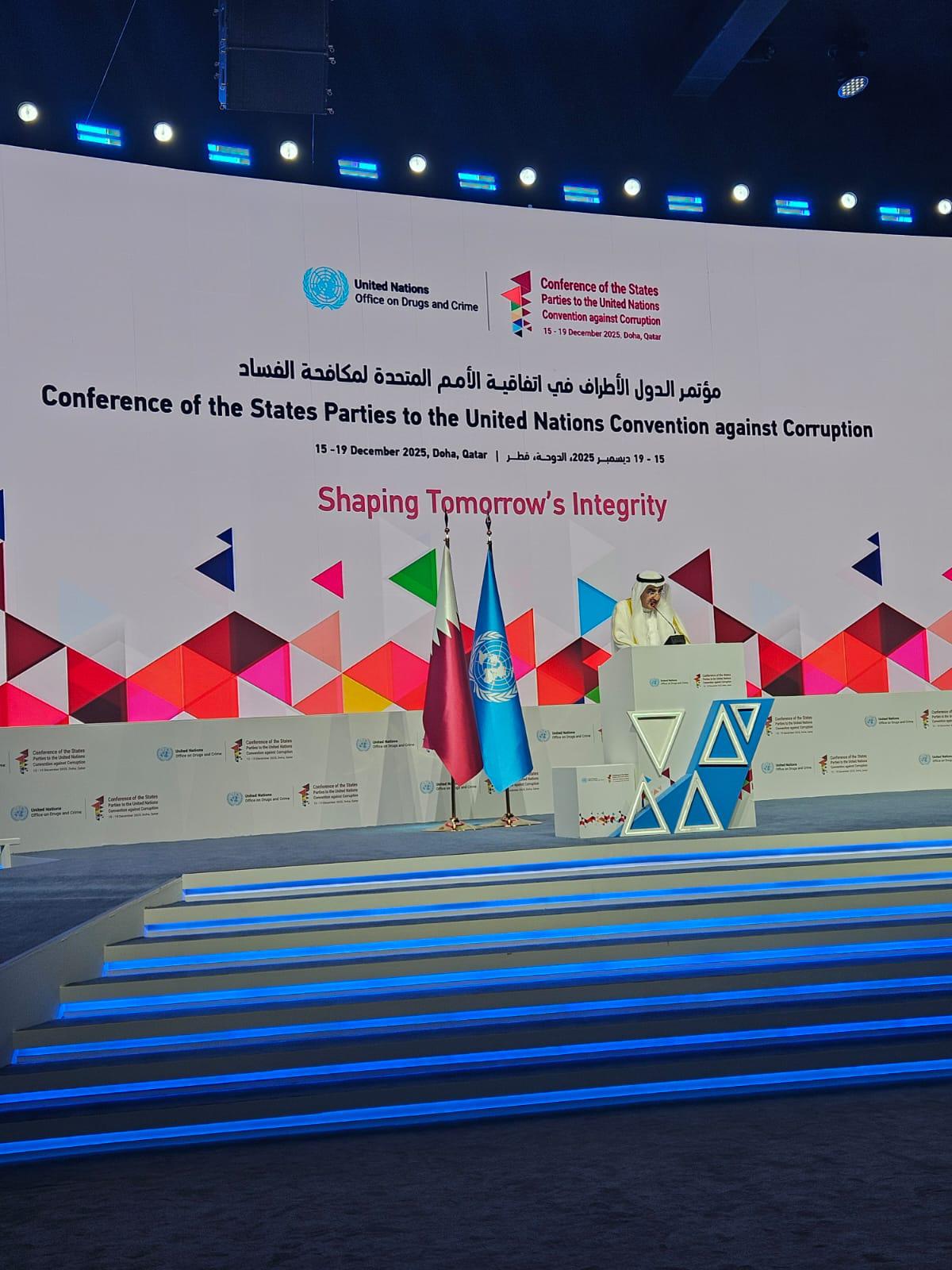
In his speech at the eleventh session of the Conference, currently being held in Doha, Al-Ibrahim affirmed that the State of Kuwait regularly and systematically seeks to develop its legislation, procedures, and national policies to ensure compliance with the implementation of the provisions of the United Nations Convention against Corruption.

In addition to existing legislative, procedural, and oversight frameworks, Kuwait has issued several new laws directly linked to strengthening the optimal implementation of the Convention.
Among these is Law No. (69) of 2025 amending certain provisions of the law establishing the Public Authority for Anti-Corruption, which includes the development of a number of procedures supporting the Authority’s objectives, mandates, and powers, and enhancing the elements and aspects of its technical independence.
He also noted the issuance of Law No. (79) of 2025 on international judicial cooperation in criminal matters, which was enacted in response to the requirements of implementing international recommendations.
This legislation represents a serious and substantive step toward strengthening the national legislative and procedural framework for facilitating international criminal cooperation, given the provisions, rules, and measures it contains to ensure the effectiveness of mechanisms for receiving, executing, and exchanging cross-border mutual legal assistance requests.
Al-Ibrahim added that, as part of Kuwait’s continued development of its strategic policies in areas related to the prevention and combating of corruption, the State of Kuwait is currently preparing and formulating the second phase of its National Strategy for Enhancing Integrity and Combating Corruption, in line with the latest international and national developments in this field.
This comes alongside efforts to update the National Strategy for Combating Money Laundering and Terrorist Financing in accordance with the standards and recommendations of the Financial Action Task Force (FATF).
Over the course of five days, the Conference discusses the review of States Parties’ implementation of the Convention, coordination mechanisms for the exchange of technical assistance, activation of preventive anti-corruption programs, asset recovery, as well as monitoring challenges and measures aimed at preventing and combating corruption and strengthening international cooperation.
The Head of the Delegation, Mr. Abdulaziz Abdul Latif Al-Ibrahim, extended his thanks to the Chair and Vice-Chairs of the Bureau of the Eleventh Session of the Conference, and expressed his appreciation to the United Nations Office on Drugs and Crime (UNODC) for its efforts in supporting the implementation of States Parties’ commitments under the United Nations Convention against Corruption.
In a related context, the delegation of the State of Kuwait, represented by the Public Authority for Anti-Corruption (Nazaha), is participating in meetings concerning draft resolutions submitted by States Parties totaling eleven draft resolutions currently under negotiation.
The delegation affirmed its support for any resolution that contributes to curbing corruption and corrupt practices, noting that there are proposals that can be built upon and activated to contain the scourge of corruption and eradicate it.