The 2025 G20 Leaders’ Summit opened in Johannesburg with India emerging as a decisive voice for the Global South. As the G20 convened on African soil for the first time, Prime Minister Narendra Modi underscored India’s vision of inclusive development, climate responsibility, and equitable global governance.
With Africa at the center of this year’s theme — “Solidarity, Equality and Sustainability” — Modi positioned India as a bridge between continents, unveiling a sweeping set of initiatives spanning traditional knowledge, critical minerals, healthcare cooperation, satellite data sharing, and countering drug-terror networks. His proposals not only reflected India’s civilizational ethos but also reinforced New Delhi’s growing leadership in shaping a fairer, more resilient world order.
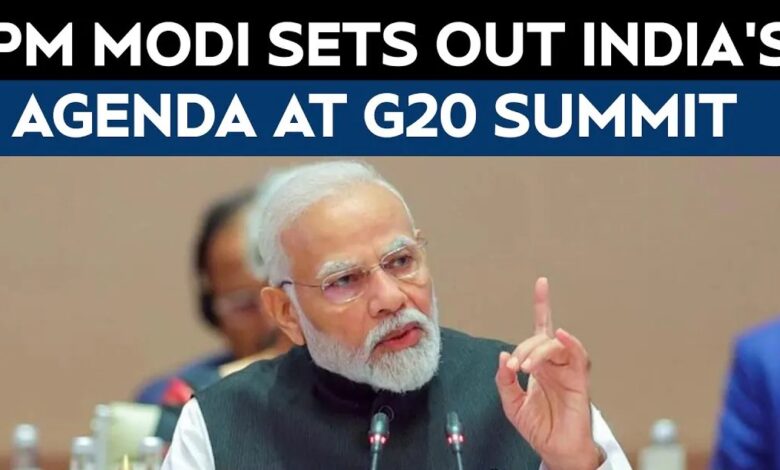
On the opening day Modi positioned India at the center of global problem-solving with a suite of ambitious initiatives, NDTV reports.
Modi announced six major global initiatives, projecting India’s civilizational wisdom, technological strength, and commitment to human-centric progress.
These include a Global Traditional Knowledge Repository, an Africa Skills Multiplier Program, a Global Healthcare Response Team, an Initiative on Countering the Drug–Terror Nexus, a G20 Open Satellite Data Partnership, and a Critical Minerals Circularity Initiative.
He emphasized that each proposal reflects India’s ethos of inclusive growth and can serve as a catalyst for worldwide development.
In the first session on inclusive and sustainable economic growth, PM Modi highlighted India’s role as a global knowledge partner.
The traditional knowledge repository aims to preserve and share humanity’s collective wisdom, while the Africa Skills Multiplier Program seeks to train one million certified youth trainers, boosting local capacity and long-term development across the continent. Modi also proposed a rapid-response health team drawn from G20 nations to combat pandemics and future global health emergencies.
During the second session, themed “A Resilient World,” PM Modi urged collective action on climate, food security, and disaster preparedness. He called for the Critical Minerals Circularity Initiative to support recycling, urban mining, and second-life battery technologies — essential for clean energy transitions — and championed the Open Satellite Data Partnership to give Global South nations improved access to space-based data for agriculture, fisheries, and disaster management.
India also pushed for stronger cooperation with the Coalition for Disaster Resilient Infrastructure (CDRI), a key legacy of its G20 Presidency.
PM Modi drew attention to India’s pioneering work in food security, including the world’s largest nutrition program, extensive crop insurance, and leadership in promoting Shree Anna (millets) — nutritious, climate-resilient grains ideal for a warming world.
He praised the South African G20 Presidency for advancing key issues such as tourism, skilled migration, the digital economy, and women’s empowerment, noting that the New Delhi Summit’s historic decisions continue to guide global action.
Calling for a new development paradigm rooted in balance and sustainability, PM Modi invoked the Indian philosophy of Integral Humanism, stressing harmony between human progress, society, and nature.
With India’s voice resonating strongly in Johannesburg, the G20’s first African summit is unfolded as a powerful platform for India to champion a fairer, greener, and more cooperative world order.