Legal Equality Ensures Equitable Economic Opportunities
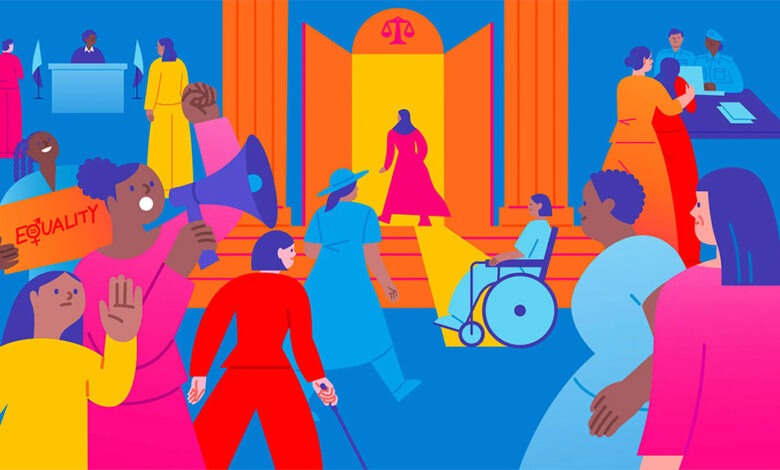
As agents of change, women in leadership positions are vital to push through women-centric reforms, strengthen accountability and transparency, help disrupt biased gender perspectives, and wield justice more equitably.
THE TIMES KUWAIT REPORT
More than 95 percent of women around the world live in an economy that does not provide full legal equality to them, and no economy in the world secures the legal rights needed to ensure the full participation of women in the economy. This, and other glaring gaps in gender-equitable laws to support economic engagement of women, are brought to the fore in this year’s ‘Women, Business and the Law’ (WBL) index released recently.
Drawing on data from 190 global economies, the annual benchmarking WBL index, prepared by analysts at the World Bank Group, notes that although many countries have passed reforms to support women in the workforce, only about half of all laws and reforms are effectively enforced—limiting opportunities for women and denying them access to equal pay, assets, entrepreneurship support, childcare, and workplace protections.
In his foreword to the index, Chief Economist and Senior Vice President for Development Economics at the World Bank Group, Indermit S. Gill noted: It is a shocking statistic that less than 5 percent of women worldwide have access to full legal equality. Although economies score an average of 64 out of 100 in the WBL index on laws that support women’s economic equality, when it comes to actually enforcing the laws, the average score is down to 53. And, when the systems needed to implement those rights are assessed for adequacy, the score is a dismal 47.
The sharp drop from available to accessible legal equality emphasizes the importance of not only having laws, regulations, and policies favoring gender equity, but also the systems to equitably implement the laws. It is apparent that along with expediting legal reforms and eliminating gender-discriminatory provisions, policymakers need to also put in place mechanisms to enforce these laws and regulations, and ensure that granted legal rights translate into protections and opportunities in daily life.
There is a substantial body of research to substantiate that reducing obstacles for women in the workplace can generate real economic results. Laws that promote opportunities for women and shape gender-inclusive development are shown to result in more productive economies and more resilient societies. And yet, regions that need women’s contributions the most—the Middle East and North Africa, South Asia, and Sub-Saharan Africa—continue to maintain some of the most restrictive legal barriers to the full economic participation of women.
Amid the continued denial of equal legal rights to women worldwide, and the rights of women and girls are being rolled back in many places, it is noteworthy that in Kuwait, women have in recent years made significant advancements in achieving equal rights and equal justice. Today, Kuwaiti women play an important role in national development, particularly in education, healthcare, business, politics, diplomacy and judiciary.
Kuwaiti women hold 28 percent of ministerial and senior government posts, a percentage that continues to grow in sectors such as diplomacy, the police force, the oil industry, and the judiciary. As one report put it, women in Kuwait are not only participants in national development, they are also increasingly designers of its progress, visionaries of its future, and representatives of a progressive, purposeful nation that values freedom, equal rights and equity in all aspects of life.
As agents of change, women in leadership positions are vital to push through women-centric reforms, strengthen accountability and transparency, help disrupt gender-biased perspectives, and wield justice more equitably. The historic appointment of Kuwaiti women as public prosecutors in 2013, despite opposition from some lawmakers, served as the entry point for women to make further inroads in the country’s judicial system.
In 2020, backed by legal rulings, the government took the unprecedented step of appointing Kuwait’s first eight female judges. That it took over five decades from the enrollment in 1967 of the first batch of female students in judicial studies, to the appointment of the first female judges in 2020, speaks volumes of the hurdles that women have had to overcome in realizing their judicial aspirations.
In September 2025, in yet another remarkable milestone in the history of Kuwait’s judiciary, Kuwait’s Supreme Judicial Council announced the appointment of two women judges to the prosecution office of the Court of Cassation, the country’s highest judicial authority. Inclusion of the two judges marked the entry of women to the top echelons of Kuwait’s legal system and is seen as one of the most significant advancements for women in the judiciary.
Through their diligent efforts and professional dedication women in Kuwait now serve in various judicial capacities, from officiating in criminal courts to serving as court session secretaries. Their services support judicial work and help promote equal legal rights for women in access to economic and other opportunities. Empowering women and ensuring their legal rights is also the main agenda at the 70th session of the Commission on the Status of Women (CSW70) currently underway in New York.
CSW70, the largest annual UN gathering on gender equality and women’s rights, reiterates that without justice systems that work for women, rights become a promise that never arrives. Ahead of CSW70, UN Women urged all governments, partners, institutions and communities everywhere to stand up, show up and speak up for rights, justice and action, so all women and girls can live safely, speak freely and exist equally.
Several barriers continue to hinder women’s full participation in economic life, including safety, availability of childcare, and lack of access to a favorable entrepreneurial environment.
Safety is foundational, as women cannot work or travel freely, or participate fully in public life, when protections against violence are weak or poorly enforced. Lack of childcare is another major obstacle, as without reliable and affordable childcare, mothers have to cut work hours, turn down opportunities, or step out of the workforce entirely.
Additionally, although entrepreneurship is a pathway to economic independence, women still encounter hurdles that limit their access to credit, markets, and enforcement of economic rights. While the legal ability to start a business is nearly universal, only about half of the world’s economies currently guarantee equal access to finance. Without capital, women-led firms cannot grow, innovate, or contribute fully to economic development.
It is laudable that on the very second day of CSW70 governments adopted by broad consensus, a powerful set of Agreed Conclusions aimed at strengthening access to justice for all women and girls and advancing gender equality worldwide. Affirming that access to justice is a transformative force for women and girls which advances equality and non-discrimination, the leaders agreed upon a roadmap to build more inclusive governance, support social cohesion, and prevent violations.
Justice is the foundation of every right that women and girls are entitled to, and at CSW70 the call to action is for everyone to join in helping close the justice gap.
The path to stronger, more resilient, and more inclusive economies runs directly through gender equality, and no economy can afford to leave half its potential untapped, and its future constrained by structural biases that deny women their rights.
Speaking on the sidelines of CSW70, at a Town Hall Meeting he held with women civil-society leaders, UN Secretary-General António Guterres said: “Working together, we have shown how institutions become stronger and more credible when women are in senior leadership; and how outcomes improve when women are included as decision makers from the start. Your work is making a real difference for women and girls; for peace and sustainable development; for human rights; and for the shared future of each and every one of us.”