Kuwait calls for major reset of 2030 Sustainable Development Plan
. . . pushes for measurable, people-centered approach to 2030 agenda
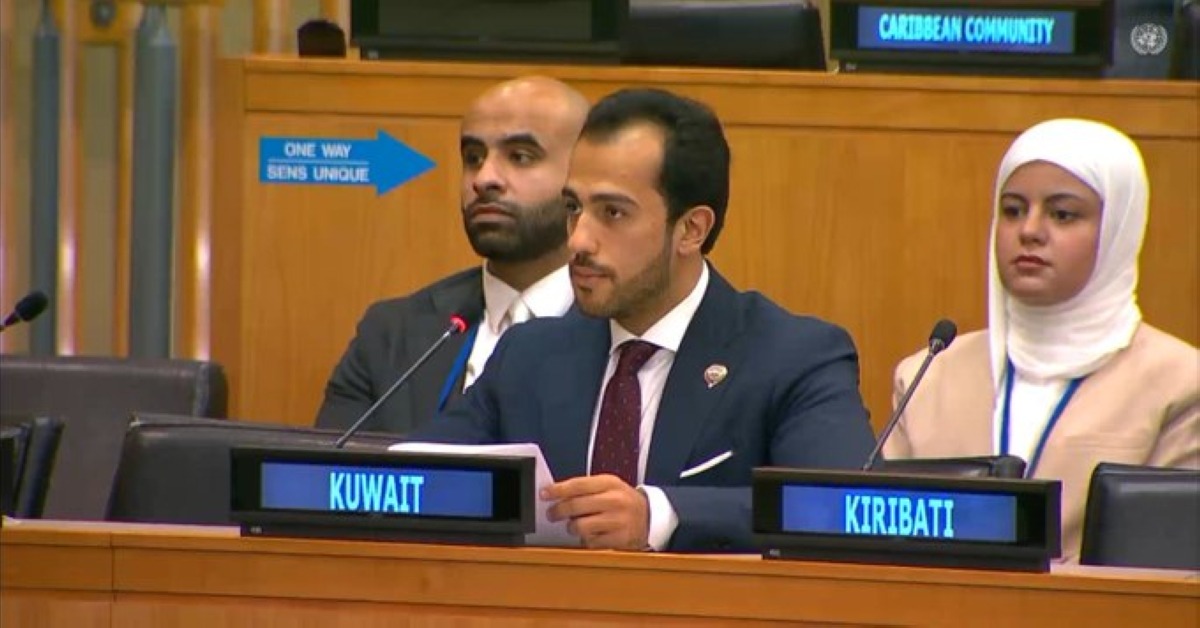
Kuwait has called for a major readjustment of the implementation mechanism of the United Nations’ 2030 Sustainable Development Agenda, urging a shift toward clear priorities that protect human capital, expand the fiscal space available to developing countries and link public and private investment to measurable development goals while respecting national priorities.
The call was made by Kuwait’s diplomatic attaché Abdullah Bousakher in a speech before the general debate of the Economic and Financial Committee, known as the Second Committee, of the United Nations General Assembly. Bousakher said the 2030 Agenda is no longer simply a test of political commitments, but a measure of the international community’s ability to turn those commitments into tangible improvements in people’s lives.
He warned that the gap between what countries have pledged and what has been achieved on the ground remains wide and is growing in areas including food security, decent work, clean energy, sustainable cities and resilient institutions. He stressed that reducing development to numerical indicators without addressing the underlying causes of inequality, financing costs and fragile supply chains risks stripping the plan of its substance. Implementation, he said, must instead be directed toward clear priorities capable of producing a tangible impact on people’s lives.
Kuwait’s National Development Approach
At the national level, Bousakher reaffirmed Kuwait’s commitment to the 2030 Agenda through the Kuwait 2035 Vision, which places economic diversification, human capital development and sound management of public finances among the key pillars of national development. He said Kuwait has incorporated the Sustainable Development Goals into its sectoral plans while strengthening investment in education, healthcare and social development, expanding youth and women’s empowerment programs, and supporting digital transformation and e-government services.
Kuwait is also working to improve resource efficiency, develop infrastructure and promote public-private partnerships in renewable energy, water management and sustainable transport, he added, contributing to a more resilient and diversified economy. Bousakher also highlighted Kuwait’s development contribution as an integral part of its foreign policy, pointing to the role of the Kuwait Fund for Arab Economic Development, established in 1961.
The fund has financed more than 1,000 development projects in 107 countries across sectors including roads, electricity, water, agriculture, education and healthcare. He said the fund provides financing on favorable terms that take into account the needs of partner countries, while strengthening the long-term impact of projects through national capacity building, knowledge transfer and local partnerships.
Development Linked to Security and Stability
Bousakher stressed that development cannot be separated from security and stability, reiterating Kuwait’s strongest condemnation of the Iranian attacks targeting its territory, in accordance with UN Security Council Resolution 2817 of 2026. He also condemned Iran’s closure of the Strait of Hormuz and threats to freedom of navigation, as well as what he described as continued obstruction and disruption of navigation in the Bab Al-Mandab Strait through its regional proxies.
Such developments have repercussions for food and energy security, raise the cost of basic commodities and hinder developing countries’ efforts to eradicate poverty and achieve the Sustainable Development Goals, he said. Bousakher called for the freedom and safety of navigation to be guaranteed in accordance with international law and the 1982 United Nations Convention on the Law of the Sea, arguing that protecting development gains is essential to advancing the 2030 Agenda.
On the Palestinian issue, Bousakher expressed Kuwait’s strongest condemnation of what he described as systematic destruction by the Israeli occupation in the occupied Palestinian territories. He said the destruction has affected infrastructure, the environment and food systems, alongside the imposition of a blockade, closure of humanitarian corridors, obstruction of aid deliveries and attacks on fields, warehouses, mills and hospitals.
He said starving civilians is a prohibited method of warfare under UN Security Council Resolution 2417 of 2018 and constitutes a violation of human dignity and a grave breach of international humanitarian law. Concluding his speech, Bousakher reaffirmed Kuwait’s position that eliminating poverty in all its forms must remain the overarching priority of the Second Committee.
He called for equitable development, predictable and sustainable financing, environmental protection and expanded social protection systems. The implementation of the 2030 Agenda, he stressed, cannot be completed without respect for state sovereignty, an end to aggression and occupation, and guarantees of peoples’ rights to security and development.