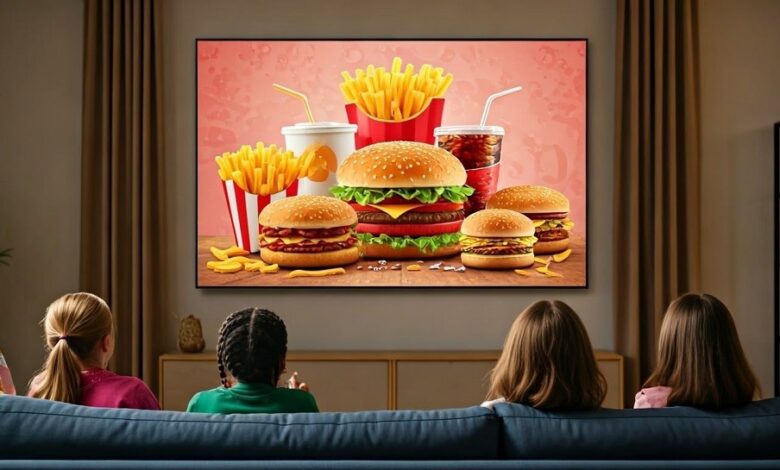
Advertising on media, whether using traditional sources such as newspapers, radio and television, or more contemporary ones such as websites and social media platforms, is an effective form of marketing products and services to customers. The success of advertisements comes from the subconscious impact they can have on our decision-making process when it comes to purchase choices.
An international team of researchers led by scientists at the University of Liverpool in the United Kingdom are now urging policymakers to urgently introduce advertising restrictions to protect the health of children. The call for advertising oversight came after new evidence from the team’s studies affirmed that even brief exposure to junk food marketing, across TV, social media, radio, or billboards, leads to overeating in children.
The research found that exposure to junk food advertisements—in comparison to viewing non-food adverts—results in children and adolescents consuming significantly more calories during the day. A randomised crossover trial also showed that the extra calorie consumption came regardless of whether advertising was on traditional or contemporary media. Moreover, brand-only ads—where only logos of food brands were advertised and have no restrictions placed on their advertising—proved just as potent as enticing image-rich food ads.
For their study, the researchers tested the eating pattern of 7–15-year-olds when exposed to just 5 minutes of adverts for foods high in saturated fats, sugar, and/or salt (HFSS). The young participants were found to consume, on average, an extra 130 kilocalories per day following their exposure to the advertisements. The research is timely given the overweight and obesity epidemic affecting children and adults worldwide.
The study also comes at a time when many countries around the world are considering implementing curbs on unhealthy food advertising to tackle rising childhood obesity levels. While the causes of obesity are complex and influenced by many factors, the study findings offer crucial novel information on the extent, nature, and impact of unhealthy food marketing via different types of media on young people’s eating behavior.
The fact that even short exposure to marketing of HFSS foods can drive excess calorie consumption and potentially weight gain among children and adolescents is particularly concerning. Children are not only more susceptible to advertising, they also tend to scroll through and view scores of pages on their digital devices each day. The display of junk food ads can influence their food choices and lead to eating habits that affect their lifelong health.
While the research highlighted the connections between product-based advertising of HFSS foods in audiovisual media and children’s consumption of calories, little is known about the impact of other forms of media, including brand-only advertising such as logos, or audio only advertisements such as podcasts and radio, on shaping eating patterns. It is also unclear whether food advertising effects differ by individuals’ sociodemographic characteristics and unequal health outcomes.
To explore this further, researchers conducted a randomised crossover trial to quantify the impact of HFSS food (vs non-food) advertisement exposure on children’s immediate and later food intake, and to assess whether this was moderated by either advertisement content (brand-only vs. product), media type (audiovisual [e.g., TV] vs. visual [some social media posts] vs. audio [podcasts] vs. static [print, billboards]), or sociodemographic characteristics.
In total, 240 school-age volunteers between the ages of 7 and 15 in the UK participated in the study. On two different occasions, participants were exposed to five minutes of HFSS food and then non-food advertisements that were either brand-only or product-based through one of the four different media. Researchers then measured children’s subsequent intake of snack and lunch foods and their height and weight to calculate their body mass index (BMI).
Home postcodes were also used to calculate area-level socioeconomic status (SES) using the 2019 English Index of Multiple Deprivation. The analysis found that following exposure to HFSS food ads, children consumed more snacks (+58.4 kcals), more lunch (+72.5 kcals), and more food overall (snack and lunch combined, +130.90 kcals) than after exposure to non-food ads. Interestingly, advertisement content did not moderate this effect, such that brand-only ads were as effective as product ads in increasing intake.
While neither the type of media (i.e., audiovisual, visual, audio, static image) nor socioeconomic status moderated children’s intake, the researchers found that for every standardised unit increase in BMI score (zBMI, adjusted for a child’s age and sex), children consumed an additional 17 kcal overall. The study postulated that unhealthy food marketing leads to sustained increases in caloric intake in young people at a level sufficient to drive weight gain over time.
This study is the first to demonstrate that brand-only food ads, for which there is currently no restrictive advertising policy globally, increase children’s food intake just as product-based advertising does. This new knowledge will hopefully lead to the enactment of broader restrictive food marketing policies that protect children’s health and promote healthier eating patterns.
Follow The Times Kuwait on X, Instagram and Facebook for the latest news updates