India’s renewable revolution captivates Davos spotlight
At WEF India steals the global spotlight with its remarkable renewable energy achievements; from record-breaking solar and storage capacity to innovative decentralized solutions for the Global South, India showcased how bold policies, cutting-edge technology, and coordinated action are transforming its energy landscape and setting a benchmark for the world.
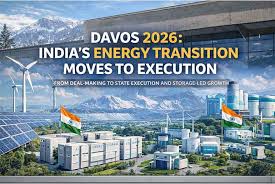
- At the World Economic Forum (WEF) Annual Meeting 2026 in Davos, India solidified its position as a global leader in the energy transition, shifting from ambitious, long-term targets to rapid, tangible execution.
- The Indian delegation, led by Union Minister for New and Renewable Energy Pralhad Joshi, showcased a landmark achievement: surpassing its 2030 goal of 50% non-fossil installed capacity, five years ahead of schedule.
As snow blanketed the Swiss Alps, the World Economic Forum Annual Meeting 2026 in Davos became more than a forum for global concerns — it emerged as a stage celebrating momentum, innovation, and action.
Amid debates on economic growth, climate change, and technological disruption, India’s renewable energy journey stood out, capturing the attention of global policymakers, investors, and industry leaders.
With scale, speed, and system defining its narrative, India’s presence at Davos underscored how a large emerging economy can achieve rapid growth while leading a global transition to clean energy.
Davos and the Global Energy Imperative
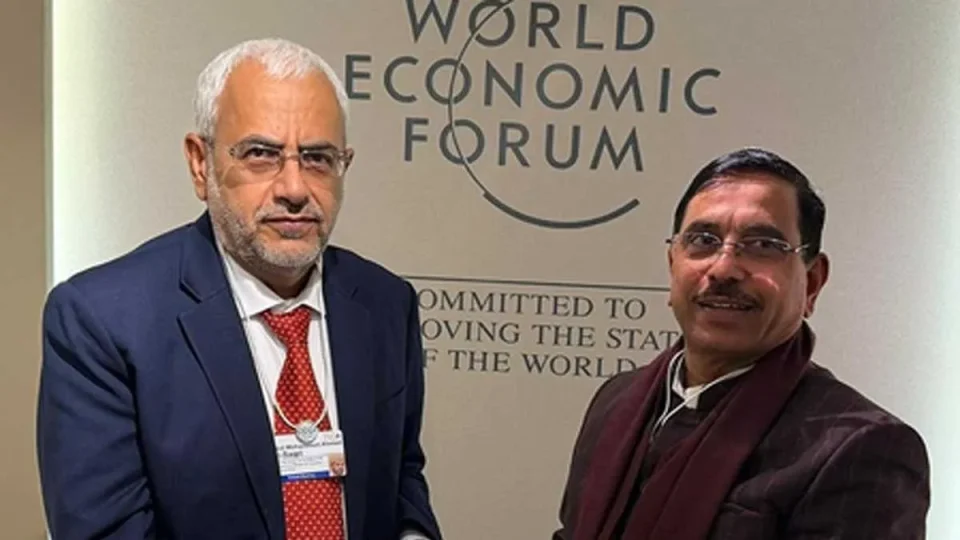
In a year when energy security, affordability, and sustainability dominate global strategy, India emerged as a model of practical execution. High-level engagements led by Union Minister for New and Renewable Energy Pralhad Joshi highlighted India’s approach as just, inclusive, and investment-ready, proving that renewable transitions can be fast, reliable, and economically viable.
India actively engaged with global leaders, including WEF President Børge Brende and Union Minister Ashwini Vaishnaw, emphasizing that government-private sector collaboration is key to resilient, sustainable development.
Execution, Not Aspiration: India in the Global Spotlight
Addressing multiple sessions, Joshi highlighted that India’s clean energy transition is anchored in execution rather than ambition alone. By December 2025, India had achieved 267 GW of non-fossil fuel capacity, a milestone underpinned by strong policy frameworks, domestic manufacturing, and institutional alignment.
Solar tariffs in India have dropped nearly 80% over the past decade, making renewable power highly competitive. Combined with storage solutions, renewables now ensure cost-effective energy, grid reliability, and national energy security.
Decentralized Energy: A Model for the Global South
India showcased its decentralized renewable solutions to developing economies, highlighting rooftop solar, agricultural solarization, and mini-grid initiatives.
Flagship program like PM Surya Ghar Muft Bijli Yojana and PM-KUSUM demonstrate how clean energy can reduce costs, expand access, and strengthen resilience in remote areas.
These initiatives offered replicable models for the Global South, emphasizing that energy transitions need adaptable solutions tailored to local contexts.
States Driving the Transition
Joshi highlighted the critical role of Indian States in implementing national policy. Madhya Pradesh, for instance, has become a leader in utility-scale renewables, offering some of the lowest solar and battery storage costs globally, along with competitive green hydrogen prices.
State-led momentum showcases how India’s federal system accelerates the clean energy transition on the ground.
Manufacturing and Future Fuels
India’s renewable push now extends beyond power generation into manufacturing and green fuels. Domestic renewable energy manufacturing stands at 144 GW, positioning India as a major clean energy market and global hub.
At Davos, Joshi emphasized India’s competitive green hydrogen and ammonia pricing, signaling the country’s readiness to become a reliable supplier in emerging clean fuel markets. Stable policies and expanding infrastructure reinforce India’s appeal as a long-term investment destination.
Investment Momentum and Global Partnerships
India’s clean energy narrative translated into concrete investor interest at Davos. Discussions with Mercuria Group focused on renewable scaling, carbon markets, energy storage, and green fuels. Mercuria plans to allocate nearly 50% of its portfolio to green energy, reflecting growing confidence in India’s ecosystem.
Joshi also pitched a USD 300 billion green energy opportunity, showcasing India’s policy stability, coordinated Centre-State engagement, and robust investment environment.
AI and Digital Platforms: Powering Efficiency
India highlighted the transformative role of Artificial Intelligence in energy. Joshi explained how AI improves forecasting, reduces losses, and enhances grid reliability.
Through Digital Public Infrastructure for Energy, India is moving from pilot projects to platform-based, scalable adoption, integrating AI across the energy value chain to strengthen efficiency and resilience.
A Credible Global Partner in Energy Transition
India’s engagements at Davos conveyed a clear message: the future of the global energy transition relies on execution, and India offers tested, scalable, and replicable solutions. From decentralized systems to utility-scale renewables, from manufacturing to digital integration, India has emerged as a trusted partner in climate-secure growth.
As the 2026 World Economic Forum concluded, India’s renewable energy achievements stood firmly in the global spotlight, signaling not just progress, but a maturing leadership role in the global clean energy transition — anchored in action, scale, and strategic foresight.