India’s 77th Republic Day: Celebrating democracy, unity, and progress

By Yash Shetty, VII-A
New Indian Private School
Special to the Times Kuwait
India celebrates its 77th Republic Day on 26th January, marking the adoption of the Constitution of India and the nation’s transformation into a Republic on 26 January 1950. On this historic day, the Constitution replaced the Government of India Act, 1935, ending the British colonial system of governance and establishing India as a sovereign, democratic republic governed by its own people.
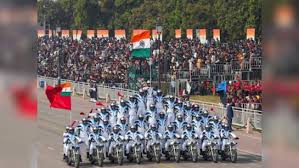
The main Republic Day celebrations are held at Kartavya Path in New Delhi, the ceremonial boulevard stretching from Rashtrapati Bhavan on Raisina Hill to India Gate. The event is hosted by the President of India and features grand military parades, cultural performances, and tableaux representing the 28 States and 8 Union Territories of India.
The Constitution of India was drafted by a seven-member Drafting Committee chaired by Dr. B. R. Ambedkar, the chief architect of the Constitution. The other members were Mohammad Saadulla, K. M. Munshi, N. Gopalaswami Ayyangar, Alladi Krishnaswami Ayyar, B. L. Mitter (later replaced by N. Madhava Rau), and D. P. Khaitan (later replaced by T. T. Krishnamachari). Their work laid the foundation for the world’s largest written Constitution.
A special feature of Republic Day is the presence of a Chief Guest, usually a head of state or government from another country. The first Chief Guest was President Sukarno of Indonesia in 1950. Last year’s Chief Guest was President Prabowo Subianto of Indonesia, while this year’s Chief Guests are Ursula von der Leyen, President of the European Commission, and António Costa, President of the European Council, representing the European Union.
The date 26 January was chosen with great significance. On 26 January 1930, the Indian National Congress, under the leadership of Pandit Jawaharlal Nehru, declared Purna Swaraj, meaning complete independence. To honour this historic declaration, the Constitution was deliberately enforced on the same date in 1950, making the people of India the ultimate source of power.
Republic Day is far more than a public holiday. It is an annual reaffirmation of India’s identity as a sovereign, secular, socialist, democratic republic. Seventy-six years after the Constitution came into force, the nation gathers at Kartavya Path to witness a spectacular celebration that bridges India’s ancient civilizational roots with its vision of becoming a developed nation by 2047.
The theme of this year’s tableaux is “Viksit Bharat 2047”, showcasing India’s goal of becoming a $30 trillion economy with world-class infrastructure. A major highlight of the 2026 celebrations is Technological Sovereignty, marked by the debut of indigenous semiconductor chips and deep-sea exploration vessels, symbolizing India’s growing self-reliance. The parade also features India’s advanced indigenous technology and, for the first time, the Army’s Remount and Veterinary Corps, presenting Bactrian camels and Zanskar ponies native to Ladakh.
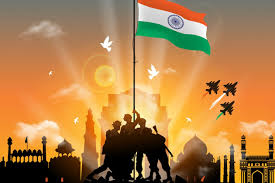
The Indian Air Force flypast remains one of the most thrilling moments, featuring Tejas fighter jets and Dassault Rafale aircraft, culminating in the spectacular Vertical Charlie maneuver. The celebrations officially conclude on 29 January with the Beating Retreat Ceremony at Vijay Chowk, a centuries-old military tradition that has been Indianized with classical Indian instruments and a grand light and drone show depicting India’s freedom struggle and future space exploration.
This year also marks 150 years of “Vande Mataram”, India’s national song. The celebrations highlight India’s achievements in space technology, led by ISRO, which has launched numerous satellites and made significant discoveries in space.
The 77th Republic Day stands as a testament to the strength and resilience of Indian democracy. In a world where many post-colonial nations struggled, India’s Republic has thrived, guided by a living Constitution that ensures justice, liberty, equality, and fraternity for over 1.4 billion people. With 448–470 Articles, 25 Parts, 12 Schedules, and 106 Amendments, it remains the largest written Constitution in the world.
As the Tricolor flutters high above Kartavya Path, Republic Day reminds us that the strength of India lies in its unity in diversity, shared responsibility, and unwavering commitment to democratic values. While the nation reflects proudly on its achievements over the past seventy-six years, the journey towards a more inclusive and developed India continues with renewed hope and determination.