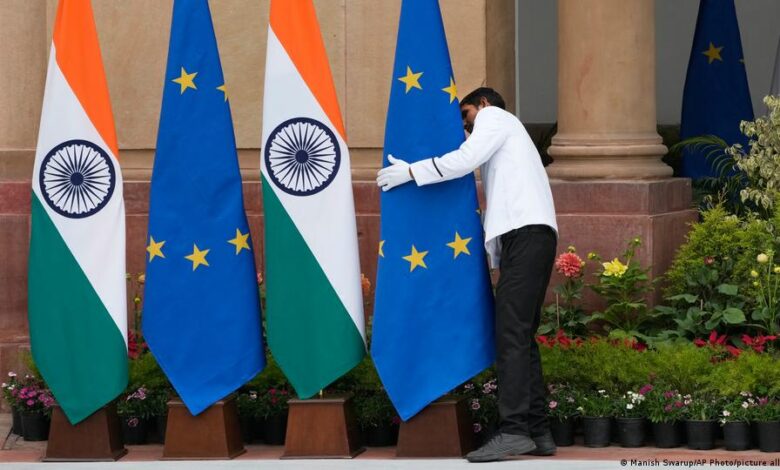
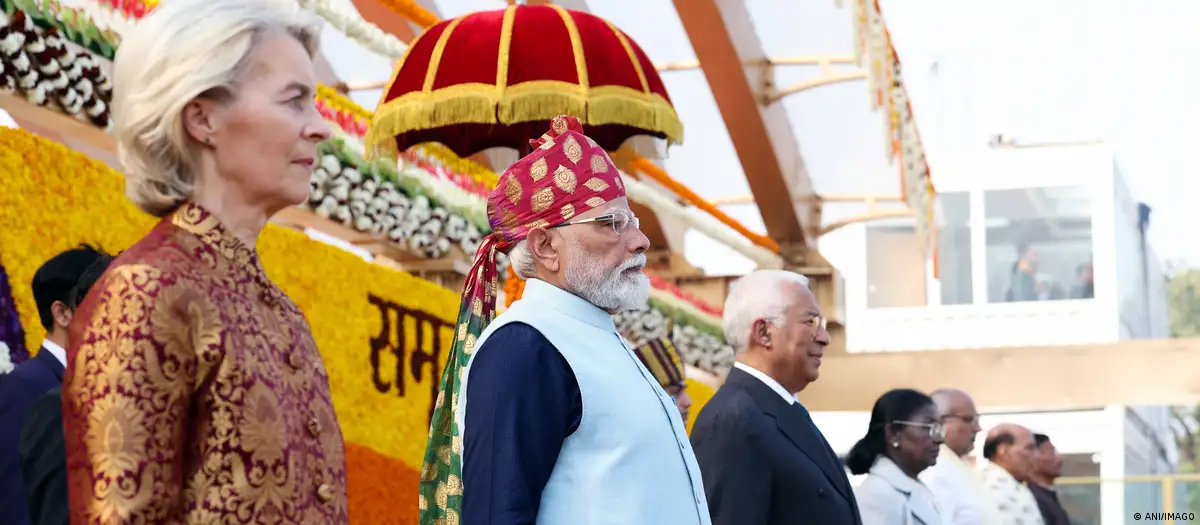
- President of the European Council, Antonio Costa, and European Commission President Ursula von der Leyen co-chair an India–EU summit with Prime Minister Narendra Modi
- The deal will pave the way for free trade of goods between the bloc of 27 European nations and India
- EU top diplomat Kaja Kallas also aims to sign a security and defense partnership with India
- India and Europe have made a clear choice. The choice of strategic partnership, dialogue and openness. We are showing a fractured world that another way is possible.” — von der Leyen
- India is a crucial partner for the EU. Together we share the capacity and responsibility to protect the rules-based international order.” — Antonio Costa, European Council President
- Their [Von der Leyen and Costa’s] presence underscores the growing strength of the India-European Union partnership and our commitment to shared values. The visit will add momentum to the deepening engagement and cooperation between India and Europe across diverse sectors.” — Indian Prime Minister Narendra Modi
- There is strong momentum for closer cooperation with India, and we are seizing it.” — Kaja Kallas, Vice-President of the European Commission
After nearly 20 years of deadlock, the proposed free trade agreement (FTA) between India and the European Union has re-emerged as a strategic priority — propelled as much by global geopolitical shifts as by newfound flexibility in policy positions on both sides.
“The sudden geopolitical circumstances have clearly facilitated the push to conclude the deal now,” Gulshan Sachdeva, Professor and Jean Monnet Chair at the Centre for European Studies at Jawaharlal Nehru University, told DW.COM in an exclusive interview.
Negotiations for the India–EU FTA began in 2007 but stalled in 2013 amid sharp differences in ambition. While Brussels sought a deep and comprehensive pact covering wide regulatory and standards-related commitments, New Delhi favored a phased, more cautious approach. Talks only resumed in 2022.
According to Sachdeva, India’s more recent trade agreements with countries such as the United Kingdom and Australia helped create practical templates that eased compromise, especially on previously sensitive issues including labor rights, environmental standards and sustainability provisions.
“Earlier India was quite resistant to these issues,” he noted. “Now policymakers have learned how to accommodate them in ways that do not necessarily translate into rigid legal obligations.”
Beyond technical trade issues, the timing of the deal carries powerful political symbolism. As global trade norms face mounting strain — particularly with the United States promoting a more unilateral and protectionist trade posture — a potential India–EU agreement sends a broader signal.
“When the global trading system is in serious trouble, a deal between the EU and a large, fast-growing economy like India sends a message that there are still countries that believe in rules-based trade,” Sachdeva said. “It also indicates that there are credible alternatives beyond the US.”
Balancing Domestic Pressures
Domestically, the agreement is not without sensitivities in India. Sachdeva pointed to concerns about opening the automobile sector to greater European competition.
However, he added that Indian industry is simultaneously pushing for improved access in areas such as financial services and information technology — sectors that could also facilitate professional mobility.
“So overall, it has to be balanced,” he said, suggesting that trade-offs across sectors may help smooth internal resistance.
US Criticism Adds Geopolitical Edge
The revived momentum has drawn sharp criticism from Washington. US Treasury Secretary Scott Bessent publicly rebuked the EU for advancing trade ties with India while US–India negotiations remain strained in the context of the Russia–Ukraine war.
Speaking to ABC News, Bessent argued that Europe was “financing a war against itself” by deepening trade engagement with New Delhi, claiming it undercuts US efforts to pressure India over its continued purchases of Russian oil.
“We have put 25% tariffs on India for buying Russian oil. Guess what happened last week? The Europeans signed a trade deal with India,” Bessent said. He further alleged that Russian crude is shipped to India, refined and then exported to European markets.
A Relationship Decades in the Making
India–EU ties date back to 1962, when India established diplomatic relations with the European Economic Community, the EU’s predecessor. Over the decades, cooperation has expanded steadily across trade, technology and security domains.
Today, the EU stands as India’s largest trading partner in goods, with bilateral trade reaching approximately €120 billion in 2024. The relationship was elevated to a Strategic Partnership in 2004, marking its 20th anniversary in 2024.
Engagement has deepened further through the India–EU Trade and Technology Council, launched in 2022, with collaboration spanning semiconductors, 6G research and artificial intelligence. Security cooperation has also expanded, including joint naval exercises.
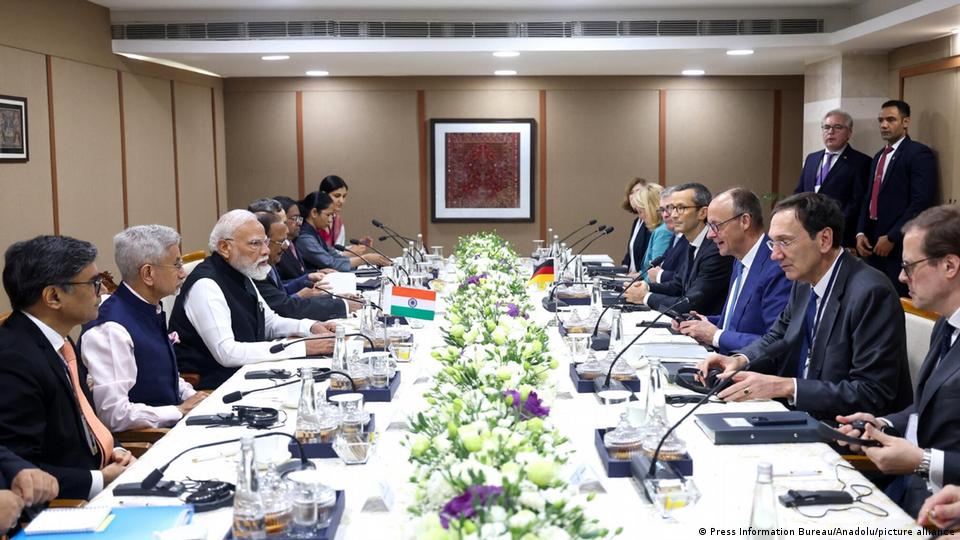
In January, German Chancellor Friedrich Merz signaled Berlin’s intention to strengthen security cooperation with India, partly aimed at reducing India’s dependence on Russia. Following talks with Prime Minister Narendra Modi, the two countries signed agreements covering critical minerals, healthcare and an artificial intelligence innovation center.
“The MoUs being signed today (Tuesday) on all these issues will give new momentum and strength to our cooperation,” Modi said at a joint press conference.
With geopolitical realignments accelerating and major powers recalibrating their trade strategies, the India–EU FTA is increasingly seen not just as an economic agreement — but as a strategic statement about the future shape of the global trading order.