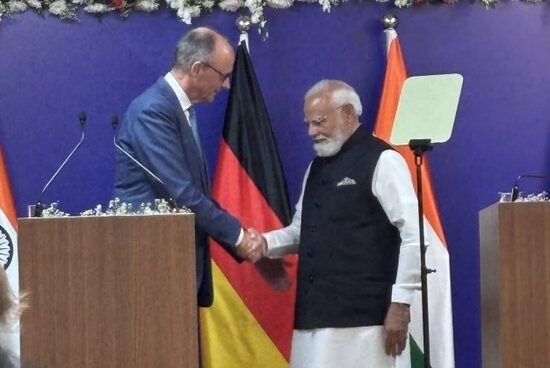
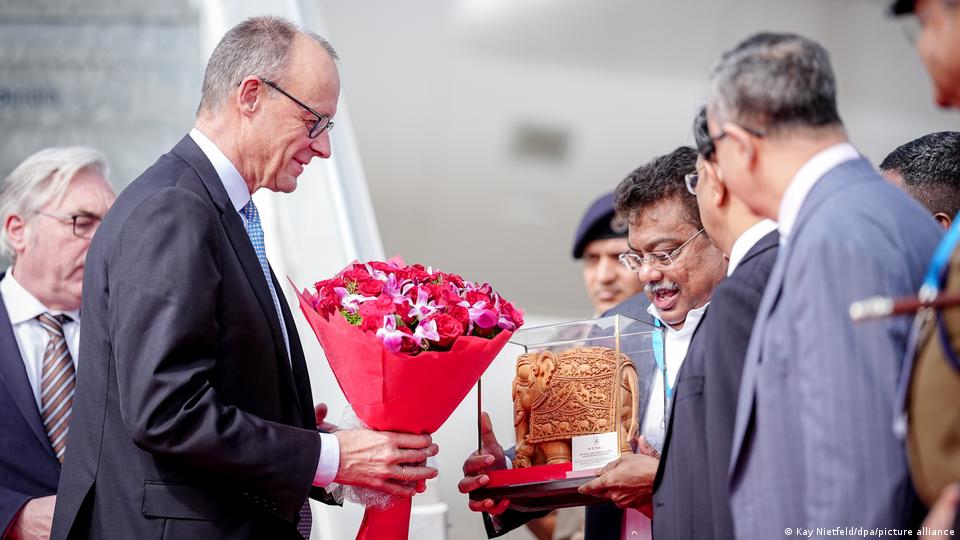
German Chancellor Friedrich Merz’s maiden visit to India marks a strategic turning point in bilateral relations, with both sides committing to deepen cooperation in trade, defense, technology and global governance. The visit comes just weeks ahead of the planned signing of the long-awaited EU-India Free Trade Agreement, which both leaders pledged to conclude by the end of January.
At the heart of the talks with Prime Minister Narendra Modi was a strong reaffirmation of shared democratic values and commitment to a rules-based international order, positioning India as a key European partner in an increasingly fragmented global landscape, reports dw.com
Trade and economic ties dominated the agenda, with Modi confirming that bilateral trade with Germany reached a record $50 billion in 2024, making Germany India’s largest trading partner in Europe. Both leaders stressed the importance of expanding investment, supply chains and industrial cooperation.
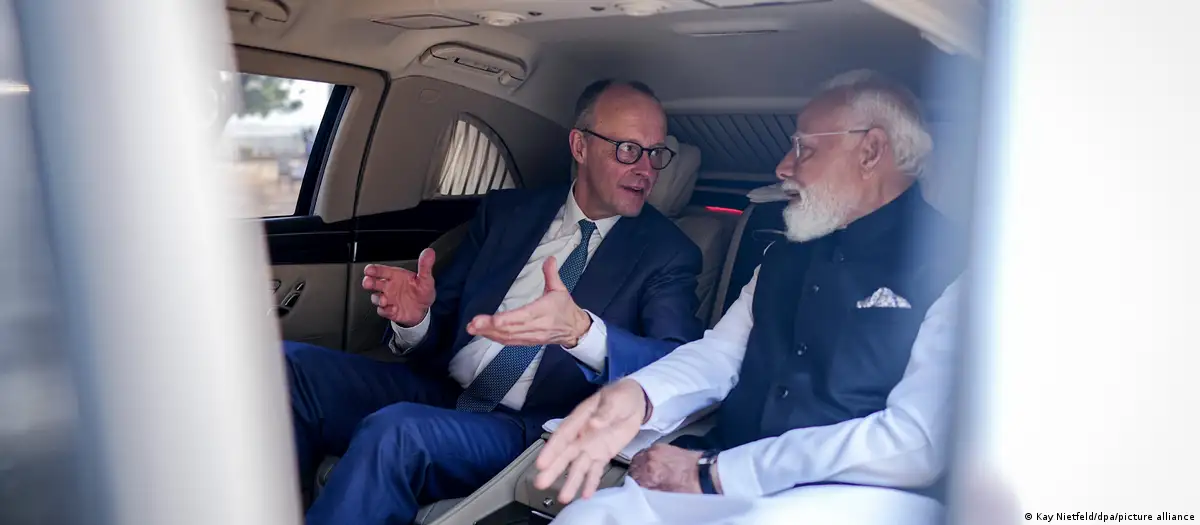
Defense and security cooperation emerged as a major pillar of the relationship. Merz and Modi signed a declaration of intent to develop a defense industry roadmap, focusing on joint production, technology partnerships and military-to-military cooperation through exchanges and joint exercises.
A potential €8 billion submarine deal between Germany’s Thyssenkrupp Marine Systems and India’s Mazagon Dock Shipbuilders remains under negotiation. Indian officials said discussions are progressing with “positive momentum,” although no final agreement has yet been announced.
The leaders also agreed to strengthen cooperation in critical technologies, artificial intelligence, rare earth supply chains and innovation, with plans to establish an India-Germany Centre of Excellence as a shared platform for knowledge and research.
On global issues, both sides condemned the Iranian government’s violent crackdown on protesters, with Merz calling the use of force a sign of weakness and Modi denouncing the violence in the strongest terms.
Russia’s war in Ukraine featured in discussions, with Merz urging India to reduce dependence on Russian oil. While Modi did not offer firm commitments, both leaders acknowledged the complexities of India’s energy needs and agreed to maintain dialogue.
A sensitive humanitarian issue, the case of Baby Ariha, an Indian child in German social care, was raised by Modi. India reiterated its commitment to pursue the matter at every diplomatic level to secure her return.
The visit also highlighted growing people-to-people ties, with Germany now home to around 280,000 Indian nationals, including 60,000 students. Indians form the largest group of international students in Germany and are among the highest-earning foreign workers.
Modi welcomed Germany’s efforts to simplify defense trade procedures and praised the Global Skills Partnership, which aims to facilitate the mobility of healthcare professionals and skilled workers between the two countries.
Culturally, Merz’s visit to Ahmedabad, including the Gandhi Ashram and kite flying with Modi, underscored the symbolic and historical dimension of the partnership, blending diplomacy with cultural connection.
On the second day, Merz travelled to Bengaluru, India’s technology capital, where he visited German companies such as Bosch and the Indian Institute of Science’s Centre for Nano Science and Engineering, highlighting the depth of tech-driven cooperation.
Experts described the relationship as now “truly strategic,” noting that defense, technology and Indo-Pacific cooperation are shaping a new phase of engagement beyond traditional trade ties.
Overall, Merz’s first visit to India as chancellor signaled Berlin’s clear preference for India as a long-term strategic partner, reflecting a broader European shift towards trusted alliances amid global uncertainty.
The trip concluded with both sides projecting confidence that India-Germany cooperation is not only bilateral in impact but significant for global stability, positioning the partnership as a cornerstone of future Europe-Asia relations.