From Services to Experiences, Human-Centered Government Must Define Kuwait’s Next Phase of Reform


By Sarah Al Sabah
Government Advisor & Communication Strategist
Special to The Times Kuwait
Governments today are not judged only by the elegance of their policies; they are judged by the lived experiences they create for people. Citizens expect services to be as intuitive as the best private-sector platforms they use daily. When interactions with the government are confusing or time-consuming, trust erodes. When they are smooth, clear, and responsive, confidence grows. As Kuwait advances toward Vision 2035, human-centered government must become a defining pillar of its next phase of reform.
Human-Centered Approach: A human-centered approach begins with a simple shift in mindset: designed around people, not procedures. Instead of asking how ministries operate internally. We must ask what the citizen or the resident actually experiences when having a child, starting a business, applying for a service, or navigating a regulatory process. The key is life-event models, where services are organized around key moments in a person’s life. Around the world, governments that have adopted life-event models have seen major gains in satisfaction and efficiency. Kuwait has taken steps in this direction through unified platforms like Sahel. The opportunity now is to embed this thinking across the entire government.
Listening Systems for Human- Centered Government: Human-centered government requires listening systems that continuously capture citizen needs. Surveys, digital feedback tools, and service-center observations help governments spot pain points early. But more importantly, they create a culture where public institutions learn and adapt.
Multi-way communication: citizens to government, government to citizens, and horizontally across government sectors. A multi-way communication system builds transparency and strengthens the public’s sense of partnership. This is essential for modern governance. Trust must be earned through daily actions, not occasional announcements.
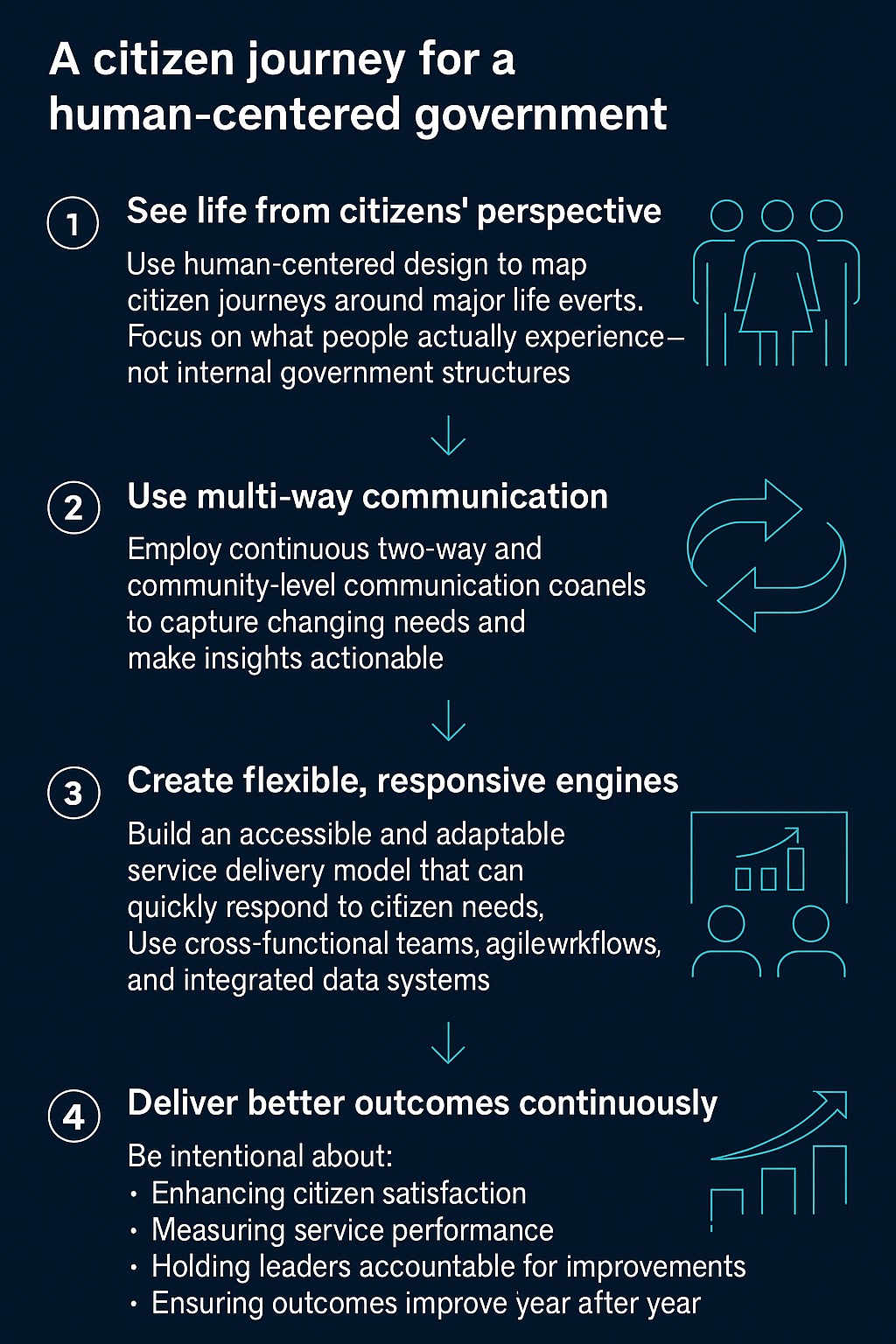
From Transactions to Experiences: Shifting from transactions to experiences is at the heart of this transformation. Many frustrations with public services stem not from the service itself but from the journey to access it: unclear instructions, multiple visits, repetitive paperwork, or lack of status updates. Efficiency alone does not solve this. What matters is how people feel during the process. Are the people confident or confused, supported or lost? Studies consistently show that citizens who have positive service interactions are far more likely to trust government institutions. That trust becomes a foundation for national stability and economic confidence.
Kuwait can build on global best practices by applying service design methods, journey mapping, and behavioral insights to redesign key public experiences. This means analyzing every step from a citizen’s perspective. The idea is to identify where friction occurs and remove unnecessary burdens. Redesigning processes around clarity, transparency, and emotional ease does more than improve efficiency. Redesigning shapes a government that feels accessible, humane, and responsive.
Human-centered government begins with seeing services through the eyes of the citizen — as one coherent journey, not separate transactions.
Technology: Technology plays a vital role. The aim in the use of technology is as an enabler not a substitute for human insight. Digital transformation succeeds only when guided by empathy. A poorly designed digital service can frustrate people just as much as a slow in-person procedure. Artificial intelligence and data analytics offer powerful opportunities to personalize services and anticipate needs. For instance, proactively alerting a citizen about required renewals or eligibility for benefits. AI cannot replace compassion, cultural understanding, or the reassurance that comes from a human interaction when complexity arises. The most successful digital governments use technology to amplify the human touch, not eliminate it.
Lead Citizen Experience: Kuwait is well positioned to lead in citizen experience. The country already benefits from high digital readiness, strong institutional reform momentum, and a young population eager for modernized services. What comes next is embedding human-centered principles into everyday government operations. Ministries can develop citizen-experience blueprints for major life events. One way is to map out the ideal journey and align all relevant agencies. These blueprints serve as shared frameworks, ensuring coordination across the public sector and reducing inefficiencies that burden citizens.
Public Servants as Experience Designers: Equally important is investing in public servants as experience designers. This requires training in design thinking, empathy-based engagement, and cross-government collaboration. Many countries now operate service design labs. A place where innovation teams prototype and test solutions before wider rollout. Kuwait could create similar hubs to drive reform from within. The result would empower teams to challenge old assumptions and rethink how services should be delivered in a digital, human-centered era.
Beyond Administrative Improvement: The rewards of this transition extend far beyond administrative improvement. Human-centered government strengthens the social contract. Through this system government actions illustrate to citizens and residents that their time, dignity, and needs matter. This type of government system supports economic diversification.
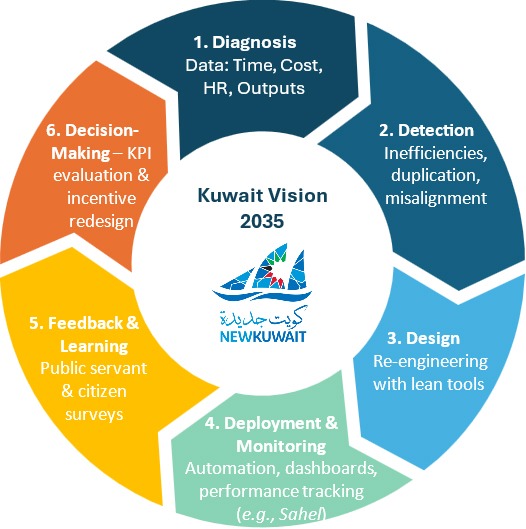
When bureaucracy eases, it opens the path to start businesses, attract investment, and navigate regulation. Human-centered government contributes to national unity. The system ensures public services are fair, inclusive, and accessible to all. Ultimately, human-centered government aligns with Vision 2035 in that it envisions a government that is efficient, transparent, and responsive to people.
The Next Chapter: As Kuwait steps into its next chapter, the question guiding reform should be simple: Does this make life easier, clearer, and more dignified for the people we serve? When the answer is yes, then the government becomes more than an institution; it becomes a partner. Human-centered government is the path that transforms strategic ambition into everyday impact. Mainly human-centered government ensures that every citizen and resident feels seen, heard, and supported on the journey toward Kuwait Vision 2035.
Editors Note: As Kuwait accelerates its national transformation under Vision 2035, the question is no longer whether government services should be digital, but whether they are truly designed around people’s lives. This op-ed explores why human-centered government, grounded in empathy, listening, and real-life experience, must guide Kuwait’s next era of reform.
The analysis offers timely insight for policymakers, innovators, and public leaders. From service design labs to AI-enabled personalization. The article highlights practical pathways for building a government that earns trust through every interaction.