From Samarkand to Failaka: When the Earth Speaks the Language of Civilization

By Tareq Yousef Alshumaimry
Former Secretary-General of the Commercial Arbitration Centre
of the Gulf Cooperation Council
Cities thousands of years old reveal striking parallels between Uzbekistan’s heritage and Kuwait’s story. A few days in Tashkent and Samarkand inevitably lead one to reflect on Kuwait’s history.
In August 2026, I participated in the International Media Forum, “Islamic Civilization: A New Perspective – New Discoveries,” which brought together around 300 experts and media representatives from nearly 50 countries.
Between the forum’s sessions and visits, however, something else made itself unmistakably felt: history remains alive in these places.
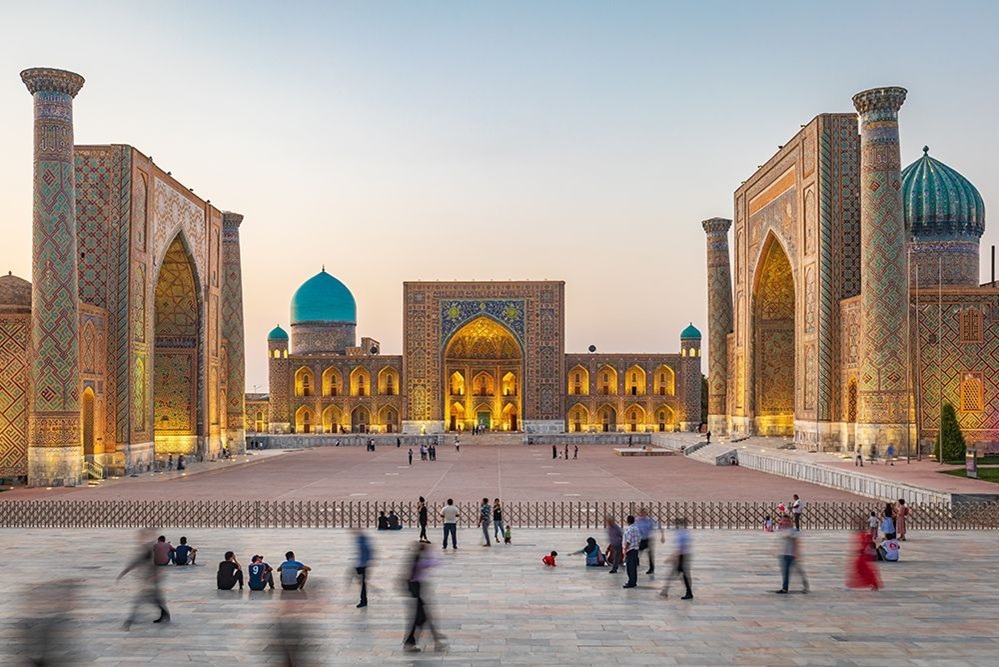
A History That Is Still Alive
In my address to the forum, I said that the real challenge facing the media today is not simply to preserve the memory of Islamic civilization, but to present it anew to younger generations in a language that enables them to feel that this history is part of their own story and heritage not merely pages in an old book.
The idea that Tashkent and Samarkand share cultural and civilizational similarities is not difficult to grasp. I saw it in their buildings, markets, mosques and roads, and even in the way people welcome their guests. From there, my thoughts naturally turned to Kuwait.
I began looking at Kuwait through the same lens with which I viewed Samarkand, and in many archaeological and historical sites I discovered that Kuwait, too, has a deep and remarkably similar civilizational story.
Samarkand – More Than Two Thousand Years of History
Today, Samarkand stands as one of the oldest historic cities in Central Asia. UNESCO indicates that evidence of settlement in the area dates back to around 1500 BCE, while Afrasiab, ancient Samarkand, was established in the seventh century BCE.
Yet Samarkand’s greatness is not simply a consequence of its age. Its true advantage lay in its location. The city stood at the crossroads of caravan routes carrying goods, ideas and cultures between China, Central Asia, Persia and the Middle East.
By the early centuries of the Common Era, Samarkand had become an important center along the Silk Roads, reaching the height of its glory during the Timurid period in the 14th and 15th centuries. UNESCO has therefore described it as a “cradle of cultures.”
Standing before Samarkand’s history, its scholars, jurists, mosques and architecture it is difficult to regard these figures and monuments simply as relics of the past. They are remnants of an era in which architecture, science, astronomy, trade and politics formed part of a single civilizational project.
Tashkent – A Story That Began Before the Name We Know Today
In Tashkent, the story takes me back to the ancient region of Chach and the archaeological city of Kanka. UNESCO identifies Kanka as the first capital of Chach, a vast fortified city through which the Silk Road network once passed.
Agriculture also developed in this region centuries before the Common Era, with water, farming and trade becoming fundamental drivers of the growth of urban settlements. This offers an important lesson for us in the Gulf: ancient civilizations did not wait for perfect conditions. They turned geography into opportunity.
Uzbekistan had no sea, but it was at the heart of Asia, so it transformed the caravan routes into lifelines. Kuwait was not at the heart of the continent, but it stood at the head of the Gulf, and it transformed the sea into its gateway to the wider world.
Kuwait – A Story That Began More Than 7,000 Years Ago
The Kuwait we know today with its modern cities, ports, roads and markets conceals beneath its soil a history stretching back to the end of the sixth millennium BCE, more than 7,000 years ago.
In Subiya, north of Kuwait, archaeological excavations have uncovered settlements associated with the Ubaid culture, workshops for producing shell beads, and evidence of maritime activity, including a clay model of an early seagoing boat.
The discovery of Greek-era remains on Failaka Island, dating to the third century BCE, makes the picture even more compelling. Among the most significant is the Ikaros inscription, dated approximately to between 246 and 226 BCE, which UNESCO added to the Memory of the World Register in 2025.
These discoveries make one thing clear: Kuwait was not a remote periphery of the great civilizations of the ancient world. It was part of their network of communication and exchange.
The National Council for Culture, Arts and Letters has noted that archaeological surveys and excavations indicate that human settlement in Kuwait began in the late sixth millennium BCE. Excavations at Subiya have documented Ubaid-period sites, shell-bead workshops, evidence of maritime activity and a clay boat model.
The end of the third millennium and the beginning of the second millennium BCE also witnessed the emergence of Bronze Age villages, with evidence of this period found at several locations and islands across Kuwait, including Failaka, Umm Al-Namil, Shuwaikh and northern Kuwait Bay.

Samarkand and Kuwait – Caravans and Trading Ships
I have not found evidence of a direct ancient route linking Samarkand and Kuwait. The similarity, however, lies in the role each played. Samarkand was a station for caravans, while Failaka and Kuwait served as stations for ships.
Samarkand opened its doors to travelers arriving from the East and West; Kuwait opened its shores to those arriving from the north, east and south of the Gulf. Both transformed trade into something greater than an exchange of money.
They created communities that encountered people from elsewhere, engaged with them and benefited from their differences.
The Guest Comes First – A Shared Tradition in Kuwaiti and Uzbek Homes
In Kuwait and across the Gulf, one does not need a history book to understand the meaning of hospitality. The majlis, coffee, dates and food, asking after the guest and the host’s insistence on honoring and welcoming them are all traditions that Kuwaitis and Gulf Arabs understand instinctively.
In Uzbekistan, I encountered something remarkably similar. Hospitality expressed through tea, bread, shared family meals and a warm welcome is not simply a tradition maintained for visitors or tourists. It is deeply rooted in Uzbek social culture.
Even the marketplace has a similar role. The old markets of Samarkand and Tashkent were not merely places for buying and selling, just as Kuwait’s traditional markets were never simply shops. They were places to meet, exchange news, build relationships and introduce new cultures into society.
The same can be said of the respect for knowledge
Samarkand became associated with scholars of astronomy, mathematics, medicine and religion, while Kuwait developed, from an early period, a tradition of kuttabs, religious education and scholarly gatherings before the emergence of modern formal education. The details may differ, but the value placed on knowledge and learning feels familiar in both experiences.
The Modern Story of Kuwait and Uzbekistan
The most encouraging aspect of the Kuwait-Uzbekistan story is that it does not end with the past. On February 17 and 18, 2025, Uzbek President Shavkat Mirziyoyev visited Kuwait, opening a new chapter in relations between the two countries. The two sides announced the elevation of their relationship to the level of a comprehensive partnership.
The agreements covered a wide range of sectors, including industry, aviation, labor, smart cities, healthcare, tourism, culture and the arts, in addition to cooperation with the Kuwait Fund for Arab Economic Development.
In the past, caravans and ships did not necessarily provide a direct route between Kuwait and Samarkand. Yet they were among the most important instruments of commercial and cultural exchange in both regions.That connectivity today is being carried forward through investment, aviation, technology, artificial intelligence, education and development projects.
The Kuwait Fund for Arab Economic Development, established in 1961, represents one of the clearest practical expressions of Kuwait’s relations with countries around the world.
It was never merely a financing institution; it became one of the ways Kuwait established its presence and reputation across the developing world.
In Uzbekistan, the Fund financed development projects including a rural housing infrastructure project through loans, and contributed to a project to equip specialized medical institutions in urology, kidney diseases, dialysis and kidney transplantation.
As modern Uzbekistan advances its development vision, I see opportunities for cooperation expanding into infrastructure, logistics, agriculture, green energy, healthcare, industry, services and investment.
This is how political relations can evolve into development partnerships rooted in a shared civilizational outlook.
From the Memory of Civilization to a Future of Cooperation
Perhaps what stayed with me most from the forum in Tashkent is the realization that the story of civilization should not remain confined to museums and books. A living civilization is one that can move from memory into the future.
That is why, when I think of Samarkand today, I no longer see it as a distant and unfamiliar city in Central Asia. I see a city that resembles Kuwait in an important way: both recognized early that openness to the world could be a source of strength rather than a threat to identity.
The caravans of Samarkand carried silk and ideas. Kuwaiti ships carried pearls, goods and news.
Today, airplanes, investments, universities, media and culture can carry something even more valuable: partnership between two peoples. Both peoples have deep histories, and both look toward the future. The goal is not to live in the past, but to understand it well so that we do not build the future without roots.
From Samarkand to Failaka, and from the Silk Roads to the Gulf routes, times change and means of communication evolve. Yet humanity continues to search for connection, learning and trade to discover the other, and then return home enriched by what it has learned from the wider world.
There may be no single ancient road between Kuwait and Samarkand that can be traced on a map. But between them lies an idea that is far older:
Civilization begins when geography is transformed from a boundary into a bridge of cooperation and partnership.

Tareq Yousef AlShumaimry, served as Chairman of the Finance Committee and Chairman of the General Budget Committee of the Permanent Court of Arbitration in The Hague (PCA) and an observer in the Administrative Council of the Court and the Consular at International Court of Justice (ICJ) and the Embassy of the State of Kuwait in the Netherlands during this period from 2013 to 2020. Email: tareq@alshumaimry.com