A Culinary Journey Across 27 Nations
As part of a series The Times Kuwait will publish recipes of the European Union on a weekly basis. We begin the first part with Austria.
Food has a remarkable way of bringing people together, transcending borders, languages and cultures through the universal pleasure of sharing a meal. From treasured family recipes passed down through generations to distinctive regional specialities shaped by history and tradition, every dish tells a story of the people, places and heritage behind it. It is this spirit of cultural discovery and togetherness that lies at the heart of A Union of European Flavours, a celebration of the culinary diversity of the 27 Member States of the European Union.
Launched by the Delegation of the European Union in Kuwait, the cookbook brings together an extraordinary collection of recipes contributed by the embassies of EU Member States accredited to the State of Kuwait. Each recipe offers readers a taste of Europe’s rich gastronomic landscape, revealing the unique ingredients, cooking techniques and traditions that distinguish one country from another while highlighting the shared appreciation for good food that unites them all.
From the Mediterranean’s vibrant flavours and the rustic warmth of Central European kitchens to the distinctive specialities of Northern and Eastern Europe, the collection takes readers on a journey across a continent where food is deeply intertwined with identity, history and everyday life. Behind every recipe lies a tradition shaped by geography, local produce, family customs and generations of culinary knowledge. Together, these dishes offer more than inspiration for the kitchen; they provide an intimate glimpse into the cultural character of Europe’s diverse nations.
Yet, A Union of European Flavours is about more than cooking. It reflects the belief that food can serve as a bridge between cultures, encouraging curiosity, conversation and mutual understanding. In Kuwait, where diverse communities come together and hospitality remains an important part of social life, the cookbook also celebrates the shared values that connect Europeans and Kuwaitis around the dining table.
As the European Union and Kuwait mark four decades of diplomatic relations, this culinary collection carries a special significance. It brings the partnership between the two sides into homes and kitchens, inviting readers to explore unfamiliar flavours, recreate traditional dishes and discover the stories that make each cuisine unique.
Whether prepared for a family gathering, a festive occasion or a simple everyday meal, every recipe offers an opportunity to experience a different part of Europe. Ultimately, A Union of European Flavours reminds us that while culinary traditions may differ, the joy of preparing food, welcoming guests and sharing a meal is universal. Through these 27 national cuisines, the cookbook celebrates not only Europe’s extraordinary diversity but also the enduring friendships that grow whenever cultures meet around a table.
EUROPEAN FOOD CULTURE
Austria: WIENER SCHNITZEL
The Original Wiener Schnitzel is made from veal
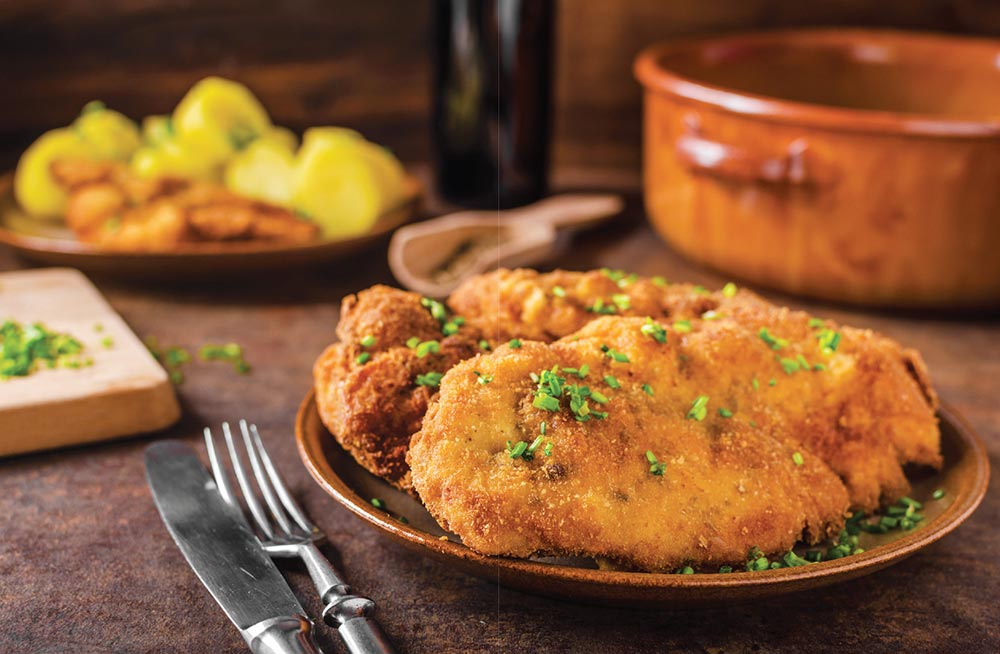
The dish is traditionally served in Austria with lettuce tossed with a sweetened vinaigrette dressing, optionally with chopped chives or onions, potato salad, cucumber salad, or parsley potatoes. Currently, it is also served with rice, French fries, or roasted potatoes.
If you ever are in a small Austrian restaurant, the beating noise out of the kitchen tells you exactly when a Schnitzel is in process, because a true Wiener Schnitzel should be beaten to a very thin thickness.
The Schnitzel is one of the best-known specialties of Viennese cuisine and is a national dish of Austria. According to a legend, Field Marshal Joseph Radetzky von Radetz brought the recipe of “Wiener Schnitzel” from Italy to Vienna in 1857.
INGREDIENTS
- For 4 persons
- 600 g veal
- About 200 g flour
- 3 eggs
- About 300 g dry bread crumbs
- Lemon slices and parsley for garnish
PREPARATION
- Beat the meat to approximately 4 mm thickness.
- Incise the edges and put salt on both sides.
- Prepare 3 plates, each containing flour, beaten eggs (a little salt, pepper and 1 spoon of milk can be added), and dry, very fine bread crumbs.
- Coat and dip the meat on both sides in the following order: 1. flour, 2. eggs, 3. dry bread crumbs.
- Heat oil (2–3 cm deep) in a large, flat pan to a high temperature (a piece of butter added to the oil improves the taste of the “Wiener Schnitzel”).
- Lay in the meat and fry it for about 2 to 3 minutes (to be fried in a frying pan, not in a deep fryer), depending on the thickness of the meat. Turn only once. The color should be golden brown on both sides.
- Remove the Wiener Schnitzel and drain on kitchen paper.
- Serve garnished with slices of lemon and parsley.