
















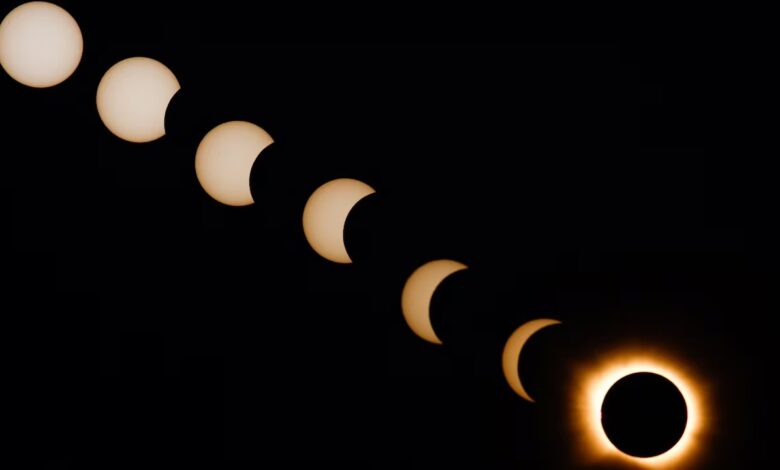
Europe witnessed a rare celestial spectacle on August 12, as the Moon’s shadow swept from Iceland across Spain, bringing the continent its first total solar eclipse since 1999 and giving mainland Spain its first such event in more than a century.
For several extraordinary minutes, the Moon completely covered the Sun along the path of totality, plunging parts of Europe into darkness and revealing the Sun’s normally hidden corona.
The shadow first crossed northern Russia before moving through Greenland, Iceland and the Atlantic Ocean, eventually reaching Spain and a small part of Portugal. Near Iceland, totality lasted as long as two minutes and 18 seconds.
Around 15 million people lived within the path of totality, while hundreds of millions more across Europe, parts of North America and northwestern Africa were able to see at least a partial eclipse.
Spain captures one of the most dramatic views
Spain offered some of the most striking scenes of the eclipse. The event began there at around 5:30 p.m. UTC, or 7:30 p.m. local time, with totality reaching different parts of the country roughly an hour later.
Because the Sun was already low in the western sky, photographers had an unusual opportunity to capture the eclipsed Sun against landscapes rather than viewing it high overhead. The low position of the Sun was one of the defining features of this eclipse, as the Moon’s shadow traveled across the northern part of the planet.
In northern Greenland, totality was particularly striking, briefly bringing darkness to areas that had experienced almost continuous daylight throughout the summer.
Burgos: A sudden transformation
National Geographic Explorer Rüdiger Ortiz-Álvarez watched the eclipse from Burgos, Spain, close to the center of the path of totality. He described the transition from daylight to darkness as sudden and surreal, with the Sun’s corona appearing around the Moon’s dark silhouette.
The dramatic change also affected wildlife. Ortiz-Álvarez observed birds suddenly flying toward shelter as though night had arrived without warning.
Researchers documented similar reactions from animals through citizen-science projects, including Ecoeclipse, a Spanish initiative examining how the eclipse affected the acoustic behavior of birds and bats.
A different perspective from the Ebro Delta
Catalan photographer and National Geographic Explorer Wayra Ficapal had planned to experience the eclipse in Spain for about a year, but selected her final location only a week before the event.
After realizing that the Moon’s shadow would follow much of the Ebro River from northern Spain toward its Mediterranean outlet, she chose the Illa de Gràcia bridge in Sant Jaume d’Enveja in the Ebro Delta. Her aim was to capture the eclipsed Sun reflected across the water, offering a distinctive landscape perspective of the rare event.
Millions experienced the eclipse
The eclipse was not only a spectacular visual event but also an important opportunity for scientists studying the Sun. Researchers positioned along the path of totality used the brief period when the corona became visible to collect observations and images that can help advance understanding of the Sun’s outer atmosphere.
Viewers were reminded that proper eye protection was essential whenever any portion of the Sun remained visible. Certified eclipse glasses or an appropriate solar filter were required during the partial phases, while direct viewing was safe only during the brief period of complete totality.
Eclipse meets the Perseid meteor shower
The celestial spectacle continued after the eclipse. The Perseid meteor shower reached its peak later that same night, creating the possibility of another unusual skywatching experience.
Because a solar eclipse occurs only during a new moon, there was little moonlight to interfere with observations of the meteor shower. Under favorable conditions, observers could potentially have seen a bright Perseid meteor even during the brief period of totality.
For millions across Europe, however, the defining moment remained the same: the Moon’s shadow arrived, daylight faded and the Sun’s corona emerged against a darkened sky, creating a rare spectacle that many observers had waited decades to experience.