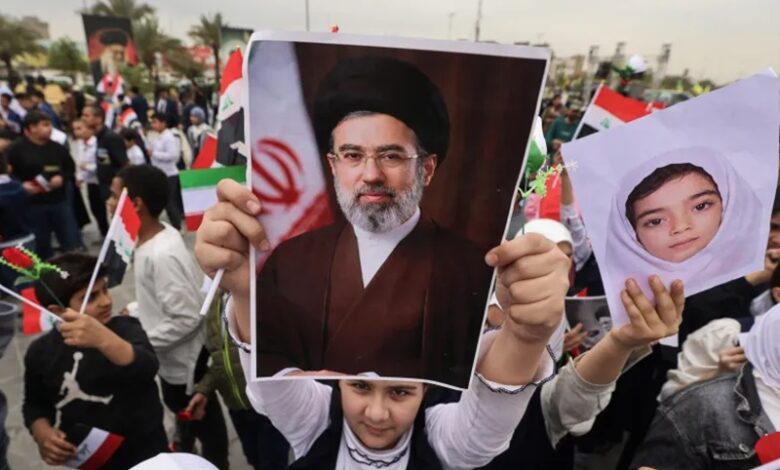
Tensions across the Middle East have intensified after Iran’s newly appointed Supreme Leader, Mojtaba Khamenei, issued his first statement since assuming leadership, outlining a hardline stance against the United States and reaffirming Iran’s intention to maintain pressure in the region.
The statement, read by a presenter on Iranian state television, comes as the conflict involving Iran, Israel, and the United States continues to expand across the Middle East.
Khamenei, who has not appeared publicly since succeeding his father, Ali Khamenei, warned that all US military bases in the region should be closed immediately or they would remain targets for Iranian attacks.
He emphasized that Iran seeks “good relations” with neighboring countries, but stated that Iranian forces would continue striking US bases located on their territory as part of what he described as defensive retaliation.
Key Points from Khamenei’s First Statement
In his message, Khamenei outlined several major positions that signal Iran’s strategy moving forward:
- All US military bases in the region should be shut down immediately or face continued attacks.
- Iran seeks positive relations with neighboring states and says its operations are directed solely at US bases located in those countries.
- The Strait of Hormuz should remain closed as a pressure tool against Tehran’s adversaries.
- Iran will continue fighting to “avenge the blood of its martyrs,” from the slain former supreme leader to civilians, including children, killed in recent attacks.
- Khamenei praised Iran’s armed forces for preventing the country from being “dominated or divided,” acknowledging their sacrifices and pledging financial and humanitarian support for those affected by the war.
- He also called for national unity among Iranians, stressing the need to overcome internal differences during the conflict.
Strait of Hormuz at the Center of the Crisis
The Strait of Hormuz remains one of the most sensitive flashpoints in the escalating conflict. The narrow waterway links the Persian Gulf to the Gulf of Oman and is one of the world’s most important maritime routes for oil and gas shipments.
Nearly one-fifth of the world’s oil supply passes through the strait, meaning any disruption to shipping could have immediate consequences for global energy markets and international trade.
Attacks on Commercial Shipping
Maritime tensions have also risen sharply in recent days. Several commercial vessels have reportedly come under attack in the Gulf region.
Two oil tankers were struck near the coast of Iraq, while a container ship was hit in waters near the United Arab Emirates.
Iranian state media said Iranian forces were responsible for at least one of the attacks. Maritime security analysts warn that continued strikes on shipping could further destabilize vital international trade routes.
Shipping companies operating in the region have already begun reassessing routes and implementing additional security measures as fears grow that the conflict could spread further across Gulf waters.
Strikes Inside Iran
Meanwhile, air strikes carried out by the United States and Israel have targeted several locations in the Iranian capital, Tehran.
Among the reported targets were street checkpoints operated by the Basij, a paramilitary group affiliated with Iran’s Islamic Revolutionary Guard Corps that has historically played a key role in suppressing domestic protests.
Western officials are believed to be attempting to weaken Iran’s internal security structures in hopes of increasing pressure on the country’s leadership.
However, analysts warn that the strategy may instead deepen fear among civilians living through the conflict.
Veteran journalist Lyse Doucet observed that while Washington and Tel Aviv may hope the strikes encourage public unrest, many ordinary Iranians are instead experiencing growing anxiety as the war intensifies around them.
Conflict Spreads to Lebanon
The fighting has also spilled into neighboring countries. Israeli air strikes in Lebanon have killed several people, including at least eight individuals in the seafront district of Beirut, according to local officials.
Residents described waking up to powerful explosions that shook coastal neighborhoods overnight, with one man recounting how he woke “in a panic” as blasts echoed across the city.
Growing Regional Concerns
With attacks affecting Gulf shipping routes, Iranian territory, and parts of the Levant, the conflict between Iran, Israel, and the United States is increasingly taking on a wider regional dimension.
Regional governments and global markets are closely watching developments, particularly the threat to the Strait of Hormuz, which remains critical to global energy supplies.
Security analysts warn that continued escalation could significantly disrupt oil flows and international trade if the crisis deepens in the coming days.